
Imagine this: you promise yourself you won’t check your phone before bed. Two minutes later, you’re scrolling again and you don’t even remember deciding to do it. That moment isn’t failure. It’s your brain following a path it has practiced many times before.
Habits aren’t about weakness or lack of discipline. They’re the brain’s way of saving energy and finding quick rewards like comfort, relief, or distraction. Once a reward becomes predictable, the brain repeats the behavior — even when we don’t actually want it.
In this guide, you’ll see what’s happening in your brain in simple language, and how to work with it instead of fighting against it. You’ll learn practical steps that feel realistic, gentle, and proven by human behavior research.
Here’s what we’ll explore next, step by step:
- The simple science behind habits and the reward loop
- Why your brain chooses comfort over better choices
- How dopamine keeps habits alive (and how to use it wisely)
- A practical shift that helps you keep the reward while changing the behavior
By the end, you’ll understand why breaking habits is hard — and more importantly, how to start rewiring them in a way that actually lasts.
Table of Contents
What Is a Habit, Really? (And Why Your Brain Loves Them)
A habit is simply a shortcut your brain builds. Instead of thinking through every choice, your brain stores repeated actions and runs them on autopilot. This helps you move through daily life faster, with less effort.
Automation matters because the brain is designed to save energy. Every decision you make uses mental fuel. When a behavior becomes automatic, the brain spends less energy deciding and more energy handling other important tasks.
You see habits everywhere in daily life. They often feel natural and almost invisible.
Some common examples include:
- Reaching for your phone the second you wake up
- Brushing your teeth at the same time every day
- Eating snacks when you feel bored
- Checking email as soon as it pings
These patterns form not because you are weak, but because your brain is trying to be efficient. Over time, the brain links certain situations with automatic actions, and those actions start to feel “normal.”
And this is where rewards come in. When a habit brings comfort, relief, or pleasure, the brain remembers it. That reward quietly teaches the brain to repeat the behavior again — even when it’s not the best choice.
Next, we’ll look at how this reward loop works, and why it makes breaking habits feel harder than it should.
The Reward Loop: Why Breaking Habits Is Hard
At the heart of every habit, there is a simple loop your brain follows again and again. It happens so quickly that most of the time you don’t even notice it. Understanding this loop is the key to understanding why change feels so difficult, even when you truly want it.
The loop has three parts: something happens, you respond, and your brain gets a reward. Over time, the brain learns to run this pattern on autopilot because it sees it as useful and efficient.
Here’s how it works in plain language:
- Trigger: something happens around you or inside you, like stress, boredom, a notification, or a certain time of day.
- Behavior: you react almost automatically, such as scrolling, snacking, smoking, or snapping at someone.
- Reward: you feel relief, comfort, pleasure, or distraction, even if it only lasts a short time.
The important part is this: the brain doesn’t cling to the habit itself. It clings to the reward. If a habit makes you feel better, even for a moment, your brain tags it as helpful and stores it for later.
This is why even bad habits can feel good in the moment. They solve a problem quickly. They calm nerves, fill silence, or take away discomfort. The long-term cost doesn’t matter to the brain right away. It is focused on short-term relief.
Every time the loop repeats, the path becomes stronger, like walking the same trail through grass until it turns into a clear walkway. After enough repetition, the brain stops asking, “Should I do this?” It simply does it.
When you see your habits through this lens, you stop blaming yourself. You start seeing patterns. And once you understand the pattern, you can begin to change it — one loop at a time.
Why the Brain Chooses Familiar Comfort Over Better Choices
The brain is wired to protect you. From its point of view, anything familiar feels safe, even if it is not the healthiest choice. A habit that you have repeated many times becomes predictable, and the brain loves predictability because it means less risk.
Change, on the other hand, feels uncertain. It requires extra effort, focus, and energy. When you try something new, the brain has to work harder, and it doesn’t yet know if the result will be comfortable or stressful. So it quietly pushes you back toward what you already know.
Stress makes this even stronger. When life feels overwhelming, the brain looks for fast relief. It reaches for the habits that have given comfort before, like scrolling, overeating, or avoiding tasks. These options may not solve the real problem, but they reduce discomfort for a moment.
This is also why motivation disappears so quickly when life gets busy. Motivation lives in the thinking part of the brain, but habits live deeper, where automatic behaviors are stored. When you are tired, rushed, or stressed, the brain chooses the path that feels easiest.
Here is a simple real-life example. Someone decides to stop drinking soda and switch to water. They do well for a week. Then work becomes stressful, evenings get busy, and without thinking, they grab a soda again. It is not that they forgot their goal. Their brain simply returned to the familiar comfort that once brought quick relief.
Understanding this doesn’t make change easier overnight. But it helps you approach yourself with patience. When you see that your brain is choosing comfort, not failure, you can start building new habits in a way that feels safer, steadier, and more realistic.

Dopamine: The Brain Chemical That Keeps Habits Alive
Dopamine is a brain chemical that helps you pay attention and stay motivated. Many people think it only shows up when you feel pleasure, but it actually works even earlier. Dopamine is more about anticipation. It makes your brain expect that something good or comforting is about to happen.
When your brain notices that a certain behavior leads to feeling better, it builds a message that sounds like this: do this and you will feel relief. Over time, that message becomes stronger. The brain starts to believe that the habit is the fastest way to fix discomfort, stress, boredom, or emotional pain.
What makes this powerful is that dopamine can be released before you even act. A smell, a location, a sound, or a memory can trigger the brain. For example, walking into the kitchen may instantly make you think of snacks, even if you are not hungry. The cue signals your brain, and dopamine nudges you toward the habit.
This is also why simply knowing better does not stop a habit. Logic lives in one part of the brain, but habits and rewards live in another. You can understand the risks, make a promise to yourself, and still fall back into old patterns when dopamine kicks in.
Understanding dopamine doesn’t mean you have to fight your brain. It means you can work with it. When you start creating new habits that also lead to relief or satisfaction, dopamine begins to support those choices too. Step by step, the brain learns a new path.
The Hidden Triggers You Don’t Notice (But Your Brain Does)
Many habits don’t start with a decision. They start with a trigger. A trigger is anything that reminds your brain of a habit and quietly nudges you toward it. These triggers often work in the background, which is why habits can feel automatic and hard to control.
Triggers usually fall into a few simple categories. When you learn to spot them, you begin to understand why certain habits show up so quickly.
Environment triggers
These come from places, objects, and situations around you.
Walking into the kitchen, sitting at your desk, or seeing your phone on the table can activate a habit without you thinking about it.
Emotional triggers
Emotions can be powerful signals.
Stress, boredom, loneliness, frustration, or even excitement can push the brain to look for relief. When a habit has worked before, the brain brings it back fast.
Time-based triggers
Some habits connect to a specific time of day.
Evening snacking, morning coffee, or late-night scrolling often happen simply because the clock hits a familiar moment.
People and social cues
The people around you can also trigger habits.
Being with certain friends, seeing someone else repeat a behavior, or following old group routines can restart habits you thought you had left behind.
To make this practical, try a simple exercise. For the next three to five days, write down when a habit happens. Note where you were, what you felt, who you were with, and what time it was. Patterns will start to show up.
This awareness is powerful. Once you see your triggers clearly, you can prepare for them instead of being surprised by them. And that is the first real step toward changing the loop for good.
Why Willpower Fails (And What Actually Works Instead)
Many people blame themselves when they can’t break a habit. They think they just need more willpower. But willpower is like a battery. It works for a while, then it runs low. When you are tired, stressed, or distracted, that battery drains fast.
Habits don’t live only in the thinking part of the brain. They sit deeper, in the areas that control automatic behavior. That means you can promise yourself you will stop, and still find yourself doing the habit again without meaning to.
When the brain feels overwhelmed, it switches into automatic mode. It chooses whatever is easy and familiar because that feels safer and faster. This is why bad habits often show up at night, after busy days, or during stressful seasons.
So the goal isn’t to force yourself to stop a habit through pure self-control. The smarter approach is to change where the reward comes from. Instead of removing the reward, you replace the behavior that leads to it.
For example, if a habit gives you relief, comfort, escape, or stimulation, look for healthier ways to feel the same thing. The brain still gets what it is looking for, but through a new path. Over time, that new path becomes the default, and willpower becomes something you rely on less and less.
The Practical Shift: Keep the Reward, Change the Behavior
Real change doesn’t start with fighting your habits. It starts with understanding them. When you realize that every habit exists because it delivers some kind of reward, you can begin to change the behavior without losing what your brain is really looking for.
The goal is simple: keep the reward, but choose a healthier path to reach it. This approach works with your brain instead of against it, which makes the process feel more natural and less exhausting.
Here is a clear, step-by-step way to begin.
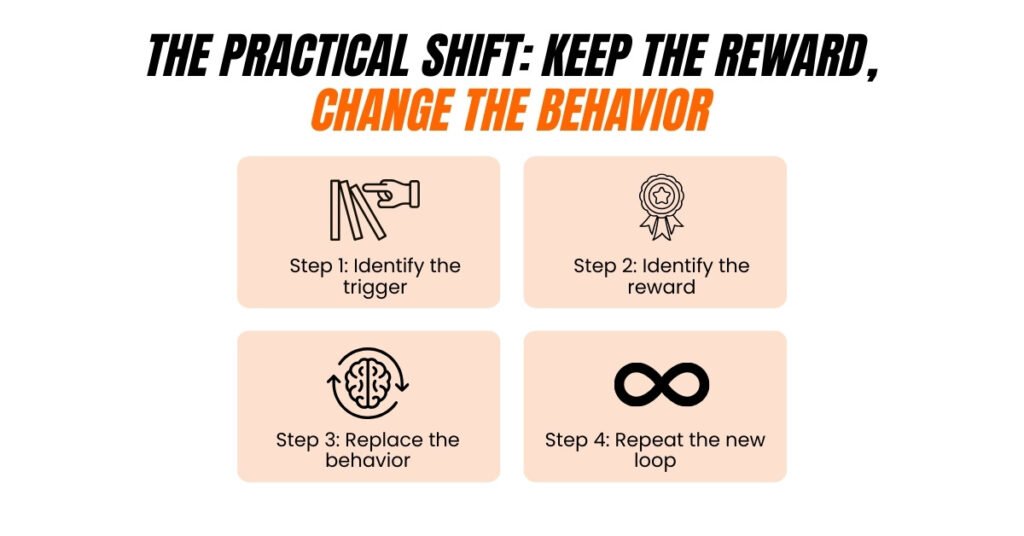
Step 1: Identify the trigger
Notice what happens right before the habit. Is it a place, a feeling, a person, or a time of day? Write it down so you can see patterns forming.
Step 2: Identify the reward
Ask yourself what the habit gives you. Relief, comfort, escape, stimulation, or a break from thinking. Be honest and curious, not judgmental.
Step 3: Replace the behavior
Choose a healthier action that can give a similar reward. It may not feel perfect at first, but the brain learns with repetition.
Step 4: Repeat the new loop
Practice the new pattern consistently. Over time, the brain starts to reach for the new behavior automatically, because it now connects it with relief and comfort.
Here are some simple examples.
Stress leads to scrolling, which brings temporary relief.
Instead, try one of the following:
- A short walk
- A few slow breaths
- A quick journal note to clear your thoughts
Loneliness leads to overeating, which brings comfort.
Replace it with options that also create connection or soothing:
- A short call or text to someone you trust
- Joining a simple community activity
- Checking in with your emotions through writing or reflection
This process takes patience, but it is deeply effective. You are not forcing yourself to be someone else. You are gently teaching your brain a new way to feel safe, supported, and in control. Step by step, the loop changes — and so does the habit.
Final Thoughts: You’re Not Broken — Your Brain Is Just Trained
Breaking habits is hard not because you are weak, but because your brain has been trained through repetition and reward. Once a habit becomes part of your routine, the brain treats it like a shortcut. That can feel frustrating, but it also means change is possible with the right approach.
This journey requires patience and self-respect. Some days will feel easy. Other days will feel slow. Both are normal. What matters most is staying curious instead of critical, and noticing progress, even when it is small.
If you try the framework in this guide, start with one habit. Watch your triggers. Understand the reward. Then build a new path that gives your brain what it needs in a healthier way. Small shifts, repeated often, create powerful results.
Real growth isn’t about quick fixes. It’s about learning how your mind works and building habits that support your future. When you trust the process and take steady steps, you give yourself the chance to create lasting change — one day, one loop, and one choice at a time.
Frequently Asked Questions
How do I know if something is a habit or just a choice?
A habit usually happens on autopilot and repeats in the same situations. If you find yourself doing something without thinking, especially after a trigger like stress or boredom, it’s likely a habit, not a conscious choice.
Can bad habits really be rewired, or do they stay forever?
Habits can be rewired. The old pathway may still exist, but building a new, stronger loop can replace it. With consistent repetition, the brain begins to favor the new pattern over the old one.
Why do my habits come back when I’m stressed?
Stress pushes the brain to look for fast relief. During stressful times, the brain switches to automatic mode and reaches for shortcuts that once brought comfort. That’s why old habits often resurface.
How long does it take to change a habit?
There is no single number. Some habits shift in weeks, others take months. The key factor is consistency. Small, steady practice works better than trying to change everything at once.
What should I do if I slip back into the habit?
Treat it as information, not failure. Look at what triggered it, understand the reward your brain was seeking, and restart the new loop. Progress comes from learning and adjusting, not perfection.