Have you ever sat down to get something done and suddenly you are doing everything except that task? Like your room starts looking messy, so you clean it. Then you make tea. Then you check your phone. Then you tell yourself you will start in five minutes. And somehow hours pass. Yeah, most of us have been there.
This is not laziness. It is not because something is wrong with you. Most of the time, we avoid tasks when they feel too big, too unclear, or just too tiring to start. Our mind wants comfort, not pressure. So, it pushes us toward easier things. Even if we know those things are not important right now.
Procrastination often comes from feeling overwhelmed or unsure. When we do not know where to begin, we begin nowhere.
This is where time blocking helps. Time blocking is simply deciding what to do at a certain time, so you do not have to think about it again and again. It reduces confusion, stress, and that constant debate in your head like Should I start now or later. Once your time is set, your mind relaxes because the plan is already made.
Time blocking does not make you a perfect person. It just makes starting easier. And once you start, momentum grows. You feel clearer, calmer, and more in control of your day.
In this blog, we are going to look at some simple and realistic ways to use time blocking to beat procrastination and boost focus. Nothing complicated. Nothing extreme. Just steps you can actually follow in real life. Even on days when you are not feeling your best.
Let’s make things easier, not harder.
Table of Contents
Why We Procrastinate
Let’s be real for a minute. Most people think procrastination means you are lazy. But that is not true at all. If you were lazy, you would not feel bad about delaying things. You would not care. But you do care. You want to do better. You just get stuck.
So why does this happen?
Our brain avoids tasks that feel boring, hard, or unclear. If something feels too big or confusing, your mind will push you toward something easier. Like checking your phone. Watching one more video. Cleaning your desk. Anything that gives small comfort right now.
This happens because our brain loves quick rewards. When we do something easy, we feel a tiny bit good, even if we know it is not helping long term. That tiny good feeling keeps us locked in a loop.
We say we will start soon. Then we delay again. Then we feel guilty. Then we delay more because we feel bad. And the loop goes on.
The problem is not you. The problem is the task feels too heavy to start. So your brain protects you by avoiding it. It is just trying to help you feel safe and comfortable.
Once you understand this, things get lighter. You stop blaming yourself. You stop calling yourself lazy. You start seeing procrastination as a response to stress or confusion, not a personality trait.
And this is where time blocking becomes powerful. Because it breaks tasks into small steps. Small steps feel easier. Easier steps feel doable. Once things feel doable, your brain stops running away.
You start. And starting is what brings everything back into motion.
If you read this and thought Yes this is exactly what I do then good. You are already on step one. You understand yourself better now. That is where real change begins.
What Is Time Blocking
Time blocking is a simple way of planning your day, so your mind feels clear and focused. Instead of trying to remember what to do next or jumping between tasks, you give each task its own time space. Think of it like gently telling yourself This is what I am doing at this time and nothing else.
It is not about making a strict or perfect schedule. It is not about filling every minute. It is more like giving your day some shape so your mind does not have to keep deciding over and over again.
When you do not plan your time, your brain works harder than it needs to. Every few minutes you are asking yourself Should I start now Should I do this or that first. Those small questions drain your energy and make you feel tired before you even start.
Time blocking helps remove all that noise. Instead of thinking all day, you decide once. Then you just follow your own plan at a gentle pace.
This reduces decision fatigue which means your mind has to make fewer choices.
It also stops task overwhelm because big tasks are broken into smaller blocks.
And it reduces mind wandering because you know exactly what you are doing and when you are doing it.
Time blocking is like giving your day some calm. It helps you start without stress and finish without feeling drained. Even small blocks can make your day feel smoother and more in your control.
It is not about being perfect. It is about making life easier.
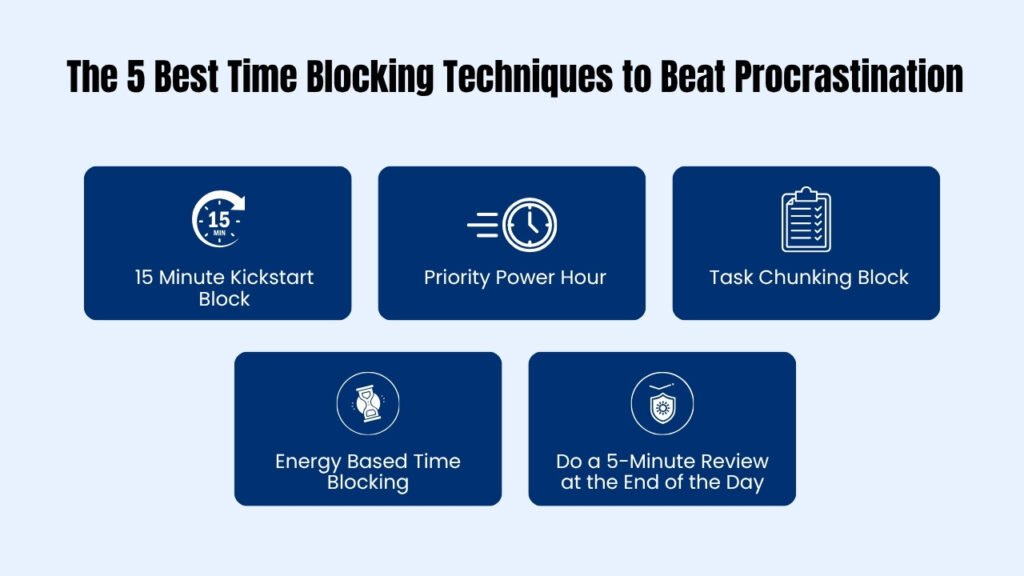
The 5 Best Time Blocking Techniques to Beat Procrastination
These techniques are friendly, simple, and made for real life. No pressure to be perfect. The goal is just to start and slowly build flow. Use what feels easy for you and ignore what does not.
The 15 Minute Kickstart Block
This technique works great on days when you look at your task and your mind just says I will do it later. The task feels too heavy or too boring, so your brain keeps pushing it away. The trick here is to make the task so small that your mind does not feel threatened by it.
Set a timer for 15 minutes. Only 15.
Tell yourself I am not trying to finish anything. I am just getting it started.
This changes everything because your brain can handle small steps. Once the timer starts, focus only on the task in front of you. Do not worry about how much is left. Just stay with those 15 minutes.
Most of the time, once you begin, you feel your mind settling. The pressure drops. You find your rhythm. And you naturally keep going.
But even if you stop after 15 minutes, you still did something. You showed up. You moved forward. That is enough. Progress grows from small starts.
Think of this like opening the door instead of trying to run the whole journey at once.
The Priority Power Hour
Every day has one task that matters more than the rest. A task that actually moves your life or goals forward. But usually we push it to the end of the day. Then we are tired. Then we delay it. Then it never gets done. And we feel bad again.
The Priority Power Hour flips this pattern.
Pick your most important task and give it one focused hour.
No multitasking. No checking your phone. No tiny breaks in between. Just gentle focus.
If one hour feels too big, break it into two blocks of 30 minutes. The key is focus, not time length.
This hour builds confidence. It trains your brain to work deeply. It reminds you that your goals deserve priority, not leftovers. Even one solid focused hour a day can change how your whole week feels.
You will notice something after doing this for a few days. You start feeling more capable. You trust yourself more. And that feeling is priceless.
The Task Chunking Block
This is for big tasks that feel scary or confusing. When we see a big task as one giant thing, our mind freezes. It cannot see where to start, so it does nothing. The solution is to break the task into tiny pieces.
Ask yourself What is the smallest step I can take here.
For example
Study chapter becomes
Read one page
Underline key points
Write a small summary
Or
Make presentation becomes
Open slides
Write slide titles
Add one idea to each slide
Tiny steps feel easy. And once something feels easy, your brain does not resist it. You begin. You move. And with each small step, your confidence grows. Before you know it, the big task is already halfway done and the fear is gone.
Chunking is like shining a small light on a dark road. You do not need to see the whole path. You just need to see your next step.
Energy Based Time Blocking
Every person has certain hours in day where mind feels clear and active. And other hours where everything feels slow and heavy. When we try to do hard tasks during low energy time, we end up procrastinating because mind is not ready.
Energy based time blocking means noticing when your mind feels sharp and using that time for your most important tasks. And using your low energy time for simple or routine tasks.
For example
Maybe you think best in morning
Or maybe your brain wakes up after lunch
Or maybe evening feels more calm for you
There is no right or wrong. It is just about observing yourself for a few days.
Ask yourself
When do I feel most focused
When do I feel most tired
Once you know this, you can place your hardest tasks in your sharp hours. And your easy tasks like replying messages, cleaning room, checking emails, or organizing notes in your low energy hours.
This makes your day feel smoother. You are not fighting your brain. You are working with it. This reduces frustration and makes progress feel more natural and less forced.
You get more done with less stress simply because you are honoring your energy instead of ignoring it.
The Protected Focus Block
A Protected Focus Block is one time block in your day that you guard with care. This block is for deep work. For something important to you. For something that matters. It could be studying, working on your skill, writing, planning, or building something meaningful.
During this block, there are no distractions. No phone. No notifications. No social scrolling. No jumping from one thing to another.
Just one task. One space. One calm bubble.
You can start with 25 minutes. Or 40. Or 60. The length does not matter as much as the protection. You are telling yourself This time is special. This time is for me. This time is not for anyone else’s demand.
When you give yourself one protected block every day, even a small one, your progress becomes steady. Your confidence grows. You no longer feel like your day is slipping away from you.
You will start to notice something beautiful.
Your mind learns to enter focus faster.
Your distractions become quieter.
Your inner peace grows stronger.
This block teaches your brain that your goals are important.
And you deserve time that is only for you.
Example Daily Schedule Using These Techniques
Let’s look at a simple routine that feels real and doable.
Not a perfect routine. Not a super aesthetic one.
Just a day that feels human.
This is only an example. You can shift the timings based on your life and your energy levels.
Morning
Wake up gently
Drink water
Stretch or sit quietly for a minute
No rush
Priority Power Hour
Pick your most important task of the day
Work on it for one hour with focus
No phone near you during this time
Short Break
Walk a little
Breathe
Drink water
Give your mind a small reset
Task Chunking Block
Take your next big task
Break it into small steps
Do one small step at a time
No pressure to finish everything at once
Lunch + Rest
Eat slowly
Take a small walk or relax
Let your mind breathe
Energy Based Block
Work during your natural sharp time
Maybe this is afternoon or evening for you
Choose tasks that need thinking and clarity
Small Admin or Easy Tasks
Reply messages
Check emails
Organize notes
Do things that require less brain power
Great for low energy hours
Protected Focus Block
Choose one task that matters to you personally
This could be learning, reading, journaling, skill building, writing, or your goals
Give it a protected time space
No distractions
Just you and your growth
Evening Slow Down
Light activities
Spend time with people you care about
Do something that relaxes you
This keeps your mind calm before sleep
Night
Reflect on your day
What went well
What felt hard
Be kind to yourself
Sleep at a time that supports your health and energy
The goal here is not to follow every step perfectly.
The goal is to create a day that feels supportive, gentle, and balanced.
When your day has structure, your mind feels safer.
When your mind feels safe, procrastination becomes weaker.
When procrastination becomes weaker, your focus returns naturally.
Small steps.
Simple blocks.
Soft progress.
That is how real change happens.
How to Stick to Time Blocking Even on Not So Productive Days
Some days feel smooth and everything flows. Other days feel heavy and slow. This is normal. You are not a machine. You are a human with changing thoughts, moods, and energy. Time blocking is not about being perfect every day. It is about giving yourself gentle structure that supports you no matter what kind of day you are having.
Here are a few simple ways to stay consistent in a kind and realistic way.

Keep blocks short at first
Start small. You do not need to plan your whole day. Begin with just one or two blocks. Maybe a 15 minute kickstart block or one protected focus block. When blocks are small, your mind feels safe to try. Small steps build trust and rhythm over time.
Do not try to optimize everything on day one
You do not have to color code anything. You do not need fancy planners. You do not need to make your day look perfect. Just pick one time and one task. That is enough. Progress grows by doing, not by planning the perfect system.
Adjust do not quit
If a block gets messy or you miss it, do not throw the whole day away. Just shift it. Move it. Bend it a little. Time blocking is flexible. It is meant to work with your life, not against it. You can always return to your next block. The day is not ruined. You are still on your path.
Normalize imperfect days
Some days will not go as planned. You may be tired, stressed, or distracted. That is okay. Time blocking is not about winning every day. It is about showing up again tomorrow. One imperfect day does not erase your progress. You are allowed to be human.
Be gentle with yourself
Talk to yourself like you would talk to a friend who is trying. You are learning a new habit. You are building a new relationship with your time. This takes patience. This takes softness.
With time, you will notice something shift. You will feel more in control. You will feel calmer. You will trust yourself more. Not because you worked harder. But because you worked with yourself. Not against yourself.
Conclusion
Small steps count. Small improvements build real progress. You do not have to change your whole life in one day. You do not have to be perfect. You only need to start with one small block of time and gently keep showing up.
Procrastination is not failure. It is just your mind asking for clarity and kindness. You are not behind. You are not weak. You are learning how to work with your energy instead of forcing yourself through stress.
So try one small time block today. Maybe 15 minutes. Maybe one quiet focus block. Just one.
See how it feels.
See how your mind reacts.
See how even a small start can shift your day.
You deserve ease.
You deserve clarity.
You deserve a life that feels balanced and steady.
One small block at a time. We move forward together.
Frequently Asked Questions
What if I keep procrastinating even after trying time blocking
This is normal. It takes time for mind to adjust to a new way of working. Start with very small blocks. Even 5 or 10 minutes is fine. The goal is to make starting easier. Not to be perfect on day one.
Can I use time blocking even if my day feels unpredictable
Yes. Time blocking is flexible. You can create soft blocks instead of strict ones. This means you decide what you want to do next without fixing exact times. You just move through blocks in order. This works well when life is busy.
What if I fail one day or skip my schedule
Nothing is ruined. You simply start again with the next block or the next day. Time blocking is about progress not perfection. One missed block does not undo anything.
Do I need special apps or planners to time block
No. You can start with a simple notebook or your phone timer. Tools can help later if you want but they are not required. The real power is choosing one task for one block of time.
How long should each time block be
There is no fixed rule. Start with what feels comfortable. Some people begin with 15 minutes. Some like 30 minutes. Some do one hour. Choose a time that feels easy for you, so your mind does not feel stressed to begin.