
Taking care of yourself can feel strange sometimes. Many people feel guilty when they slow down, rest, or say no to something that drains them. We’re often taught that being busy means being responsible, and that putting others first is always the “right” thing to do. Because of that, the simple act of caring for our own mind and emotions can feel selfish, even when we truly need it. But caring for yourself is not a sign of weakness. It’s a sign of respect for your health, your energy, and your future.
Self-care is not meant to be a luxury or something you do only when life feels perfect. It is maintenance. Just like you charge your phone before it dies or get your car serviced before it breaks down, your mental health also needs regular care. Small, consistent habits protect you from burnout, overwhelm, and emotional exhaustion. When you take care of yourself, you think more clearly, handle stress better, and show up with more patience and kindness for the people around you.
This guide will walk you through simple, practical self-care routines that fit into real life. No expensive tools, no complicated steps, and no guilt attached. You’ll find ideas you can try right away, along with real examples that show why they work. The goal is not to make your days perfect — it’s to help you feel more grounded, more supported, and more in control of your emotional well-being.
By the end, you’ll see self-care as something natural and necessary, rather than something you have to “earn.” And hopefully, you’ll feel confident starting small, listening to what your mind needs, and treating yourself with the same care you give to everyone else.
Key Insights
- Self-care works best as maintenance, not an emergency fix. Small, regular habits help prevent burnout before it builds.
- Tiny actions can create big change. Even one minute of breathing, walking, or journaling adds up when done consistently.
- Caring for yourself helps your relationships too. When you’re calmer and clearer, you communicate better and show up with more patience and kindness.
Table of Contents
What Self-Care Really Means (And Why It’s Not Selfish)
Self-care means doing things that help your mind and body stay healthy. It’s about taking small actions that make you feel calmer, stronger, and more balanced. It isn’t selfish. It simply gives you the energy you need to handle life better — at home, at school, at work, and with the people you care about.
Self-Care vs. Escaping Problems vs. Over-Indulging
Self-care
Self-care is choosing habits that support your well-being. It can be resting when you’re tired, talking to someone when you feel stressed, taking a walk, or writing down your thoughts. These small actions protect your mental health over time.
Escaping problems
Escaping happens when we try to avoid our feelings instead of dealing with them. Maybe we scroll for hours, stay busy all the time, or push hard feelings aside. It may feel good for a while, but the stress eventually returns.
Over-indulging
Over-indulging is when something that feels comforting becomes too much. It might be shopping, food, games, or binge-watching every time life feels hard. The goal isn’t to remove comfort — it’s to avoid using it as the only way to cope.
Why Self-Care Helps Every Part of Your Life
When your mind is overloaded, everything feels heavier. Work becomes harder, relationships feel tense, and even small problems feel big. But when you take care of yourself, you think more clearly, react more calmly, and feel more in control. Caring for your mental health doesn’t take you away from your responsibilities — it helps you show up better in every part of your life.
Quick Myth-Busting: Self-Care ≠ Laziness
“If I rest, I’ll fall behind”
Many people believe that if they slow down, they’ll lose their edge. In reality, constant push leads to stress, mistakes, and exhaustion. Rest is not wasted time. It helps your brain reset so you can think clearly and work smarter. A short break, a nap, or even a quiet walk can bring back focus faster than forcing yourself to push through.
Real-life example: A student studies all night and forgets half of what they read. Another student studies, sleeps well, and remembers more. Rest helped, not laziness.
“Self-care is only for people with extra time”
This myth makes self-care feel out of reach. The truth is that self-care can happen in small pockets throughout the day. One minute of deep breathing, five minutes of journaling, or a short stretch can lower stress without changing your entire schedule. You don’t need hours. You just need small moments that help you reset.
Real-life example: A busy parent takes three minutes to breathe before answering emails. They reply calmer and think more clearly, saving time later.
“Self-care means expensive products and spa days”
Self-care has been marketed like a luxury. But real self-care is usually simple and often free. It might look like saying no, going for a walk, talking to someone you trust, turning off notifications, or getting enough sleep. These habits protect your mental health far better than buying things you don’t actually need.
Real-life example: Someone spends money on fancy candles but still feels stressed. Another person sleeps earlier, sets boundaries at work, and feels better. The difference came from habits, not price tags.
Self-care is not about escaping life. It is about taking care of the person who has to live it every day — you. Small, consistent habits keep you steady, prevent burnout, and give you the strength to handle challenges with more confidence.

The Simple Idea That Changes Everything: Maintenance, Not Luxury
Think about a car. You don’t wait until it completely breaks down before taking it to the service center. You change the oil. You check the tires. You get regular checkups. These small steps keep the car running smoothly and help you avoid big problems later.
Your mental health works the same way.
You don’t need to wait for burnout, panic, or emotional breakdowns before taking care of yourself. Small, regular actions can keep your mind steady, clear, and supported. Self-care is not a rare treat. It is regular maintenance that helps you feel like yourself.
The CARE Framework: A Simple Way To Practice Self-Care
To make self-care easier to remember, think of the CARE framework. It keeps things simple and practical, even on busy days.
Check-in
Ask yourself, “How am I really feeling right now?” Maybe you’re tired, stressed, overwhelmed, or tense. Naming the feeling is the first step. It helps you understand what you actually need instead of guessing.
Act small
Choose one small action that supports your well-being. It could be drinking water, stepping outside for five minutes, stretching, journaling, or sending a message to someone you trust. Tiny actions done often create real change.
Repeat
Self-care works best when it becomes a habit. The goal isn’t perfection. The goal is consistency. When you repeat small actions every day, your brain begins to feel safer and calmer.
Evaluate gently
At the end of the day, ask yourself, “What helped me today?” and “What felt overwhelming?” This isn’t about judging yourself. It’s about learning what works so you can take better care of yourself tomorrow.
When you view self-care as maintenance, not luxury, everything becomes easier. You stop waiting for the “right time.” You start building small habits that protect your mind, your energy, and your future — one simple step at a time.
15 Best Self-Care Routine Ideas for Mental Health
Life can move fast. We rush from one task to the next, trying to handle work, family, friends, and everything in between. Somewhere in the middle of all that, our minds get tired — but we keep pushing anyway. That’s usually when stress builds up, sleep gets worse, and small problems start to feel huge.
Self-care is the gentle pause that helps you reset.
These ideas are not about being perfect or living a “picture-perfect” lifestyle. They’re about simple habits anyone can try, even on busy days. Small actions, done often, protect your mental health, build emotional strength, and help you feel more like yourself again.
Let’s walk through them one by one. Take what fits your life. Leave what doesn’t. And start small — that’s where real change begins.
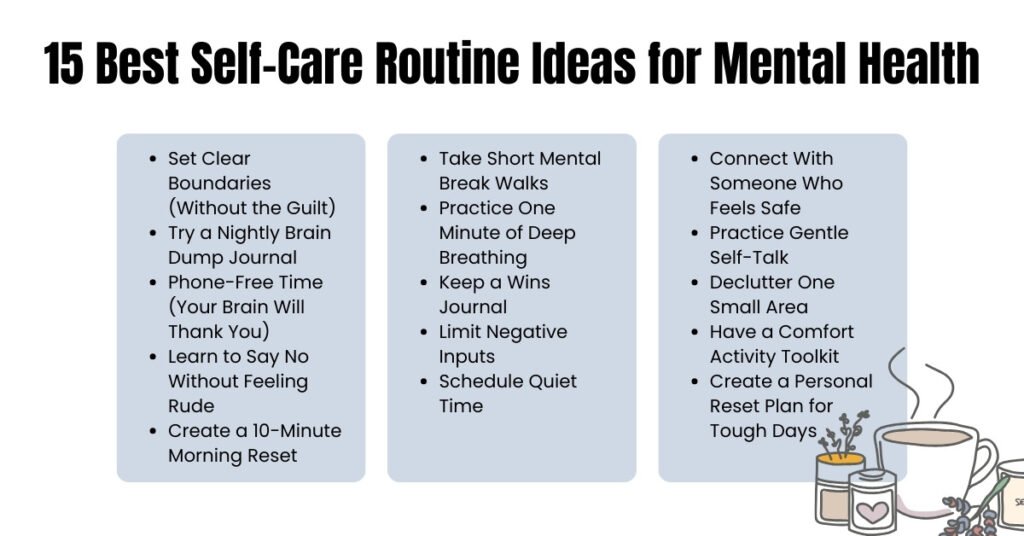
1. Set Clear Boundaries (Without the Guilt)
Boundaries are simple limits that protect your emotional energy. Without them, you easily say yes to things you don’t have time or strength for. Over time, that leads to stress, resentment, and burnout. With boundaries, you feel calmer, clearer, and more in control of your day. They don’t push people away. They simply teach others how to treat you with respect.
You can start with small, honest sentences. You don’t need long explanations or arguments. Just speak calmly and clearly.
Here are a few examples you can use in common situations:
“I’d love to help, but I can’t commit right now.”
“I need some time to recharge. Let’s talk later.”
“That doesn’t work for me — can we find another option?”
At first this may feel uncomfortable, especially if you are used to pleasing everyone. But over time, saying no when necessary becomes an act of self-care, not selfishness.
Reflection: Where do you feel most drained in your life — and what boundary could protect your peace there?
2. Try a Nightly Brain Dump Journal
A nightly brain dump journal is one of the easiest ways to quiet a busy mind. It simply means writing down everything that is spinning in your head. Thoughts, worries, reminders, ideas, tasks — anything that keeps repeating in your mind goes on paper instead.
This works because your brain relaxes when it doesn’t have to hold everything at once. Instead of circling the same worries, it lets go. Anxiety lowers, thinking becomes clearer, and falling asleep becomes easier.
To try it, take five minutes before bed. Sit with a notebook and write freely. Don’t worry about making it neat. Don’t try to solve problems. Just empty your thoughts onto the page. When you’re done, close the notebook and remind yourself that tomorrow is another chance to handle what’s left.
Reflection: Which thoughts show up most often in your journal, and what small step might help you deal with one of them?
3. Phone-Free Time (Your Brain Will Thank You)
Phone-free time simply means giving your mind a break from constant screens. Most of us pick up our phones without even thinking. We scroll, swipe, tap, and before we know it, 30 minutes have passed and we feel more stressed than before. Endless scrolling looks like relaxation, but it actually floods the brain with information it can’t process all at once.
Taking short breaks from your phone helps your brain slow down. It reduces anxiety, improves focus, and makes it easier to stay present. You may even notice you feel lighter and calmer, simply because your thoughts finally have room to breathe.
Start small. Choose a few phone-free zones such as during meals, right before sleep, or during the first 30 minutes of your morning. Try a simple 10-minute challenge where your phone stays out of reach. Sit, breathe, walk, talk to someone, or just enjoy quiet. Over time, increase the break if it feels good.
Reflection: When do you grab your phone out of habit, not need — and what could you do instead in those moments?
4. Learn to Say No Without Feeling Rude
Saying no is not about being difficult. It is about protecting your time, energy, and emotional health. Many people say yes because they don’t want to disappoint others — but that often leads to stress, resentment, and exhaustion. When you constantly push yourself past your limits, your mind eventually pays the price.
Learning to say no helps you take back control. It gives you space to rest, think, and focus on what truly matters. It also creates healthier relationships because people understand your limits instead of expecting you to handle everything.
You don’t need long explanations. Use simple, respectful sentences like:
I can’t take that on right now.
Thanks for asking, but I need to pass.
That doesn’t work for me, but I appreciate it.
At first it may feel uncomfortable, but with time it becomes easier — and your mental peace grows stronger.
Reflection: What do you keep agreeing to that leaves you tired or frustrated afterward?
5. Create a 10-Minute Morning Reset
A morning reset is a short routine that helps you begin the day calm instead of rushed. Many people wake up and immediately check messages, news, or social media. That puts your brain into stress mode before you even leave the bed. A gentle reset changes that pattern.
When you start your morning slowly, your brain feels safer and more organized. You think more clearly, your mood improves, and you react less emotionally to small problems. It sets the tone for the rest of the day.
Keep it simple. Spend about 10 minutes stretching your body, drinking a glass of water, getting sunlight near a window or outdoors, and setting a small intention such as, “Today I’ll be patient with myself.” You don’t need perfection — just consistency.
Reflection: Notice how your day feels on mornings when you rush versus mornings when you give yourself a calm start.
6. Take Short Mental Break Walks
Mental break walks are short walks designed for your mind, not fitness numbers. You don’t need to walk fast or far. The goal is to step away from noise, breathe, and let your thoughts settle. When you move your body, your brain receives more oxygen, and stress levels naturally begin to drop.
Walking helps untangle heavy thoughts and reduce tension in your body. Many people find that solutions come more easily during a quiet walk than when they are stuck sitting and worrying.
Choose a simple plan: walk for 5 to 15 minutes when you feel overloaded. Leave notifications off if you can. Pay attention to the sounds, the air, or the movement of your feet. Let the walk be a reset instead of another task.
Reflection: When was the last time you took a walk just to clear your head, not to rush somewhere?
7. Practice One Minute of Deep Breathing
Deep breathing is one of the fastest ways to calm your body and your thoughts. When stress rises, your breathing becomes shallow. That sends a message to your brain that something is wrong, even when you are simply overwhelmed.
A simple 4–6 breathing pattern can help. Breathe in through your nose for a count of 4. Hold for a second. Then breathe out slowly through your mouth for a count of 6. Repeat this for one minute. Your heart rate begins to steady, your muscles relax, and your mind feels clearer.
Use this anytime you feel stressed, during arguments, before a big task, or when emotions start to build up. It’s quiet, quick, and always available.
Reflection: How does your body feel after just one minute of slow breathing compared to when you rush through your day?
8. Keep a Wins Journal
A wins journal is a simple notebook where you write down one small win each day. It doesn’t have to be big. Maybe you handled a tough conversation kindly. Maybe you finished a task you were avoiding. Maybe you simply took care of yourself when you didn’t feel like it.
Writing these moments helps train your brain to notice progress instead of only seeing mistakes. Over time, this builds real confidence. You start to see proof that you can handle challenges, grow, and keep moving forward.
At the end of each day, take one minute and write a win. One sentence is enough.
Reflection: What small progress did you make today that deserves recognition, even if no one else noticed?
9. Limit Negative Inputs
Your mind is shaped by what it constantly receives. If your day is filled with bad news, comparison on social media, and stressful conversations, it becomes harder to stay calm. Your brain begins to believe that everything is urgent, dangerous, or not good enough.
Limiting negative input does not mean ignoring the world. It means choosing balance. Reduce the time you spend scrolling through upsetting content or comparing yourself to others. Instead, fill some of that space with uplifting, educational, or inspiring material that helps you grow.
You’ll notice your mood slowly shift from tense and worried to grounded and hopeful. Small changes in what you consume can completely change how you feel inside.
Reflection: What is one negative source you can reduce this week — and what positive source can replace it?
10. Schedule Quiet Time
Quiet time means choosing a part of your day where there is no TV, no calls, no chores, and no multitasking. It’s a short pause where you let your mind rest without noise or pressure.
In silence, your thoughts slow down. You notice how you feel. You may reflect, breathe, or simply sit. This calm space helps your brain process emotions and recover from constant stimulation. It can also spark new ideas and clarity you don’t get when you’re always distracted.
Start with 10 minutes. Sit somewhere comfortable. No screens. No tasks. Just quiet. Let your mind wander without judging it. Some days you may think a lot. Other days you may simply rest — both are okay.
Reflection: When was the last time you allowed yourself to sit quietly without trying to be productive?
11. Connect With Someone Who Feels Safe
Connection is one of the strongest forms of self-care. Talking to someone who listens — without judging you — can make stress feel lighter. It reminds you that you don’t have to handle everything alone.
You don’t need long, deep conversations every time. Sometimes self-care looks like a short phone call, a quick walk with a friend, or even sending a message that says, “Hey, I’ve been thinking about you.” These simple moments can lift your mood, reduce loneliness, and give you emotional support.
Human connection supports mental health because it creates comfort, trust, and understanding. Your mind relaxes when it knows it has someone to lean on.
Reflection: Who in your life makes you feel safe to be honest — and when could you reach out next?
12. Practice Gentle Self-Talk
The way you speak to yourself matters. Many people talk to themselves in ways they would never speak to someone they love. Over time, harsh self-talk damages confidence and increases stress.
Gentle self-talk doesn’t mean ignoring mistakes. It means treating yourself fairly. Instead of attacking yourself, you speak with understanding and patience.
Here are a few simple rewrites:
“I failed” becomes “I’m learning.”
“I’m bad at this” becomes “I’m getting better.”
“I always mess up” becomes “Sometimes I struggle, and that’s okay.”
When you change the words, your brain starts to believe something different — and your mental health slowly strengthens.
Reflection: What is one unkind thought you say to yourself often, and how could you rewrite it more gently?
13. Declutter One Small Area
A messy space can quietly add stress to your mind. When there are piles, scattered items, or things you don’t use anymore, your brain constantly sees “unfinished tasks.” This creates mental noise, even if you don’t notice it right away.
Decluttering doesn’t mean cleaning your entire house at once. Start small. Choose one drawer, one shelf, or one corner. Follow the 10-minute declutter rule: set a timer, pick up what doesn’t belong, and either throw it out, donate it, or put it back in its place. When time is up, stop — and celebrate the progress.
A tidy space sends your brain a simple message: things are under control. That calm feeling spreads into the rest of your day.
Reflection: Which small space could you clear today that would make you feel lighter when you look at it?
14. Have a Comfort Activity Toolkit
A comfort activity toolkit is a small collection of things that help you relax when you feel stressed or low. These are not distractions. They are gentle activities that calm your nervous system and bring you back to center.
Your toolkit might include reading, listening to music, drawing, making tea, journaling, coloring, or sitting quietly outside. The key is choosing activities that feel soothing and safe for you, not what others say you “should” do.
Keep your toolkit simple and personal. When tough moments come, you won’t have to think too hard — you’ll already know what helps.
Reflection: What activities make you feel peaceful, and how can you keep them within easy reach?
15. Create a Personal Reset Plan for Tough Days
Some days feel heavier than others. A reset plan is a simple guide you follow when your emotions feel too big or life feels overwhelming. Instead of guessing what to do, you have a small routine ready.
Here is an easy checklist to remember:
Breathe – take one minute of slow breathing.
Move – walk, stretch, or change your environment.
Write – jot down what’s bothering you.
Talk – reach out to someone safe if you can.
Rest – give yourself permission to pause.
This plan gives structure when your mind feels scattered. It reminds you that you always have steps you can take, even when everything feels hard.
Reflection: What would your personal reset plan look like — and where could you keep it so you’ll see it when you need it most?
Final Thoughts: You Deserve to Take Up Space in Your Own Life
Caring for yourself does not mean you care less about others. It means you are giving your mind and body what they need to stay healthy. When you take time to rest, set boundaries, and calm your thoughts, you become more patient, more focused, and more present. That’s not selfish — that’s responsible.
Self-care is regular maintenance. Just like you look after your body and your home, your mental health also needs steady care. The goal isn’t perfection. The goal is feeling safe, supported, and able to handle life one day at a time.
Start with one gentle step today
Big change doesn’t happen overnight. Choose one small habit from this guide and try it today. Maybe you take a short walk. Maybe you write for five minutes before bed. Maybe you finally say no to something that drains you. Small actions, repeated often, make the biggest difference.
Every time you choose self-care, you remind yourself that you matter — and that your peace is worth protecting.
Your turn
Think about this question for a moment:
Which self-care habit feels like the best starting point for you?
If you’d like, share it in the comments or with someone you trust. Sharing helps you stay committed — and it may inspire someone else to take their first step too.
You deserve space, rest, and kindness in your life. And choosing self-care is one powerful way to claim it.
Frequently Asked Questions
Is self-care really necessary, or is it just a trend?
Self-care isn’t a trend. It’s basic maintenance for your mental and emotional health. Just like sleep, food, and movement, regular self-care helps you stay steady, focused, and resilient. Without it, stress builds up and eventually affects everything else in life.
How much time should I spend on self-care each day?
You don’t need hours. Even 5–15 minutes can make a real difference. A short walk, quiet breathing, journaling, or simply unplugging from your phone can reset your mind. Consistency matters more than time.
Can self-care replace therapy or professional help?
Self-care supports mental health, but it is not a replacement for professional care. If you feel stuck, overwhelmed, or notice symptoms that don’t improve, talking with a counselor, therapist, or doctor can provide deeper support. Seeking help is a strong and responsible choice.
What if I forget my routine or fall off track?
That’s normal. Self-care is not about perfection. If you miss a day, simply start again the next day. Think of it like brushing your teeth: you don’t quit because you skipped once — you pick it back up.
How do I know which self-care habits are right for me?
Notice what makes you feel calmer, clearer, and more grounded. Try one habit at a time and pay attention to how you feel afterward. If it helps your mood, focus, or energy, keep it. If it doesn’t, adjust and try another approach. Self-care is personal — it should fit your life, not the other way around.