Most days don’t go as planned. Work piles up. Someone needs help. Your phone keeps buzzing. By the afternoon, it feels like the day has already slipped away. It’s easy to think you “failed” before you even had a chance to start.
But here’s the truth: life is naturally messy. The problem isn’t you. The real challenge is trying to fit big goals into days that are unpredictable. When we expect perfection, we burn out. When we build simple systems, we quietly move forward — even on tough days.
You don’t need long routines or strict schedules to make progress. Small, steady actions can change your life when they connect to what matters. This guide shows you how to stay consistent without pressure, guilt, or overwhelm.
In the next sections, you’ll learn realistic tools you can actually use. We’ll talk about how to focus on what matters most, how to recover when plans fall apart, and how to reset instead of quitting. Along the way, you’ll see that real progress happens in ordinary moments — not perfect ones.
And as we walk through this together, you’ll also discover practical ways on how to make your day aline with your goals while still living a real, full life.
What you’ll get from this guide
- Simple methods that work on busy days
- Ways to reset when your plans fall apart
- A clear structure that helps you stay calm and focused
By the end, you’ll see that progress isn’t about doing everything. It’s about doing the right things, even in small steps, and trusting that those steps add up.
Key Insights
- Daily alignment is built from small, repeatable actions, not perfect routines. When your top priorities are clear, even messy days still move you closer to your goals.
- Simple systems beat willpower. Using big rocks, mid-day resets, and Done > Perfect removes friction so you can stay consistent without burning out.
- Progress compounds. Tiny 1 percent improvements each day create meaningful change over weeks and months, especially when you reflect, adjust, and keep going.
Table of Contents
Why Our Days Drift Away From Our Goals (And Why It’s Not Your Fault)
Most people start the day with good intentions. But as the hours pass, distractions show up, new tasks pop in, and our focus slowly slips away. By evening, it can feel like the whole day went in a different direction than we planned. This doesn’t happen because you’re lazy or unmotivated. It happens because the world around you pulls your attention in many directions at once.
A big reason this happens is something called hidden friction. These are small things that quietly make progress harder: too many notifications, constant choices, lack of a clear plan, or an overloaded to-do list. Each one seems small, but together they drain your energy and attention.
We often respond by telling ourselves to simply try harder. But trying harder doesn’t fix the real issue. Willpower fades through the day, and when it fails, we blame ourselves. That guilt makes it even harder to start again, so the cycle repeats. The problem isn’t effort. The problem is relying only on effort.
What actually works better is building simple systems that guide your day for you. Systems remove extra decisions. They remind you what matters. They make the right choice easier and the wrong choice harder. Over time, this leads to steady progress without constant struggle.
Here’s a quick example. Imagine you plan to read every night, but you keep forgetting. If the book stays in another room, you’ll skip it. But if you place it next to your pillow, you’ll read at least a few pages. Same person. Same goal. Different system, better result.
Key ideas to remember
- Distractions and decision fatigue quietly drain focus
- Guilt is not a strategy and trying harder isn’t enough
- Simple systems help you stay on track, even on busy days
When you understand this, the pressure lifts. You realize you’re not broken. You simply need tools that fit real life, not more self-criticism. And once those tools are in place, progress becomes much easier to maintain.
The Core Idea: Aligning One Day at a Time
Daily alignment simply means this: what you do today matches the future you want. It isn’t about doing everything. It’s about choosing a few meaningful actions and giving them your attention. When your daily choices reflect your real priorities, even busy days move you forward.
Many people believe success comes from perfect routines. In reality, progress comes from consistent effort, even when it’s small. Instead of chasing perfect days, focus on steady movement. A simple task completed is more powerful than a perfect plan that never happens.
Each day is a chance to take one step that supports your bigger goals. If your goal is better health, that might be a short walk. If it’s learning, it might be 10 minutes of reading. These actions may look small, but they build habits that shape your future.
Think of alignment like tiny course corrections. A plane that shifts just 1 percent in the right direction ends up in a completely different place over time. Your days work the same way. Small choices repeated often can change where your life is heading, without forcing huge dramatic changes.
When you approach life this way, everything feels lighter. You stop feeling behind, and you start seeing progress even on imperfect days. That mindset creates motivation, confidence, and real results — one day at a time.
The “3 Big Rocks” Method: Simple, Clear, Doable
The 3 Big Rocks method helps you focus on what truly matters each day. Instead of trying to finish everything on your list, you choose three priorities that move you forward. These are not random tasks. They are actions that actually support your goals and make you feel accomplished at the end of the day.
Big rocks are different from distractions. A big rock might be finishing a key task, exercising, or learning something useful. A distraction might look busy but doesn’t create real progress. When you learn to tell the difference, your days become calmer and more productive.
4.1 What Are Big Rocks?
Big rocks are the three most important things you commit to completing today. They deserve your time and focus, even when life gets messy. When these are done, the rest of the day already feels like a win because you handled what mattered most.
4.2 How to Choose Your Three
A simple way to choose big rocks is to cover three areas of your life. This keeps your day balanced and prevents burnout over time.
- One work or career goal
- One personal or health goal
- One growth or future goal
These choices help you move forward at work, take care of yourself, and invest in the future at the same time. Even small steps in each area build long-term results.
4.3 How to Use Big Rocks in Real Life
Once you choose your three, write them down at the start of the day. Seeing them clearly reduces stress and gives you direction. Try to schedule them early, before distractions take over. If you can’t do them early, protect short time blocks later in the day.
Small boundaries make a big difference. This might mean turning off notifications for 20 minutes, closing extra tabs, or telling someone you’ll call back later. These little protections help you finish important work without constant interruption.
4.4 Common Mistakes to Avoid
Many people choose too many priorities and overwhelm themselves. Three is enough. If everything feels important, it usually means the list needs clearer focus.
Another mistake is picking goals that are vague, like “be productive.” Instead, choose clear actions such as “send proposal,” “20-minute walk,” or “read five pages.” Clear goals are easier to start and finish.
Finally, don’t let other people’s urgency erase your priorities. It’s okay to help others, but your goals matter too. When you protect your big rocks, you build a life that feels more intentional, steady, and aligned with what truly matters.
When Plans Break: What To Do Instead of Giving Up
No matter how well you plan, life will interrupt you. A meeting runs long, a child needs attention, or something urgent shows up out of nowhere. When this happens, many people feel frustrated and assume the day is ruined. But interruptions are part of real life, not a sign that you failed.
This is where the Plan B mindset helps. Instead of quitting when things change, you adjust. You look for a smaller version of the plan that still keeps you moving. Progress continues, even if it looks different from what you imagined in the morning.
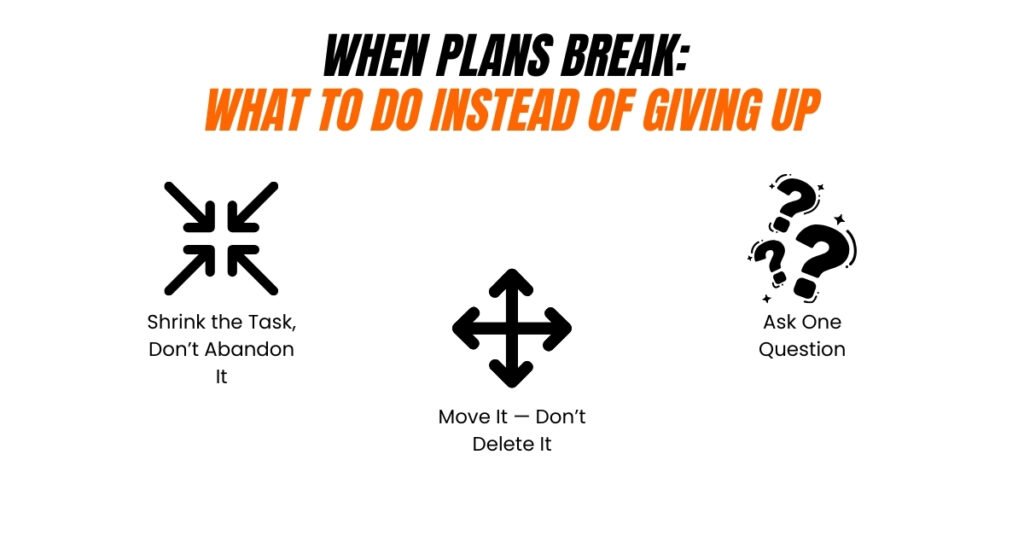
5.1 Shrink the Task, Don’t Abandon It
When time gets tight, reduce the task instead of canceling it. Doing something small is far better than doing nothing at all. It keeps your habit alive and reminds your brain that your goals still matter.
- Turn 30 minutes into 10 minutes
- Take a short walk instead of a full workout
- Write two paragraphs instead of finishing the whole article
These small wins build confidence and keep momentum going.
5.2 Move It — Don’t Delete It
Sometimes you truly cannot finish a task today. Instead of deleting it, move it to the next realistic time. This shows your brain that the task is still important, just delayed. You stay committed without feeling defeated.
Rescheduling protects momentum. It stops the all-or-nothing thinking that makes people give up for days or weeks. You’re not starting over. You’re simply continuing later.
5.3 Ask One Question
Whenever your day falls apart, pause for a moment and ask yourself one simple question:
What is the smallest next step I can still do today?
This question resets your focus. It turns a chaotic day into a manageable one. And over time, these tiny choices add up to real progress, even during the messiest seasons of life.
The Mid-Day Reset: How to Restart Without Shame
The middle of the day is often where things fall apart. Emails pile up. Calls run longer than expected. Your focus starts fading, and suddenly it feels like the afternoon is already lost. Many people react by pushing harder or giving up completely. Neither helps. A calm mid-day reset gives you a fresh start without stress or guilt.
A reset is not a punishment. It’s a gentle pause that lets you re-center and realign. Instead of feeling stuck, you step back for a moment, look at the bigger picture, and choose your next move with intention. This simple habit can turn an unfocused day into a productive one.
Resetting also builds self-trust. When you prove to yourself that you can restart at any moment, you stop labeling days as “failed.” You learn that one distracted hour doesn’t ruin everything. That mindset alone reduces pressure and keeps motivation alive.

6.1 The 2-Minute Reset Check
A powerful reset doesn’t take long. You only need two quiet minutes and three honest questions.
- What did I finish?
- What still matters most?
- What can I realistically do next?
The first question reminds you that something went right. The second question helps you refocus on priorities. The third question pulls you out of overwhelm and into action. Together, they shift your brain from worry to problem-solving.
6.2 Practical Reset Actions
After answering the questions, add one or two simple actions. These tell your mind, “We’re starting again now.”
- Stand up, stretch, and take a slow breath
- Close extra tabs and silence non-essential notifications
- Re-commit to one big rock for the rest of the day
These steps may look small, but they break the momentum of distraction. They create a clear line between the first half of the day and the second. From that point on, you’re choosing your direction again instead of drifting.
You can also add a short micro-plan for the next hour. Write down one key task and one backup task. If interruptions appear, you still know where to return. This keeps your brain calm and organized.
6.3 Why This Works
Mid-day resets work because they help your brain reset attention. Instead of relying on willpower, you use awareness. You pause, re-focus, and remove extra noise. Over time, this becomes a powerful habit that protects both your time and your energy.
Psychologists call this “pattern interruption.” When you stop the automatic cycle of distraction, you gain space to choose better actions. Even five improved afternoons each week slowly transform your results.
Most importantly, a reset teaches you that progress is flexible. You don’t have to be perfect. You only need to guide your day back on track whenever it drifts. That simple skill can change the way you work, think, and feel — especially on busy, messy days.
Done > Perfect: The Rule That Keeps You Moving
Perfection sounds inspiring, but in real life it often becomes a trap. When you wait for the perfect moment, the perfect mood, or the perfect plan, you delay action. The Done > Perfect mindset means you choose steady progress over endless polishing. You focus on finishing something useful today, instead of worrying about making it flawless.
This mindset works because action creates momentum. Each completed step builds confidence and teaches you what to improve next. Perfection delays learning. Finishing allows you to move forward faster, even if the result is not ideal yet. Over time, those finished steps stack up and create real change.
7.1 Examples Readers Can Relate To
Here are simple ways Done > Perfect shows up in daily life:
- Publish the draft and improve it later instead of editing forever
- Do a short workout when you don’t have time for a full session
- Study for 10 minutes instead of waiting for the “right” quiet moment
In each case, something meaningful gets done. And that matters more than waiting for conditions that rarely arrive.
7.2 How To Practice This Daily
You can train this habit with small, clear rules that reduce pressure and help you start faster.
- Set “good enough” standards for important tasks, like writing, studying, or planning
- Celebrate small wins on purpose, even if they feel ordinary
These simple shifts remind your brain that progress counts. Over time, you stop chasing perfect days and start building consistent results. And that consistency is what quietly aligns your life with your goals.
Put It All Together: A Realistic Daily Flow
Now let’s see how everything fits into a normal day. The goal isn’t to control every minute. The goal is to gently guide your time so your actions match what truly matters. When you follow a simple pattern, alignment becomes easier and less stressful.
Here’s what a realistic day might look like:
- Morning: choose and write down your 3 big rocks
- Mid-day: do a quick reset and adjust if plans change
- Evening: reflect on what worked, what didn’t, and one thing to try tomorrow
This rhythm gives each day a clear start, a calm checkpoint, and a thoughtful ending. It creates structure without being strict, so it still works on busy or unpredictable days.
Over time, this daily flow builds confidence. You see progress, even in small pieces. And as those pieces add up, your days start to quietly align with your bigger goals — without burning out or feeling constantly behind.
Conclusion: Progress Happens in Real Life, Not Perfect Conditions
Real life is busy, unpredictable, and sometimes chaotic — and that’s okay. Your progress is not determined by how perfect your days look, but by how often you keep moving forward. Messy days still count. Every small, honest effort brings you closer to the life you want, even if it doesn’t feel impressive in the moment.
The ideas in this guide are simple on purpose. Try them for the next seven days. Choose your three big rocks. Reset when plans fall apart. Pick progress over perfection. Notice how much calmer and more focused your days begin to feel.
As you practice, don’t judge yourself when things don’t go as planned. Reflect instead. Ask what helped, what didn’t, and what you want to adjust tomorrow. This curious mindset turns setbacks into learning instead of self-blame.
In the end, growth doesn’t come from flawless routines. It comes from showing up, adapting, and staying kind to yourself while you build better habits. Keep going — you’re far more capable of aligning your days with your goals than you may realize.
Frequently Asked Questions
What if my day is always unpredictable?
Unpredictable days are normal. Instead of trying to control everything, focus on what you can guide. Choose three big rocks, do what you can, and reset when needed. Small actions still move you forward, even when plans change.
What should I do if I miss all three big rocks?
Missing a day doesn’t mean you failed. Look at what happened, learn from it, and try again tomorrow. The goal is consistency over time, not perfection every single day. Progress returns as soon as you restart.
How long does it take to see results?
You may notice more clarity and calm within a week. Bigger changes happen as these habits stack over months. Think of it like slow, steady growth instead of instant transformation.
Can I use this system even if I have very little free time?
Yes. This system is designed for busy people. You can shrink tasks, reset mid-day, and still align small actions with your goals. Even 10 focused minutes count and build momentum.
Do I need special tools or apps to make this work?
Not at all. A notebook, a timer, or a simple notes app is enough. What matters most is clarity, intention, and showing up daily. Tools only support the system — they don’t replace it.