
In today’s fast-changing workplace, inclusive decision-making is no longer a “nice-to-have”—it’s a leadership necessity. Teams are more diverse than ever, spanning different cultures, generations, work styles, and perspectives. Leaders who fail to adapt often find themselves facing disengaged employees, missed opportunities for innovation, and decisions that don’t truly reflect the needs of their teams or organizations.
At its core, inclusive decision-making means actively seeking and valuing input from diverse voices before reaching a conclusion. It goes beyond simply having a diverse team on paper—it’s about creating an environment where equity and belonging are central to how decisions are made. This approach ensures that people feel heard, respected, and invested in the outcomes, which directly supports stronger DEIB (Diversity, Equity, Inclusion, and Belonging) initiatives.
Yet many leaders struggle in this area. Time pressure, unconscious biases, or a reliance on familiar viewpoints can easily push leaders back into traditional, top-down decision-making. The result? A loss of trust, limited creativity, and blind spots that hurt both people and performance.
In this blog, we’ll explore the key leadership skills required to practice inclusive decision-making effectively, including empathy, active listening, and cultural intelligence. We’ll also share practical frameworks and strategies you can apply to your own leadership style, along with the tangible benefits you’ll gain—from stronger team collaboration to higher innovation and engagement.
By the end, you’ll have a clear roadmap for leading with inclusivity, building belonging, and making smarter, more impactful decisions in any workplace setting.
Table of Contents
Why Inclusive Decision-Making Matters in Leadership
The Shifting Workplace
The way we work has changed dramatically. Today’s leaders are managing hybrid teams, balancing in-office collaboration with remote work flexibility. Organizations are also drawing from global talent pools, meaning cultural diversity and geographic dispersion are the norm, not the exception. Add to this a multigenerational workforce—from Gen Z professionals entering the field to seasoned Baby Boomers with decades of experience—and it’s clear that leaders must develop decision-making approaches that account for a wide range of perspectives, needs, and communication styles.
The Business Case
Inclusive decision-making isn’t just about fairness—it’s about performance. When leaders actively involve diverse viewpoints in the decision process, teams are more likely to generate innovative solutions, reduce blind spots, and anticipate challenges more effectively. Research from Deloitte shows that inclusive teams are six times more likely to be innovative and twice as likely to meet or exceed financial targets. This proves that inclusion is not only the right thing to do—it directly impacts organizational success, growth, and competitiveness.
The Emotional Case
Beyond business metrics, inclusive decision-making strengthens the human side of leadership. Employees who feel their voices are heard develop a deeper sense of trust, psychological safety, and belonging. This emotional connection boosts engagement, motivation, and retention, especially at a time when workplace burnout and disengagement are rising. Leaders who foster inclusion create environments where people are not only more productive but also more loyal and resilient.
The Data Behind Inclusion
The impact of inclusion is well-documented. According to a McKinsey report, companies in the top quartile for diversity are 35% more likely to outperform their peers financially. Furthermore, Gartner research highlights that inclusive decision-making improves team performance by up to 30%. These numbers reinforce a powerful message: inclusive leadership is no longer optional—it’s a proven driver of both business and human success.
Common Barriers Leaders Face in Inclusive Decision-Making
Even with the best intentions, many leaders struggle to practice inclusive decision-making consistently. Understanding the most common barriers is the first step toward overcoming them and creating a culture where every voice matters.
1. Unconscious Bias That Shapes Decision Outcomes
Unconscious bias is one of the biggest challenges leaders face. These are the mental shortcuts and hidden preferences that influence decisions without leaders even realizing it. For example, a manager might unconsciously favor input from team members who share their background or communication style, while overlooking equally valuable perspectives from others. Left unchecked, these biases can narrow decision-making and prevent innovative ideas from surfacing.
2. Time Pressure Leading to Shortcuts and Lack of Diverse Input
Leadership often means making decisions under tight deadlines. Under pressure, it can feel faster and easier to consult only a small, familiar circle of voices. However, this habit sacrifices inclusivity for speed, often resulting in decisions that don’t fully address the needs of the broader team. While it may save time in the moment, it can create bigger challenges later—such as disengagement, resistance, or overlooked risks.
3. Tokenism vs. True Inclusion in Discussions
Many leaders fall into the trap of tokenism, where diversity is present in the room but not genuinely integrated into the decision-making process. This can look like asking for input from underrepresented team members only as a formality, or disregarding their contributions once decisions are made. Tokenism can damage trust, reinforce exclusion, and ultimately undermine the very purpose of having diverse teams. True inclusion requires leaders to value and act on input from all voices—not just check a box.
4. Lack of Training in Active Listening and Facilitation
Inclusive decision-making is a skill, not an instinct. Many leaders have never been trained in active listening, conflict resolution, or facilitation techniques that ensure balanced participation. Without these tools, it’s easy for louder or more senior voices to dominate discussions, while quieter or minority perspectives go unheard. Leaders who lack this training may unintentionally silence the very diversity they want to leverage.
Core Leadership Skills for Inclusive Decision-Making
Inclusive decision-making doesn’t happen by accident—it’s the result of intentional leadership skills developed over time. The following five core competencies enable leaders to unlock the full value of diversity, foster belonging, and make better decisions that benefit both people and performance.
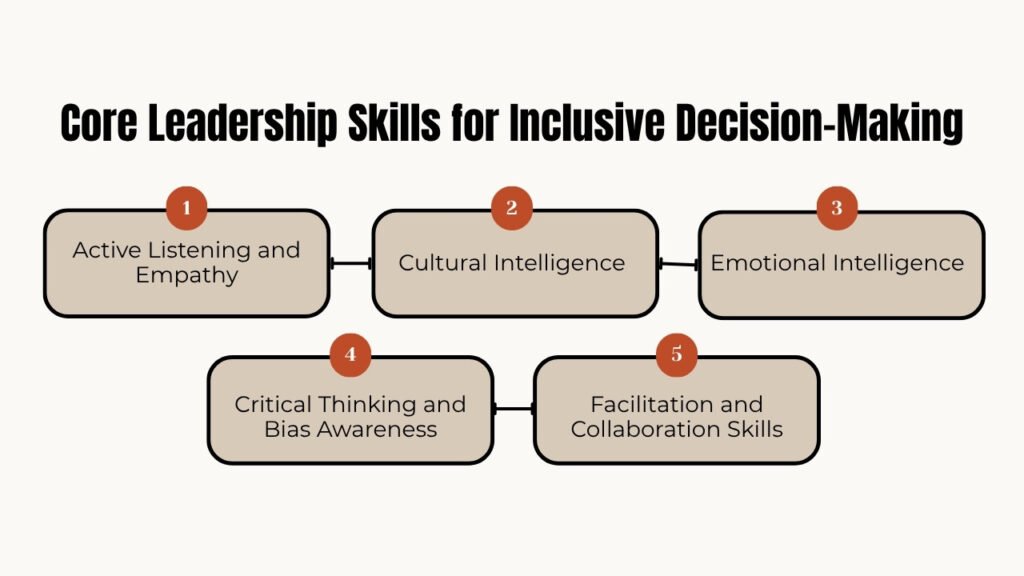
4.1 Active Listening and Empathy
Leaders who practice active listening and empathy create space where every voice is heard and valued. This means paying full attention, asking clarifying questions, and showing genuine interest in diverse perspectives. Empathy helps leaders understand not just what is being said, but why it matters to the speaker.
Practical Tip: Use structured turn-taking during meetings to ensure everyone contributes, or introduce anonymous input tools like digital surveys and brainstorming platforms to give quieter team members equal opportunity to share ideas.
4.2 Cultural Intelligence (CQ)
In a globalized workplace, cultural differences can shape communication styles, expectations, and decision-making norms. Leaders with high cultural intelligence (CQ) recognize and respect these differences, adapting their approach to fit the context rather than applying a one-size-fits-all method.
Skill in Action: A culturally intelligent leader might vary meeting formats to accommodate different cultural preferences, or adjust how feedback is delivered to ensure it is well-received across diverse groups. This flexibility strengthens inclusion and prevents miscommunication.
4.3 Emotional Intelligence (EQ)
Inclusive leadership requires more than logic—it demands emotional intelligence (EQ). Leaders with strong EQ can read emotional cues, manage conflict with sensitivity, and respond in ways that build trust rather than tension. EQ ensures decisions account for both the rational and emotional dimensions of leadership.
Skill in Action: When navigating disagreements, a leader with EQ acknowledges emotions in the room while steering the conversation back to shared goals. This balance of logic and empathy ensures constructive outcomes.
4.4 Critical Thinking and Bias Awareness
Bias—whether personal or systemic—can distort decision outcomes. Leaders who practice critical thinking and cultivate bias awareness are better equipped to challenge assumptions, examine evidence objectively, and avoid favoritism or blind spots.
Practical Tool: Use a bias checklist before finalizing major decisions, or assign a “red team” to play devil’s advocate and highlight overlooked risks or perspectives. These tools help neutralize bias and improve decision quality.
4.5 Facilitation and Collaboration Skills
Inclusivity often comes down to how decisions are facilitated. Leaders with strong facilitation and collaboration skills design processes that make it easy for all voices to participate, not just the loudest ones.
Skill in Action: Rotate meeting facilitators, use breakout groups to diversify participation, or set ground rules that prevent interruptions. By intentionally structuring inclusive processes, leaders foster collaboration and ensure decisions benefit from the richness of team diversity.
Practical Frameworks for Inclusive Decision-Making
While leadership skills create the foundation, leaders also need structured frameworks to ensure inclusivity is consistently applied to decisions. A clear process not only improves outcomes but also builds trust across teams. One powerful model to adopt is the 5-Step Inclusive Decision Framework.
The 5-Step Inclusive Decision Framework
Step 1: Define the Decision and Who It Impacts
Start by clarifying the decision at hand and identifying the people or groups most affected by it. This ensures the right stakeholders are considered from the beginning, not as an afterthought.
Step 2: Gather Diverse Input (Representation Matters)
Actively involve people from different backgrounds, roles, and perspectives. Diversity of thought helps surface blind spots and sparks innovative ideas. Remember—representation without participation isn’t inclusion.
Step 3: Weigh Options with Fairness Criteria
Evaluate potential solutions using fairness and equity as guiding principles. Ask: Does this decision benefit all groups fairly? Are there unintended consequences for marginalized voices?
Step 4: Decide Transparently, Explaining Reasoning
Once a decision is made, communicate it openly. Share the reasoning behind the choice and acknowledge how feedback shaped the outcome. Transparency builds credibility and trust, even if not every suggestion is implemented.
Step 5: Reflect and Improve Through Feedback Loops
After the decision is put into action, gather feedback on both the process and the result. Reflection helps leaders identify what worked, what didn’t, and how to improve inclusivity in future decisions.
Examples of Tools That Support Inclusive Decision-Making
- DEI Scorecards: Structured evaluation tools that measure how well decisions align with diversity, equity, and inclusion goals.
- Inclusive Brainstorming Methods: Techniques like “round-robin sharing” or “brainwriting” that give everyone equal opportunities to contribute ideas.
- Anonymous Surveys and Feedback Tools: Digital platforms that allow team members to share honest input without fear of judgment or backlash.
By following this framework and leveraging supportive tools, leaders can move from intentional inclusivity to practical inclusivity—making decisions that are not only smarter and fairer but also deeply trusted by their teams.
How Leaders Can Start Building Inclusive Decision-Making Skills Today
Developing inclusive decision-making skills doesn’t happen overnight, but leaders can take practical, actionable steps to start making a difference immediately. By combining self-awareness, small behavior changes, and continuous learning, you can create a more inclusive leadership approach that benefits both your team and organization.
1. Conduct a Self-Audit
Start by evaluating your current decision-making habits. Ask yourself:
- Whose voices do I typically seek in decisions?
- Are there patterns of exclusion or favoritism I may not notice?
- How often do I actively challenge my own assumptions and biases?
A self-audit helps leaders identify areas for improvement and set measurable goals for more inclusive practices.
2. Implement Micro-Actions
Small, intentional changes in daily leadership routines can have a significant impact over time. Consider incorporating these micro-actions:
- Rotate Meeting Facilitators: Give different team members the opportunity to lead discussions, ensuring varied perspectives shape the conversation.
- Use Inclusive Language: Avoid jargon or phrases that unintentionally exclude anyone. Simple changes in wording can make team members feel more valued and respected.
- Ask “Who’s Missing From This Decision?”: Before finalizing any decision, pause to consider who might be affected but hasn’t had a chance to contribute. This question ensures critical perspectives are not overlooked.
3. Leverage Learning Resources
Building inclusive leadership skills is a continuous process. Invest in resources that provide knowledge, frameworks, and hands-on training:
- Books: Titles focused on inclusive leadership, cultural intelligence, and equity in the workplace.
- Training Programs: Workshops and webinars on active listening, bias awareness, and inclusive facilitation.
- DEI-Focused Leadership Courses: Structured courses designed to help leaders integrate diversity, equity, and belonging principles into decision-making.
By combining self-audit, micro-actions, and continuous learning, leaders can take meaningful steps toward making every decision more inclusive, fair, and effective. Starting small, staying consistent, and committing to growth ensures that inclusivity becomes an integral part of leadership rather than a checkbox exercise.
Benefits of Mastering Inclusive Decision-Making
Mastering inclusive decision-making delivers measurable benefits—not only for leaders but for the entire organization. By intentionally involving diverse perspectives and fostering belonging, leaders can create a culture of trust, innovation, and sustainable performance.

1. Increased Trust and Credibility as a Leader
When team members see that their input is genuinely valued and considered, trust in leadership grows. Transparent and inclusive decision-making signals integrity and fairness, strengthening a leader’s credibility. Employees are more likely to engage, support initiatives, and follow through on shared goals when they feel heard.
2. Stronger, More Creative Teams
Inclusive decision-making unlocks the full potential of diverse teams. By bringing different perspectives into the conversation, leaders can generate more creative solutions, anticipate challenges, and reduce blind spots. Teams that experience equitable participation are more collaborative, innovative, and resilient in the face of complex problems.
3. Better Alignment with Organizational DEIB Goals
Organizations increasingly prioritize Diversity, Equity, Inclusion, and Belonging (DEIB) as core strategic objectives. Leaders who make inclusive decisions naturally align with these goals, reinforcing the organization’s values and demonstrating commitment to an inclusive culture. This alignment also improves organizational reputation, both internally and externally.
4. Long-Term ROI: Retention, Engagement, Innovation
Inclusive decision-making is a long-term investment with tangible returns:
- Retention: Employees are more likely to stay in environments where they feel valued and included.
- Engagement: Teams show higher motivation, accountability, and discretionary effort.
- Innovation: Diverse perspectives increase the likelihood of breakthrough ideas and solutions.
Research supports these outcomes: companies with inclusive leadership practices report higher employee satisfaction and measurable gains in productivity and innovation. Ultimately, mastering inclusive decision-making strengthens not only leadership effectiveness but also organizational performance and growth.
Conclusion
Inclusive decision-making is no longer optional—it’s a critical skill for modern leaders navigating diverse, complex, and rapidly evolving workplaces. Leaders who intentionally seek out varied perspectives, challenge their own biases, and foster belonging can drive better decisions, stronger teams, and sustainable organizational success.
The key to mastering this skill is to start small but remain consistent. Even simple actions—like rotating meeting facilitators, asking “Who’s missing from this decision?” or actively listening to quieter voices—can create meaningful change over time. Leadership is a journey, and building inclusivity into every decision is a step toward more equitable, innovative, and resilient teams.
Take a moment to reflect on your next decision. Ask yourself: Who is missing from this discussion? How can I ensure every perspective is heard? By embedding inclusivity into your decision-making process today, you not only strengthen your leadership but also create lasting impact for your team and organization.
Frequently Asked Questions
Q1. How does inclusive decision-making improve team performance?
Inclusive decision-making ensures that diverse perspectives are considered before finalizing a decision. This reduces blind spots, sparks innovation, and strengthens collaboration. Teams feel valued and empowered, which boosts engagement, accountability, and overall performance.
Q2. What is the difference between diversity and inclusion in leadership decisions?
Diversity refers to the variety of backgrounds, experiences, and perspectives within a team. Inclusion is the practice of actively involving those diverse voices in decisions and ensuring everyone feels heard and valued. A diverse team without inclusion risks underutilized potential and disengagement.
Q3. How can leaders avoid tokenism in decision-making?
Leaders can avoid tokenism by genuinely seeking input from all team members, not just including diverse voices for appearance’s sake. Encourage equitable participation, act on feedback when appropriate, and create processes that give every voice equal weight in shaping outcomes.
Q4. Are inclusive decisions slower to make?
While inclusive decision-making may initially take more time due to gathering input and fostering discussion, it reduces long-term costs such as poor decisions, disengagement, and missed opportunities. Over time, it leads to faster buy-in, smoother implementation, and higher-quality outcomes.
Q5. What are some tools leaders can use to ensure inclusivity in decision-making?
Leaders can leverage a variety of tools to support inclusivity, including:
- DEI Scorecards: Evaluate decisions against diversity and equity criteria.
- Anonymous Surveys: Encourage honest input from all team members.
- Structured Brainstorming Techniques: Methods like round-robin sharing or digital collaboration platforms help ensure everyone contributes.
- Feedback Loops: Regularly review and adjust decision-making processes based on team input.