
You try to focus, but your mind jumps from one thought to another like it has its own plan. One moment you are ready to work, and the next moment you are checking your phone without even knowing why. This does not happen because you are lazy. It happens because your brain is overloaded.
We live in a time where distractions are everywhere. Constant notifications, noise, half-finished tasks, too many choices, and too much information coming at us every hour. When the brain gets flooded, it struggles to stay with one thing for long.
A study by Microsoft found that the average attention span dropped to around 8 seconds. That is less than a goldfish. But the real message is not that we have become weaker — it is that our environment has become louder and faster than our brain can handle.
The good news is, focus can be rebuilt. You do not need a strict routine or expert-level discipline. You only need a few simple habits that make your mind feel lighter and safer.
There are simple habits that make focusing easier. When you remove distractions while working, take short breaks, and use light mindfulness or even two minutes of mini meditation, your brain gets a chance to reset. Protecting your sleep, moving your body daily, and eating simple balanced meals also support clear thinking and better brain function. These changes are not major, but they create the right conditions for your mind to settle. Focus is not about forcing yourself to try harder, it is about helping your brain feel safe, calm, and ready to work.
In this blog, you will get seven practical methods that actually work in real life, especially when your thoughts won’t sit still. Even trying just one of them can help you feel more in control of your day.
Let’s start by understanding why our focus keeps slipping and what your brain really needs to stay calm and clear.
Table of Contents
What Focus Really Means
Focus is the ability to give your full attention to one task at a time. It does not mean ignoring everything else, it means choosing what matters in the moment. When the brain focuses, it uses less energy, thinks more clearly, and finishes work faster.
Many people think focus comes from strong discipline, but in real life it comes from the right conditions. A calm mind, a healthy body, a quiet environment, and small breaks help your brain stay with one task. Focus is not pressure, it is clarity.
The more you train your brain to return to one task, the stronger your focus becomes. Just like learning a language or playing an instrument, it can be improved with gentle and steady practice. Anyone can build it, at any age.
Understanding Why Your Focus Keeps Slipping
You may think focus is just about trying harder, but most of the time your brain is not tired, it is simply overwhelmed. When too many things ask for attention at once, your mind naturally jumps around. This is how the brain protects itself when it feels overloaded. To improve focus, we first need to understand what is making it slip away in the first place.
2.1 The Real Reasons Our Brain Can’t Stay Still
Our brain is built to notice new things, which helped our ancestors stay safe. But today, instead of facing danger, we face messages, noise, tasks, pressure, and thoughts all at the same time. These are a few of the common reasons your focus keeps breaking.
Too many inputs from the digital world and mental clutter
Every day we scroll, switch, reply, react, and search for new things. Our brain receives hundreds of small signals, which leaves little space for real thinking. When your mind is crowded, staying with one task for long becomes tiring and difficult.
Lack of mental reset moments
Most of us go from one thing to another without pausing. When the brain does not get even a short break, it gets stuck in overthinking mode. A few minutes of breathing, silence, or stepping away from screens gives your mind the reset it needs to focus again.
The myth of multitasking
Many people believe doing many things at once saves time, but the brain does not work that way. It can only focus properly on one task at a time. When you switch tasks too often, your brain uses extra energy to restart each time, which leads to more mistakes and slower work.
2.2 Quick Check: Are You in Constant Alert Mode?
Sometimes the brain is not distracted, it is stuck in warning mode. This happens when it feels there is always something to respond to or worry about. Here is a simple checklist to help you notice it.
- you check your phone many times without a real reason
- you struggle to finish one task without jumping to another
- your mind keeps reminding you of unfinished work
- silence makes you feel restless
- relaxing feels hard even when you have free time
- your thoughts are fast, but your work progress is slow
If you relate to many of these, your brain may be in constant alert mode. The good news is that you can calm it. With the right tools and simple habits, you can train your mind to slow down, focus better, and finish tasks with less effort.
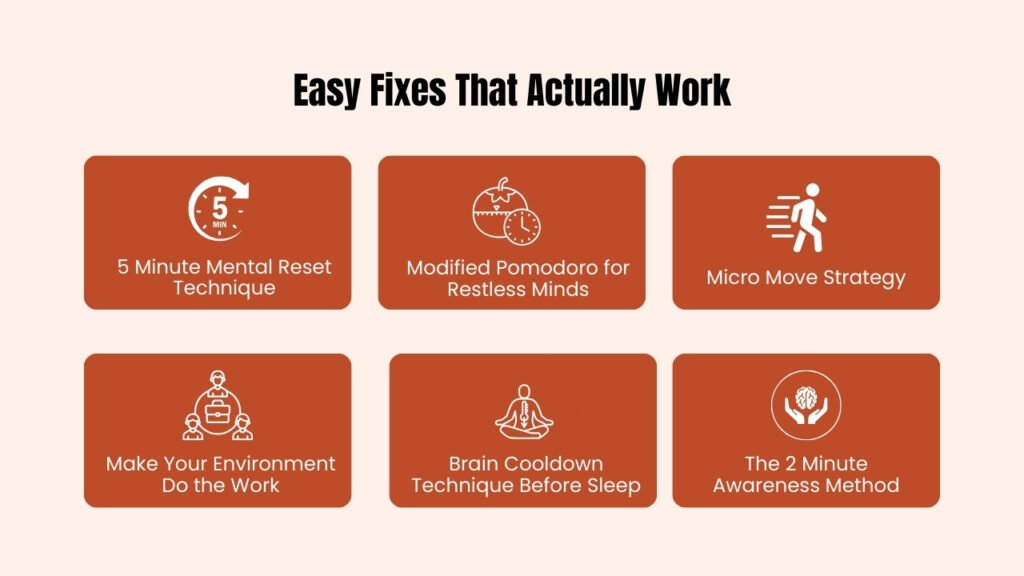
The 7 Easy Fixes That Actually Work
Improving focus does not always need strong discipline. Many times, it simply needs the right conditions for the brain to think clearly. These fixes are practical, tested, and gentle on the mind. Even trying one of them today can make your next task easier to finish.
Fix 1 The 5 Minute Mental Reset Technique
When your thoughts feel crowded, the best thing to do is pause instead of forcing yourself to continue. A short reset clears the noise and gives your brain a fresh start.
How to try it:
- Sit still without any screen for a few minutes
- Breathe slowly in and out
- Notice your thoughts but do not follow them
- Gently relax your shoulders and jaw
- Choose one task and begin slowly
This works because the brain calms down when it gets space to breathe. Even two minutes can help when your mind feels restless.
Fix 2 Modified Pomodoro for Restless Minds
The classic Pomodoro is 25 minutes of work and 5 minutes of rest, but not everyone works well with that timer. If your focus breaks too early, or you feel pressured by the countdown, it is better to adjust the timing to your natural rhythm.
You can try:
30 minutes work, then 10 minutes break
20 minutes work, then 5 minutes break
Or use the Flowtime method where you simply work until your mind starts to lose energy, then take a short break
The goal is not to fight your brain but to work with it. When you follow your natural flow, focus becomes easier and your energy lasts longer.
Fix 3 The One Thing Rule
Your brain thinks more clearly when it sees only one task. Many distractions around you may look harmless, but they take away energy without you noticing.
Try this:
Remove everything from your desk or screen except the one task you are working on
Keep your phone away or face down
Use a to-do list with only your next two or three tasks, not all of them at once
This method works because the brain understands what needs to be done. It reduces stress and brings a sense of control, which makes focusing feel easier and more natural.
Fix 4 The Micro Move Strategy
When your mind starts to wander, your body is often sitting still for too long. The brain and the body are connected, so even a little movement can wake up your focus. You do not need a workout. Just a quick micro movement for 30 seconds can help your brain come back to the task.
How to try it:
Stand up and stretch your arms
Roll your shoulders a few times
Walk around your room for half a minute
Do simple movements like neck rolls or light squats
This works because light movement increases blood flow and gives your mind a short refresh. It is like pressing a reset button. You do not need motivation to do it, only a reminder that movement helps your brain think clearly again.
Fix 5 Make Your Environment Do the Work
Focus becomes easier when your surroundings support your mind instead of distracting it. Your desk does not have to look perfect. It just needs to feel like a place where your brain knows it is time to work.
What to remove:
Phone near your hand
Many tabs open on your screen
Sticky notes all over the desk
Any item you are not using right now
What to add:
A small to-do card with your next task
A simple timer or stopwatch
A clean space in front of you that says, start here
One visual anchor like a water bottle or a pen to keep you grounded
A focused environment saves your mental energy. It tells your brain this is the right moment to work, which makes it easier to begin and continue without mental pressure.
Fix 6 The Brain Cooldown Technique Before Sleep
A tired brain struggles to focus the next day. When you carry stress into your sleep, your mind does not fully rest. Instead of sleeping deeply, it keeps thinking or worrying, and you wake up feeling heavy and slow.
A simple night routine can help your brain cool down and prepare for the next day:
Keep screens away 30 minutes before sleep
Write down any thoughts or tasks to clear your head
Use soft light or calm music to slow your mind
Take deep slow breaths before lying down
You do not need perfect sleep to improve focus, but you do need a calm mind before sleeping. A gentle evening routine helps your brain recharge so it can think clearly when morning comes.
Fix 7 The 2 Minute Awareness Method
Mindfulness is often explained in a deep way, but it can be very simple. Awareness just means paying attention to what is happening right now without judging it. You can try this for only two minutes when your focus is slipping.
How to practice it:
Pause and notice how your body feels
Listen to any sound around you
Observe your breathing without changing it
Let the moment be as it is
This helps because it brings your brain back to the present. When your mind jumps into past or future thoughts, awareness pulls it gently into now. You do not have to be spiritual or meditate for long. Two minutes is enough to help your mind slow down and reset.
Bonus Build Your Personal Focus System
You do not need a perfect routine to improve focus. Most people try to change everything at once and then feel disappointed when they cannot keep up. A better way is to build a simple focus system step by step. You can use the N.E.S.T. Focus Formula which stands for Nutrition, Environment, Sleep, and Time blocking. Each part supports your brain in a different way.
Nutrition
Your brain needs fuel to think clearly. Eating too much junk food or skipping meals can make your mind feel slow and foggy. You do not need a special diet, just simple and balanced meals that include fruits, vegetables, protein, and water during the day. Even replacing one snack with a healthier option can make a difference.
Environment
The place where you work affects how well you can focus. A clean desk, fewer screens, and one clear task in front of you make it easier for your brain to start working. You can design a small focus zone at home where your mind understands it is time to get things done.
Sleep
A tired brain cannot focus even if you try your best. Sleep is like a reset button for the mind. If you prepare your brain before sleeping and avoid screens for a while, you give it a chance to recover. Even improving your sleep by 30 minutes can boost your focus the next day.
Time blocking
Time blocking means setting a clear time for one task instead of thinking about everything at once. You can use short blocks like 20 or 30 minutes and then take a small break. This gives your brain structure and reduces stress about finishing everything at the same time.
A helpful way to follow this formula is to test one change per week and see how your focus feels. You do not need to fix everything right now. Small steps build strong habits and make focus easier and more natural over time.
When You Still Cannot Focus What It Might Mean
Sometimes even after trying different methods, focus still feels difficult. This does not mean you failed. It simply means your brain may need deeper rest and recovery. Instead of forcing yourself to work harder, it is important to understand what might be happening inside your mind.

Possible burnout
Burnout happens when your brain keeps working without rest for a long time. You may feel tired, unmotivated, or distant from your work. It is not laziness, it is your mind asking for recovery.
Mental exhaustion
When thoughts keep running and you feel overwhelmed, your brain may be low on energy. It becomes harder to think clearly or finish tasks, even simple ones. The brain needs breaks just like the body does.
Too much input and not enough recovery
If you consume a lot of information every day but hardly take time to slow down, your mind gets stuck in alert mode. This makes it difficult to focus even when you want to. The more your brain takes in, the more recovery it needs.
Choose awareness over self-judgment
Instead of blaming yourself for losing focus, try to notice what your brain is telling you. Awareness helps you understand when your mind needs rest. Judgment only makes stress stronger and focus weaker.
A simple step to begin recovery
Try to give yourself one quiet hour daily with zero digital noise. No phone, no messages, no scrolling, and no pressure to do anything. Just let your mind settle. This single hour can act like a reset and help your brain return to its natural rhythm.
Final Takeaway Focus Is a Skill Not a Gift
Focus is not a talent people naturally have, it is a skill the mind learns step by step. When your thoughts wander, it is not a sign of weakness, it is simply your brain asking for space and support. With the right habits and a little patience, focus becomes easier and starts to feel natural over time.
You do not need to change your whole life to improve focus. Just one small method can help your brain feel clearer. A five-minute reset, a short walk, a cleaner desk, or a quiet hour without screens can make more difference than forcing yourself to think harder. Progress always beats pressure.
Your goal is not to control your mind but to guide it gently. When your brain feels calm and safe, attention grows by itself. So give yourself time, choose one simple fix, and begin lightly.
Which one feels right for you to try first?
Frequently Asked Questions
Why do I lose focus so quickly?
You may be taking in too much information without giving your brain time to rest. Digital noise, stress, lack of sleep, and multitasking can overload the mind and make focus harder. Your brain is not weak, it just needs recovery.
Can focus be trained like a muscle?
Yes, focus can be trained with steady practice. Using simple methods like time blocking, short breaks, the five minute mental reset, or the one thing rule helps your brain learn how to stay with one task for longer.
How long should I work before taking a break?
Many people do well with 20 to 30 minutes of focused work followed by a short break. You can try different work and rest times to see what feels natural. The goal is not to follow a strict timer but to protect your energy.
Does sleep really affect focus?
Sleep plays a big role in focus. When the brain does not rest properly at night, it struggles to think clearly during the day. Even improving sleep by 30 minutes can help your mind stay sharper and calmer.
What is the simplest way to improve focus today?
Start with one step, not many. Clear your desk, take a short walk, use a timer, or give yourself five quiet minutes before work. Small actions help your brain return to clarity and build focus slowly over time.