
You wake up ready to crush the day. You’ve got energy, ideas, and plans buzzing in your head. But somehow the hours slip away. Notifications pull you in. Small tasks pile up. By the time you look up, the day is gone. You were busy all day, yet it feels like you achieved nothing real.
Sound familiar? You’re not alone. Most people aren’t lazy or unmotivated. They just never learned how to plan their day effectively in a way that actually fits real life. The truth is, you don’t need more hours. You need a system that helps you use the hours you already have in a smarter way.
What if you could take just ten minutes each day and set up your day so you actually stay focused, finish what matters, and still have time for yourself? Imagine ending the day feeling calm and proud, not guilty or drained. That’s what this 5-step daily planning method is built for. It’s simple, flexible, and made for real people with real lives, not perfect robots who never get distracted.
I used to wing my days, thinking I’d somehow “fit everything in.” Most nights I’d sit there wondering where the time went, feeling frustrated. But once I built and tested this method, things changed fast. My days started feeling clear and purposeful. I wasn’t just busy anymore. I was productive in a way that actually felt good.
Now, I want to show you exactly how to plan your day effectively so you can do the same — without overthinking or using complicated apps. Just five simple steps that work, every single day.
Table of Contents
Why Planning Your Day Matters (Before We Even Talk About To-Do Lists)
Let’s be honest. Most people don’t start their day with intention — they start it with a scroll. A study found that around 80% of people check their phone within the first 10 minutes of waking up. It’s crazy, right? You wake up fresh, full of energy, and before your brain even warms up, you’re already swimming in notifications, emails, and news.
Wait… be real for a second — do you do the same? It’s okay if you do. Most of us have been there. The good news is, we can fix it. All it takes is a few small shifts in how you plan your day.
Planning your day isn’t about being hyper-productive or robotic. It’s about protecting your peace and choosing how you want your day to go before the world chooses it for you.
Planning reduces decision fatigue
You know that weird feeling when you keep thinking, “What should I do now?” every hour? I used to waste so much time like that. I’d jump from one thing to another, always feeling busy but never really moving forward. My brain was tired — not from working too hard, but from constantly deciding what to do next.
That’s called decision fatigue. The more choices you make, the more your focus drains. And when your focus goes, so does your productivity. Planning your day removes that constant guessing. You already know what to do next, so you can spend your energy on doing — not deciding.
Planning protects what’s important from what’s urgent
There’s a big difference between what’s urgent and what’s important. Urgent things scream for your attention — calls, messages, last-minute tasks. Important things whisper quietly — your goals, your health, your personal growth.
Let me give you something real. Have you ever spent a full day replying to messages, attending meetings, doing errands — and at night, realized you didn’t touch that one thing that actually mattered to you? Yeah, that’s the trap. Urgent wins the noise game. Important wins the life game.
When you plan your day, you give importance a voice. You make space for what actually helps you grow before the urgent stuff eats your time.
I think this will help you to solve it “How to Improve Productivity and Stop Being Busy“
Planning gives you a win you can feel
Planning = clarity. When you have clarity, you can use your day effectively. You know where to start, what to do next, and when to stop.
You know that small, proud moment when you close your day feeling accomplished — that “I actually got things done today” feeling? That’s what clarity does. It replaces guilt with peace and chaos with control.
I used to think planning made life too strict, like it would kill creativity. But I realized it does the opposite — it gives you freedom. Because when you plan, you don’t spend your day reacting. You spend it creating.
So before you even think about apps or to-do lists, just remember this: planning isn’t about doing more. It’s about living better.
How to Plan Your Day Effectively in 5 Simple Steps
Here’s the 10-minute routine I personally use and teach. You can do this before bed or first thing in the morning. It’s simple, easy to follow, and it actually works in real life. Let’s make your day clear, focused, and calm right from the start.
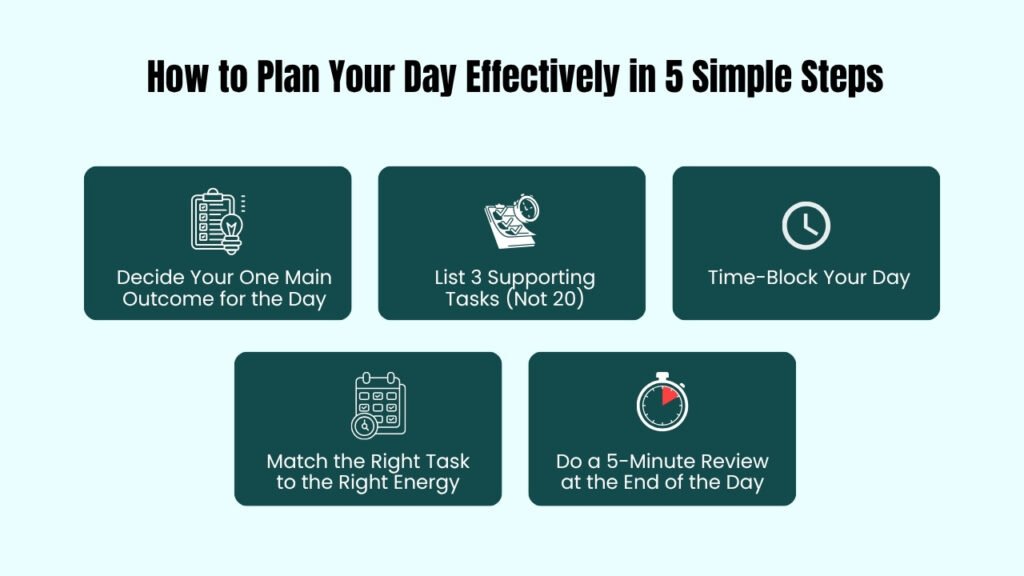
Step 1 – Decide Your One Main Outcome for the Day
Before your day even begins, ask yourself one simple question:
If I only get one thing done today, what should it be so I still feel proud tonight?
That’s your main outcome. Some people call it their MIT — Most Important Task. I like to call it the win of the day. Because once you achieve it, you already won, no matter what else happens.
This step matters more than you think. Without a clear main goal, your day can easily get hijacked by distractions, small tasks, or someone else’s priorities. You end up reacting instead of leading your day.
This is not your to-do list. It’s not about doing everything. It’s about doing what moves your life, work, or goals forward. It’s that one meaningful thing that, when finished, makes you feel like your day mattered.
For example, my MIT one day last week was writing this exact section you’re reading now. I told myself, “If I can just finish this piece with full focus today, that’s my win.” Once I did that, everything else felt like a bonus.
Step 2 – List 3 Supporting Tasks (Not 20)
After you’ve chosen your one main outcome, it’s time to pick up to three supporting tasks. These are tasks that help you complete your main goal or maintain progress in other areas of your life.
Keep this in mind — these are must-do tasks, not nice-to-do tasks. Big difference.
Here’s why you should stick to only three. When your list is too long, your brain starts panicking. You see ten things on your list and instantly think, “I’ll never finish this.” That thought kills motivation before you even start. But when you have three realistic tasks, your mind stays calm, focused, and ready to move.
A few quick tips to make your list powerful:
- Keep your tasks realistic. Don’t plan to build Rome in one day.
- Write them in action form. For example, instead of saying “Work on project,” write “Outline the first two sections of the project.”
- Make sure each task actually matters. Ask yourself, “If I skip this, will it affect my progress or peace?” If not, it probably doesn’t belong on your list today.
This small shift turns your day from chaotic to clear. You stop drowning in endless tasks and start focusing on what really counts.
Step 3 – Time-Block Your Day (Put Tasks Where They Actually Live)
Here’s the truth, if you don’t give your tasks a time, they’ll take up your entire day. You’ll keep saying “I’ll do it later” until later turns into tomorrow. Time-blocking is simple — you’re just giving every important task a home in your day.
Think of your day like a house with different rooms. Every task belongs somewhere. Once you give it a home, you don’t waste time deciding when to start. You just show up in that “room” and do what belongs there.
Here’s a simple way to break your day:
Morning block:
Use your fresh energy for your MIT, your main outcome. That’s your focus time. Protect it like your peace.
Mid-day block:
Great for meetings, calls, or errands. You’re already in action mode, so it’s perfect for handling those reactive parts of the day.
Evening block:
This is your slower zone. Good for admin work, light planning for tomorrow, and tasks that don’t need much brainpower.
And one big thing — add buffer time between blocks. Life happens. Maybe a call runs late or you need a break. It’s fine. Planning without room for life only leads to stress. Remember, you’re human, not a machine.
Here’s how a real day could look:
8:00–10:00 – Work on main project (MIT)
10:00–10:30 – Break / reset
10:30–12:00 – Tasks 2 and 3
12:00–1:00 – Lunch / messages
1:00–3:00 – Meetings / calls
3:00–4:00 – Admin + inbox
9:00–9:15 p.m. – Plan tomorrow
Once you get used to this, you’ll notice something powerful. You won’t need to “force” focus anymore. You’ll just flow.
Step 4 – Match the Right Task to the Right Energy
You’re not a robot. Your energy doesn’t stay the same from sunrise to sunset. Some people are sharp in the morning, others come alive when the world gets quiet. The secret is to plan your day around your natural rhythm instead of fighting it.
You’ve probably had days where you called yourself lazy or unmotivated. But the truth is, you were just doing the wrong task at the wrong time. When your brain isn’t ready for deep work, no amount of coffee or motivation quotes can fix that.
Here’s how you fix it for real:
- Notice when you feel most focused. Is it morning, afternoon, or late at night?
- Schedule your focus-heavy work during that window.
- Save simple or admin work for your low-energy hours.
For me, I’m a night owl. My brain just switches on when everything’s calm and quiet. That’s when I do my best work — writing, planning, creating ideas. So I plan my deep work block late in the evening when most people are winding down. It’s peaceful, focused, and feels natural to me.
You might be the opposite. Maybe mornings are your power zone. The point is, don’t copy someone else’s routine. Pay attention to your own energy curve. Once you align your work with your natural energy, everything changes. You’ll get more done without pushing harder, and your day will start feeling smoother and lighter.
Try tracking your energy for one week. Notice when you naturally feel alert and when your focus fades. Then build your daily plan around that. You’ll stop fighting your body and start working with it — and that’s when productivity finally starts to feel effortless.
Step 5 – Do a 5-Minute Review at the End of the Day
This is where your day comes full circle. I call it the shutdown ritual. It’s simple but game-changing.
Before you switch off for the day, take five minutes and ask yourself three quick questions:
- What did I finish?
- What blocked me?
- What needs to move to tomorrow?
That’s it. No overthinking. Just clarity.
This small ritual helps you end the day feeling clear, not cluttered. You’ll know exactly where you stand and what tomorrow needs. No guilt, no confusion.
It also helps you see patterns. Maybe you keep getting stuck on the same type of task. Maybe you notice your energy dips at the same time each day. That awareness alone can help you plan better next time.
Here’s a quick script you can use tonight:
Here’s what I did.
Here’s what didn’t get done and why.
Here’s what matters tomorrow.
Planning your day is about control, but ending your day with clarity is about peace. When you do this, you don’t carry unfinished thoughts to bed. You close your day on purpose.
So tomorrow, when you wake up, you won’t waste a second thinking about where to start — you’ll already know.
What a Well-Planned Day Actually Looks Like (Sample Day Plan)
So far, you’ve learned how to plan your day effectively, but let’s make it real. You might be thinking, “Okay, but what does this actually look like in my day?” I get it. Seeing a clear example makes it easier to picture how all this fits together.
A well-planned day isn’t about filling every hour or being perfect. It’s about knowing where your focus belongs and creating space for both work and life. Below, you’ll see two real examples — one for students or self-learners and another for working professionals or business owners.
Use these as a starting point, not a rulebook. Everyone’s rhythm is different. Adjust them to match your lifestyle and energy pattern.
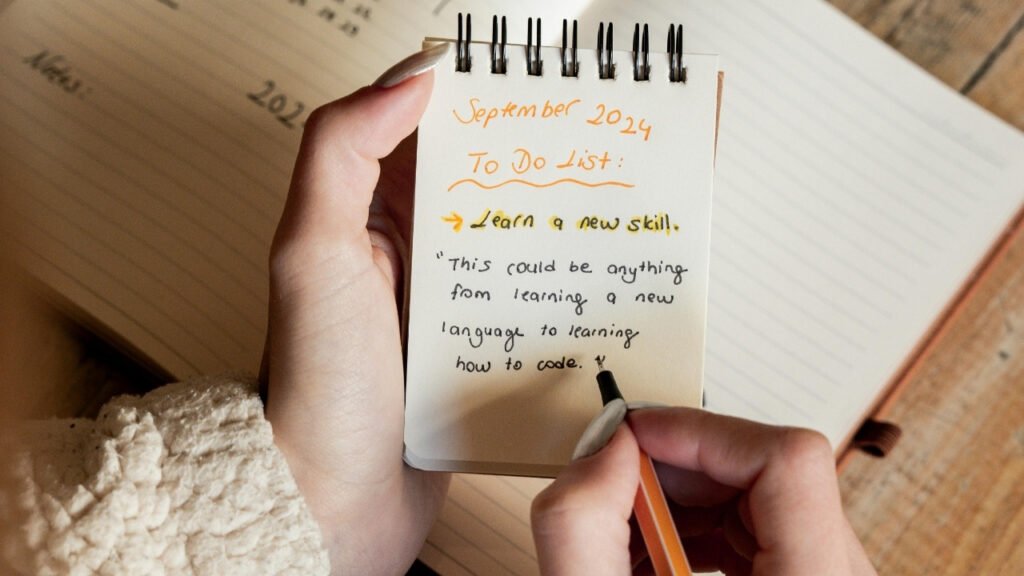
Example A: Student or Self-Learner
Morning
- 7:00 – Wake up, stretch, have water
- 7:15 – Quick review of what you’ll study today
- 7:30 to 9:00 – Study or work on your hardest subject (MIT)
- 9:00 to 9:30 – Breakfast and short break
- 9:30 to 11:00 – Practice questions or review notes
- 11:00 to 11:15 – Short break
Midday
- 11:15 to 1:00 – Lighter study or creative work (like projects or reading)
- 1:00 to 2:00 – Lunch and downtime
- 2:00 to 3:30 – Group study, revision, or attending class
Afternoon
- 3:30 to 4:00 – Quick walk or rest
- 4:00 to 6:00 – Second deep focus session for a different subject or skill
- 6:00 to 6:30 – Chill, talk to family, refresh
Evening
- 7:00 to 8:30 – Lighter learning tasks or online course
- 8:30 to 9:00 – Dinner and relax
- 9:00 to 9:15 – 5-minute review (what went well, what to adjust tomorrow)
- 10:00 – Relax or sleep depending on your energy
This plan keeps mornings for focus, afternoons for action, and evenings for review. You end your day feeling like you made real progress instead of just “trying to study all day.”
Example B: Working Professional or Business Owner
Morning
- 7:00 – Wake up and do a short morning routine (stretch, hydrate, no phone)
- 7:30 – Review your plan for the day
- 8:00 to 10:00 – Focus on your MIT (the one task that drives results)
- 10:00 to 10:30 – Break or quick walk
- 10:30 to 12:00 – Work on task two or three from your plan
Midday
- 12:00 to 1:00 – Lunch and screen-free time
- 1:00 to 3:00 – Meetings, calls, client work, or collaborative projects
- 3:00 to 3:30 – Buffer time or quick admin work
Afternoon
- 3:30 to 4:00 – Check messages, reply to emails
- 4:00 to 5:00 – Finish remaining light tasks
- 5:00 to 6:00 – Wrap-up, stretch, or spend time offline
Evening
- 7:00 – Dinner, relax, or family time
- 8:00 to 10:00 – Creative or passion work (perfect for night owls like me)
- 10:00 to 10:15 – 5-minute review (note wins, what got done, what to improve)
- 11:00 – Relax and recharge for tomorrow
Notice something? Both plans have a rhythm. There’s focus, rest, buffer time, and closure. You’re not running all day chasing tasks. You’re moving through your day with clarity.
If you’re reading this thinking, “But my schedule is messy,” that’s okay. Planning doesn’t mean locking yourself into a perfect day. It means giving your day direction, not pressure.
Try following a version of this plan for a week. See how it feels. You’ll notice less chaos, more flow, and a stronger sense of control over your time. Once you experience that, you’ll never want to go back to “winging it.”
Quick Checklist: Your Daily Planning Routine in Under 10 Minutes
Let’s wrap everything up with a simple checklist you can actually use right now. No complicated systems. No fancy tools. Just ten focused minutes that make tomorrow clear and calm before it even begins.
Use this every night or every morning — whichever feels right for your rhythm. The goal is to go to bed or wake up already knowing where your focus belongs.
Here’s your quick 10-minute daily planning checklist:
- Pick your one main outcome for tomorrow
Ask yourself: “If I get only one thing done, what should it be to feel proud at night?” That’s your win of the day. - Choose up to 3 supporting tasks
Keep it realistic and action-focused. Think small, clear actions that move your goals forward, not a long list that drains you before you start. - Put each task into an actual time block
Give every task a home in your day. Decide when it happens so you don’t waste time wondering what to do next. - Match hard tasks with high-energy hours
Do your deep work when your brain feels sharp. Save easier or admin work for low-energy times. - Leave realistic buffer time
Things rarely go as planned, and that’s okay. Add a few breaks or flexible minutes between blocks. You’ll stay calm even when life interrupts. - Do a 5-minute review at the end of the day
Ask yourself three things: What did I finish? What blocked me? What matters tomorrow? That small reflection makes a big difference.
If you follow this checklist for just one week, you’ll already start feeling more in control. Your days will stop running you, and you’ll start running them. It’s simple, but it works — because planning isn’t about perfection. It’s about direction.
So, take ten minutes today, plan your next day with intention, and give yourself the gift of clarity before tomorrow even begins.
FAQs About How to Plan Your Day Effectively
Is it better to plan your day the night before or in the morning?
Both works. Planning the night before helps you wake up ready with a clear direction. Planning in the morning gives you a fresh start with updated priorities. The real key is consistency. Choose one and stick to it. Make planning a small daily ritual that fits your rhythm.
How do I plan my day if my schedule changes a lot?
When your day is unpredictable, use half-day planning. Plan only the next few hours instead of the full day. Once that block is done, plan the next. This keeps you flexible but still focused.
How many tasks should I do in one day?
Keep it simple. One main outcome and up to three supporting tasks are enough. This helps you stay realistic, finish strong, and avoid the guilt of a never-ending list.
What if I never finish everything I planned?
That’s completely normal. Planning isn’t about being perfect. It’s about giving direction to your time and energy. If something doesn’t get done, move it to tomorrow with intention. Use your 5-minute review at night to see what matters most.
Do I need a special planner or app?
No. You can plan your day effectively with a notebook, sticky notes, or a simple phone app. The magic isn’t in the tool. It’s in having a clear system that you actually use every day.