
You have 24 hours in a day—just like everyone else. Yet some people seem to accomplish twice as much, move faster toward their goals, and still have time for rest and growth. The difference isn’t luck, talent, or even hard work—it’s how they manage their time.
Time management is simply the skill of organizing, planning, and using your hours effectively to make progress on what truly matters. It’s not about squeezing more tasks into your day—it’s about aligning your actions with your priorities, so every minute moves you closer to your goals.
In today’s fast-paced world, it’s easy to feel like you’re constantly busy but rarely productive. You jump from emails to meetings, scroll through social media for “a break,” and end each day wondering where your time went. This cycle leads to frustration, burnout, and a lingering sense that you’re capable of more—but just can’t seem to get ahead.
If this sounds familiar, you’re not alone. Most people struggle not because they lack time, but because they lack a clear system to manage it. The good news? Time management is a learnable skill—and once you master it, everything else in life starts to feel easier.
In this article, you’ll discover 7 proven and practical time management techniques that can help you reclaim your focus, reduce overwhelm, and dramatically boost your productivity. Each technique is simple to implement, grounded in real-world effectiveness, and designed to help you take control of your day—starting right now.
Table of Contents
Understanding the Power of Effective Time Management
Mastering time management is one of the most powerful skills you can develop—not just for boosting productivity, but for improving your overall well-being. When you know how to plan your day intentionally, you stop reacting to everything around you and start taking control of your time, energy, and focus.
Time management isn’t about being rigid or robotic—it’s about creating structure that supports your goals and your peace of mind. When you manage your time effectively, you create space for what truly matters: meaningful work, personal growth, and quality rest.
Here are some key benefits of mastering effective time management:
- Reduces stress and burnout: Having a clear plan minimizes last-minute chaos and anxiety. You know what needs your attention and what can wait.
- Increases focus and clarity: Time management helps you cut through distractions, prioritize important tasks, and stay mentally present.
- Improves work-life balance: With better control over your schedule, you can dedicate time to both professional success and personal fulfillment.
- Creates more time for meaningful goals: When you stop wasting hours on low-value tasks, you gain time for the goals that bring lasting satisfaction.
Ultimately, effective time management gives you a sense of direction and purpose. It helps you align your daily actions with your long-term vision—so you’re not just getting things done, but getting the right things done.
Time Blocking: Structure Your Day with Purpose
Time blocking is a powerful time management technique that helps you take control of your day by assigning specific time slots to specific tasks. Instead of working reactively—jumping from one thing to another—you proactively decide when you’ll work on each activity. This intentional structure eliminates chaos and helps you focus deeply on what matters most.
The core idea is simple: you divide your day into “blocks” of time, and each block is dedicated to one particular type of work. For example, you might schedule:
- Morning: Deep work or creative projects that require full concentration.
- Afternoon: Meetings, calls, or collaborative work.
- Evening: Learning, reflection, or personal growth activities.
By doing this, you create a natural rhythm in your day that keeps you productive without feeling rushed. When you know exactly what to focus on—and when—it becomes much easier to stay on task and avoid distractions. Time blocking also reduces procrastination because your tasks have a clear start and end point, leaving less room for indecision or wasted time.
How to Implement Time Blocking Effectively
- Use digital calendars or planners: Tools like Google Calendar, Notion, or ClickUp allow you to visually map your day and set reminders.
- Group similar tasks together (batching): Combine related activities—like responding to emails or editing content—into one block instead of scattering them throughout the day.
- Protect focus hours: Turn on “Do Not Disturb” mode during your deep work sessions. Let others know when you’re unavailable to minimize interruptions.
When practiced consistently, time blocking creates a sense of control and flow throughout the day. You’ll find yourself finishing work faster, feeling more focused, and ending each day with a sense of accomplishment—rather than exhaustion.
The Pomodoro Technique: Boost Focus Through Short Bursts
The Pomodoro Technique is one of the most effective and scientifically supported time management methods for boosting focus and productivity. Developed by Francesco Cirillo in the late 1980s, this technique is built around the idea that short, concentrated bursts of work followed by brief breaks can dramatically improve your ability to stay focused and get things done.
The process is simple: you work for 25 minutes of deep focus, followed by a 5-minute break. Each 25-minute session is called a Pomodoro. After completing four Pomodoros, you take a longer break of about 15–30 minutes to recharge.
Why the Pomodoro Technique Works
The power of the Pomodoro Technique lies in psychology and human attention span. Our brains naturally struggle to maintain deep focus for long, uninterrupted periods. By breaking work into manageable chunks, you prevent mental fatigue, reduce procrastination, and train your mind to enter a state of sustained concentration. These short bursts create a sense of urgency that keeps distractions at bay and helps you make steady progress without burning out.
How to Apply the Pomodoro Technique
- Choose one task you want to complete or make progress on.
- Set a timer for 25 minutes and focus solely on that task—no multitasking or checking notifications.
- When the timer rings, take a 5-minute break—stretch, walk, or grab water to reset your mind.
- Repeat the cycle for four Pomodoros, then take a longer 15–30 minute break to rest completely.
Optional Tools to Help You Stay on Track
- Pomofocus: A simple, browser-based Pomodoro timer that tracks your sessions.
- Forest App: A gamified timer that rewards you with a “growing tree” for every focused session, motivating you to stay off your phone.
The Key Benefit
The Pomodoro Technique is ideal for combating distractions and maintaining long-term energy throughout the day. It helps you stay engaged with your work, avoid burnout, and build momentum—one focused session at a time.
When used consistently, this method transforms how you approach productivity: instead of working longer hours, you start working smarter and more intentionally.
The Eisenhower Matrix: Prioritize What Truly Matters
One of the biggest challenges in time management is knowing what to do first. We often confuse being busy with being productive, spending hours reacting to urgent tasks while neglecting the ones that actually move us forward. The Eisenhower Matrix, named after former U.S. President Dwight D. Eisenhower, is a proven framework that helps you distinguish between what’s urgent and what’s important—so you can focus on the work that truly matters.
Understanding the Four Quadrants
The Eisenhower Matrix divides your tasks into four clear quadrants:
- Urgent and Important: Tasks that require immediate attention, like crises, deadlines, or emergencies.
- Not Urgent but Important: Long-term goals, strategic planning, skill development—activities that drive real growth and success.
- Urgent but Not Important: Distractions that seem pressing but don’t add much value, like unnecessary meetings or non-critical emails.
- Not Urgent and Not Important: Time-wasters such as endless scrolling or busywork that adds little to your goals.
This simple visual framework helps you see where your time is really going and make intentional choices about what deserves your attention.
How the Eisenhower Matrix Helps You Prioritize
By categorizing tasks, you stop reacting to urgency and start acting based on importance. Instead of getting lost in low-impact activities, you can direct your energy toward what drives progress.
For example:
- Responding to a client deadline → Urgent and Important
- Working on a long-term project → Not Urgent but Important
- Answering a non-critical Slack message → Urgent but Not Important
- Browsing social media → Not Urgent and Not Important
Steps to Apply the Eisenhower Matrix
- List your to-dos: Write down everything you need to accomplish today or this week.
- Assign each task to a quadrant: Be honest about which ones are truly important versus merely urgent.
- Focus on Quadrant 2: The Important but Not Urgent zone is where long-term growth, personal development, and meaningful success happen.
The Key Benefit
When you use the Eisenhower Matrix consistently, you learn to work smarter, not harder. It helps you spend more time on proactive, impactful tasks rather than firefighting constant urgencies.
By mastering this technique, you shift from a reactive mindset to a strategic one—ensuring that your time is invested, not just spent.
The 2-Minute Rule: Beat Procrastination Instantly
Procrastination is one of the biggest obstacles to effective time management. The 2-Minute Rule, popularized by productivity expert David Allen in his book Getting Things Done, offers a simple yet powerful solution: “If it takes less than 2 minutes, do it now.”
The idea is straightforward—rather than letting small tasks pile up on your to-do list, tackle them immediately if they can be completed quickly. This approach prevents minor tasks from building into overwhelming mental clutter that saps your focus and productivity.

Why the 2-Minute Rule Works
Small tasks often weigh on your mind, creating a sense of unfinished business that leads to stress and distraction. By addressing them immediately, you:
- Clear mental space for more important work
- Reduce the cumulative backlog of tiny tasks
- Build a habit of taking quick, decisive action
Practical Examples
- Responding to a short email
- Filing a document or tidying your workspace
- Making a quick phone call
- Jotting down a note or idea
These small actions might seem minor, but when done consistently, they prevent small tasks from overwhelming your schedule and allow you to maintain a clear, focused workflow.
The Key Benefit
The 2-Minute Rule builds momentum and reduces task anxiety. Completing quick tasks immediately gives you a sense of accomplishment and motivates you to tackle larger, more complex projects. Over time, this simple habit can significantly improve your efficiency and overall productivity.
By incorporating the 2-Minute Rule into your daily routine, you stop letting small tasks control your day—and start working with purpose and momentum.
Eat That Frog: Tackle Your Most Important Task First
Procrastination often happens because we save the hardest or most important task for later, only to let distractions take over. Productivity expert Brian Tracy coined the concept of “Eat That Frog”, which encourages you to tackle your most challenging or impactful task—the “frog”—first thing in the morning.
Why Eating the Frog Works
Focusing on your most important task early in the day has several advantages:
- Reduces decision fatigue: Completing your top-priority task eliminates one major decision, freeing mental energy for the rest of the day.
- Builds motivation early: Accomplishing a challenging task boosts confidence and sets a positive momentum.
- Prevents procrastination: By addressing your biggest task upfront, you avoid putting it off and stressing over it all day.
Practical Steps to Eat That Frog
- Identify your “frog” each morning: Determine the task that will have the greatest impact on your goals or progress.
- Block the first 1–2 hours for it: Schedule uninterrupted time to focus solely on this task, without distractions or multitasking.
The Key Benefit
Eating your frog sets a productive tone for the entire day. By completing the most significant task first, the rest of your day feels easier and more manageable. This approach transforms your productivity, helping you focus on what truly matters rather than reacting to minor tasks and interruptions.
When practiced consistently, “Eat That Frog” ensures that you make steady progress on your most important goals every single day.
The 80/20 Rule (Pareto Principle): Focus on High-Impact Work
The 80/20 Rule, also known as the Pareto Principle, is a powerful time management and productivity concept. It states that 80% of your results come from just 20% of your efforts. In other words, not all tasks are created equal—some activities deliver far greater impact than others. By identifying and focusing on this high-impact 20%, you can achieve better results in less time.
How to Apply the 80/20 Rule
To leverage this principle effectively, start by analyzing your tasks and outcomes. Ask yourself which activities contribute the most value toward your goals and which ones consume your time without significant results.
Examples of applying the 80/20 Rule:
- Focus on high-value clients or projects: Prioritize the clients, products, or tasks that generate the majority of your revenue or results.
- Eliminate or delegate low-value tasks: Stop spending time on activities that have minimal impact, such as unnecessary meetings, repetitive administrative work, or non-essential emails.
By concentrating on your most important tasks and minimizing distractions, you align your daily actions with your long-term goals.
The Key Benefit
The 80/20 Rule maximizes outcomes while reducing wasted time. Instead of trying to do everything, you focus on what truly matters—boosting productivity, efficiency, and overall success. Over time, this approach allows you to achieve more meaningful results with less effort, giving you both professional and personal advantages.
When applied consistently, the Pareto Principle helps you work smarter, not harder, ensuring that your time is invested in activities that make the biggest difference.
The Digital Detox Technique: Minimize Distractions to Maximize Focus
In today’s hyper-connected world, digital distractions are one of the biggest obstacles to productivity. Constant notifications, social media, emails, and endless news feeds pull your attention in multiple directions, leaving you mentally drained and struggling to complete important tasks. The Digital Detox Technique is a practical time management method that helps you regain control over your focus and energy.
How to Implement a Digital Detox
Even small adjustments can significantly reduce distractions and improve productivity:
- Set specific “no-screen” hours: Designate blocks of time each day where you step away from phones, social media, and non-essential emails to focus on meaningful work.
- Turn off non-essential notifications: Silence alerts from apps, emails, and social media to prevent constant interruptions.
- Use distraction-blocking apps: Tools like Freedom or Cold Turkey temporarily block distracting websites and apps, allowing you to concentrate fully.
- Combine with mindfulness or deep work blocks: Pair digital detox periods with intentional deep work sessions or mindfulness practices to enhance concentration and clarity.
The Key Benefit
The Digital Detox Technique improves focus, mental clarity, and task completion rates. By limiting digital distractions, you reclaim valuable mental energy, work more efficiently, and reduce stress caused by constant digital noise.
Incorporating this method into your daily routine helps you stay present, make intentional progress on high-priority tasks, and achieve more without feeling overwhelmed. When combined with other time management techniques like Time Blocking or the Pomodoro Technique, digital detox periods can dramatically transform your productivity and overall well-being.
How to Choose the Right Technique for You
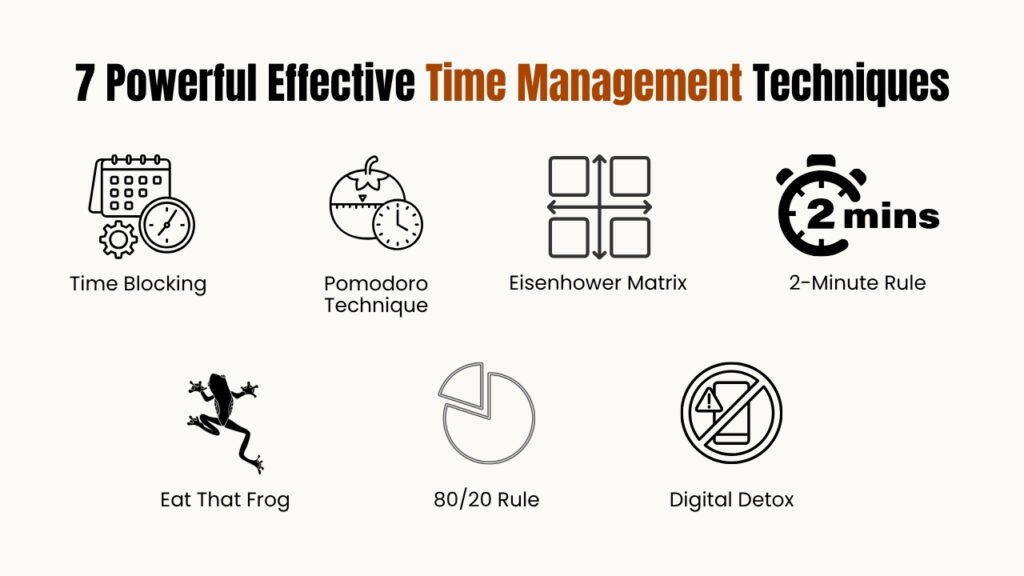
While the seven time management techniques outlined above are proven and effective, it’s important to remember that not every method works for everyone. Each individual has unique work habits, energy patterns, and responsibilities, so finding the approach that suits you best requires experimentation and self-awareness.
Experiment and Track Your Productivity
Start by testing different techniques over a 1–2 week period. Pay attention to how each method affects your focus, efficiency, and stress levels. Tracking your progress helps you identify which strategies make the biggest difference in your daily workflow.
Combine Complementary Techniques
Sometimes the most effective approach is a combination of methods. For example:
- Time Blocking + Pomodoro: Schedule deep work blocks for important tasks and use Pomodoro intervals to maintain focus within those blocks.
- Eisenhower Matrix + 2-Minute Rule: Prioritize tasks strategically while quickly addressing small items to reduce mental clutter.
Focus on Consistency Over Perfection
The key to mastering time management isn’t perfection—it’s consistency. Even if a technique doesn’t work perfectly at first, sticking with it and making small adjustments over time will produce better results than trying to implement every method flawlessly.
By experimenting, combining methods, and staying consistent, you can develop a personalized time management system that maximizes productivity, reduces stress, and aligns with your goals. The right technique is the one that fits seamlessly into your life, helping you work smarter, not harder.
Final Thoughts: Turning Time into Your Greatest Asset
Time is one of the most valuable resources you have—and how you manage it can make or break your success. The key takeaway from this guide is that productivity isn’t about doing more; it’s about doing what matters most. By focusing on high-impact tasks, minimizing distractions, and using effective time management techniques, you can accomplish more in less time while maintaining balance and clarity.
The most important step is to take action. Pick one technique from this list and start implementing it today. Whether it’s Time Blocking, the Pomodoro Technique, or the Eisenhower Matrix, consistent application will help you build momentum and transform the way you work.
Remember: Master your time, and you’ll master your life. Every intentional minute you invest today brings you closer to your goals, greater focus, and lasting success.
Frequently Asked Questions
1. What are effective time management techniques?
Effective time management techniques are strategies and methods that help you organize, prioritize, and use your time efficiently to increase productivity, reduce stress, and achieve meaningful results. Examples include Time Blocking, the Pomodoro Technique, and the Eisenhower Matrix.
2. How do I choose the right time management technique for me?
Not every technique works for everyone. Start by experimenting with different methods for 1–2 weeks, track your productivity, and identify which strategies improve focus and results. Combining complementary techniques, like Time Blocking with Pomodoro, can also be highly effective.
3. Can time management techniques reduce stress and burnout?
Yes. By prioritizing high-impact tasks, minimizing distractions, and organizing your day intentionally, time management techniques help reduce overwhelm, prevent procrastination, and promote a healthier work-life balance.
4. How long does it take to see results from using these techniques?
Results vary depending on consistency and the techniques you use. Many people notice improved focus, better organization, and reduced stress within the first week, while long-term productivity and habit formation typically develop over several weeks of regular practice.
5. Are these techniques suitable for both personal and professional life?
Absolutely. Effective time management techniques can be applied to work, study, and personal life. They help you prioritize goals, manage daily tasks, and create more time for meaningful activities across all areas of life.