
If you’ve ever started a daily routine with full motivation and then watched it slowly disappear after a few days or weeks, you’re not alone. This happens to most people. It’s easy to follow a routine for a short time but making it part of everyday life feels much harder.
When routines don’t last, many people assume they’re lazy or lack discipline. That belief is common, but it’s also unfair. The real problem usually isn’t effort or willpower. It’s the way routines are created in the first place.
Most routines are built too big, asking you to change everything at once. Others are too strict, depending on perfect timing and ideal conditions. Many are designed for “perfect days” when you feel energized, focused, and stress-free. Real life rarely works that way, and when one day goes off track, the whole routine falls apart.
When this happens, guilt kicks in. You feel like you’ve failed, and starting again feels even harder. But a broken routine doesn’t mean something is wrong with you. It usually means the routine wasn’t designed for real life.
This blog will show you a simple, step-by-step way to create a daily routine that fits into your normal days, including the busy and low-energy ones. The goal isn’t perfection. It’s building a routine that feels natural, flexible, and possible to follow every day.
Table of Contents
What a Daily Routine Actually Means
When most people think about a daily routine, they picture a strict plan with fixed timings for everything. Morning to night, every hour is decided. That idea sounds organized, but it often creates pressure and makes routines hard to follow.
In real life, a daily routine is much simpler. It is not about planning every minute. It is about creating a structure you can repeat, even when your day doesn’t go perfectly.
A daily routine is not a timetable that controls your day. It is a flexible pattern that guides your actions. You can shift things around, start late, or slow down, and the routine can still work.
A routine is built to be repeated, not followed perfectly. What matters is coming back to a few important habits again and again. Over time, this repetition creates stability and progress.
- A routine does not mean doing everything perfectly every day
- A routine means focusing on a few important actions consistently
- Even small routines count and can make a real difference
Earlier, I believed a routine meant having a full-day plan and sticking to it no matter what. If I missed one part, I felt like the entire day was wasted. With time, I learned that this thinking only made routines harder to maintain.
Once I shifted to a simpler and more flexible idea of a routine, it became easier to stay consistent. A daily routine should support your life, not fight against it. When it feels natural and realistic, it becomes something you can actually follow every day.
Before You Start: One Honest Question You Must Answer
Before creating a daily routine, there is one simple but powerful question you need to ask yourself. Skipping this step is the reason many routines look good but never last.
What kind of days do I usually have?
This question matters because many people build routines based on how they wish their days looked, not how their days actually are. They copy routines from others or design plans meant for an ideal life. When real life doesn’t match that plan, the routine breaks.
Look at your energy, not just your goals
Some days you feel focused and active. Other days you feel tired, slow, or mentally drained. Both are normal. A routine that only works on high-energy days will fail on low-energy ones.
Ask yourself:
- When do I usually feel more energetic?
- When do I feel tired or distracted?
- How much energy do I truly have on an average day?
Be honest about your time
It’s easy to overestimate how much free time you have. Between work, studies, family, and daily tasks, time disappears quickly. A routine needs to fit into the time you actually have, not the time you wish you had.
Think about:
- How much free time do I realistically have each day?
- Which parts of my day are already fixed?
- Where do I usually rush or feel time pressure?
Consider your responsibilities and distractions
Everyday life comes with responsibilities and distractions. Messages, social media, unexpected tasks, and people needing your attention are part of normal days. Ignoring them doesn’t make them go away.
Reflect on:
- What responsibilities must I handle daily?
- What usually pulls my attention away?
- What distractions show up again and again?
Why this step matters so much
A routine that ignores reality never lasts. When your routine matches your real energy, real time, and real responsibilities, it becomes easier to follow. Instead of feeling forced, it feels supportive.
This honest reflection helps you create a routine that works with your life, not against it. And that’s the foundation of a daily routine you can actually maintain.
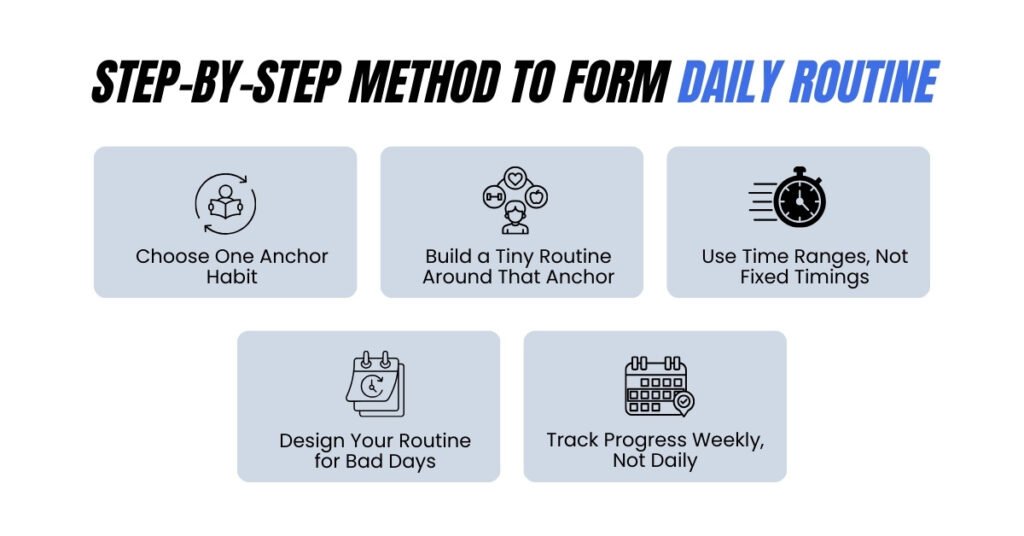
Step 1: Choose One Anchor Habit
To create a daily routine, you must start with one anchor habit. This is the simplest and most reliable way to build a routine that actually lasts.
An anchor habit is one small action that already happens every day in your life. You don’t need to remember it or feel motivated to do it. It’s already part of your day. When you attach your routine to this action, everything feels easier and more natural.
Think about moments in your day that happen automatically. These moments are stable and predictable, which makes them perfect starting points for a routine.
- Waking up in the morning
- Brushing your teeth
- Having your first tea or coffee
- Coming back home from work or school
You only need to choose one. Starting with more than one often makes the routine confusing and harder to follow.
This approach works because it uses behavior you already have. You are not forcing yourself to begin something new from scratch. You are simply adding a small action after an existing habit.
- There is no need to wait for motivation
- Your brain feels less resistance
- The routine blends into your normal day
By building your routine around one anchor habit, you create a strong foundation. From this stable starting point, consistency becomes easier, and your daily routine starts to grow in a simple, realistic way.
Step 2: Build a Tiny Routine Around That Anchor
After choosing your anchor habit, the next step is to build a small routine around it. This step is where many people go wrong, so keeping it simple really matters.
A common mistake is trying to plan the entire day at once. Morning routine, work routine, fitness routine, night routine, all packed together. It looks productive, but it quickly becomes overwhelming. When a routine feels heavy, it’s hard to return to it every day, and that often leads to quitting.
Instead of planning your whole day, start with a short routine block. Think in terms of 10 to 30 minutes. This small block is easier to repeat and fits into real life without pressure.
What a tiny routine looks like
A tiny routine is not about doing more. It’s about doing less, but doing it regularly. It sits right after your anchor habit and becomes a natural continuation of it.
Some simple formats you can start with are:
- A short morning starter routine to ease into the day
- A calm evening wind-down routine to slow things down
Both work well because they connect naturally with existing parts of your day.
Keep it small and realistic
The most effective routines are built from just a few actions. Adding too many steps makes it harder to stay consistent.
- Choose only 2 to 3 simple actions
- Keep each action easy to complete
- Focus on showing up every day, not doing it perfectly
Consistency matters more than intensity. A small routine done daily will take you much further than a big routine you quit after a week. Starting small gives your routine the chance to grow naturally over time.
Step 3: Use Time Ranges, Not Fixed Timings
One of the easiest ways to break a daily routine is to attach it to a fixed time. On paper, exact timings look organized. In real life, they create pressure.
When a routine depends on doing something at one specific time, a small delay can make the whole plan feel ruined. You wake up late, a meeting runs long, or your energy is low. Once the time is missed, many people give up for the day.
A better approach is to use time ranges instead of fixed timings. Time ranges give your routine breathing space. They allow flexibility while still keeping structure.
For example, instead of telling yourself you must work out at 6:00 AM, you give yourself a window. You work out between 6:00 and 7:00 AM. The habit still happens, even if the exact minute changes.
This simple shift protects consistency.
- You feel less pressure to be perfect
- One small delay doesn’t ruin your routine
- The routine still works on busy or low-energy days
Time ranges make routines easier to follow in real life. They help you show up without stress, which is exactly what you need if you want your routine to last long term.
Step 4: Design Your Routine for Bad Days
Most people believe routines fail because they lose motivation. The truth is different. You don’t quit routines on good days. You quit them on bad days.
Good days are easy. You have energy, time, and focus. You follow the routine without much effort. The real test comes on days when you feel tired, stressed, busy, or unmotivated. If your routine only works on good days, it won’t last.
This is why designing your routine for bad days is so important.
Instead of having only one version of your routine, create a minimum version. This is the smallest form of your routine that still counts as showing up.
For example, if your full routine takes around 20 minutes, your bad-day version might take just 2 to 5 minutes. It could be as simple as doing one small action instead of the whole routine.
- The goal is not performance, it is continuity
- Showing up matters more than doing everything
- Small effort keeps the habit alive
On bad days, lower the bar instead of quitting. This helps you avoid long breaks, which are what actually break routines.
A simple rule to remember is never skip twice. Missing one day happens. Missing two days often turns into stopping altogether. By keeping a minimum routine for tough days, you protect consistency and keep your routine moving forward, even when life feels heavy.
Step 5: Track Progress Weekly, Not Daily
Tracking your routine can be helpful, but doing it the wrong way can quickly turn into pressure. Many people try to track their routine every single day. At first, it feels motivating. Over time, it often creates stress.
Daily tracking makes you notice every small miss. When a box stays unchecked, guilt shows up. Instead of feeling encouraged, you start focusing on perfection. One imperfect day can make the whole routine feel like a failure.
A healthier approach is to track your progress weekly. Weekly reflection gives you enough distance to see patterns without judging yourself for every small slip.
At the end of the week, take a few quiet minutes and ask yourself simple questions:
- What worked well this week?
- What felt difficult or uncomfortable?
- What can I simplify next week?
This kind of reflection keeps the focus on learning, not blaming. You are not asking if you were perfect. You are asking what helped and what didn’t.
Many people stay consistent longer when they reflect weekly instead of obsessing daily. Weekly check-ins support growth, flexibility, and honesty. They help you improve your routine without turning it into another source of stress.
A Simple Example of a Daily Routine That Feels Realistic
Sometimes understanding a routine is easy, but imagining how it fits into real life is harder. This example is here to help you visualize how everything comes together in a simple and practical way.
This is not a perfect-life routine. It’s a realistic one that works even when days are busy or energy is low.
The anchor habit
Let’s say your anchor habit is waking up in the morning. This happens every day, whether the day is good or bad, which makes it a strong starting point.
The routine block
Right after waking up, you add a short routine block. Nothing complicated. Just a few actions that help you start the day calmly.
- Drink a glass of water
- Stretch or move your body for a few minutes
- Sit quietly or breathe deeply for a moment
That’s it. No long lists. No pressure.
The time range
Instead of fixing an exact time, you give yourself a flexible window. For example, you do this routine anytime between 7:00 and 7:30 in the morning. If you wake up a little late, the routine still fits.
The bad-day version
On days when you feel tired, rushed, or unmotivated, you switch to the minimum version.
- Drink a glass of water
- Take three deep breaths
It takes less than two minutes, but it keeps the routine alive.
This kind of routine works because it’s built around real life. It doesn’t expect high motivation or perfect mornings. It allows flexibility, forgives bad days, and focuses on consistency over intensity. That’s what makes a daily routine sustainable.
How Long Does It Take to Turn This Into a Real Daily Routine?
This is one of the most common questions people ask when building a daily routine. The honest answer is simple. There is no exact number.
Some habits stick faster. Others take longer. It depends on how simple your routine is and how consistently you return to it, especially on busy or low-energy days.
The first few days are mostly about learning. During the first 7 days, you are getting familiar with the routine. You are noticing what feels easy, what feels awkward, and what needs adjustment. This phase is not about results. It’s about understanding your routine.
After that, the next 2 to 3 weeks are about stabilizing. The routine starts to feel less new. You stop thinking about each step so much. Small adjustments help it fit better into your daily life. Missed days may still happen, but getting back becomes easier.
What matters most during this time is not perfection. Progress comes from showing up again and again, even when it’s imperfect. Small actions done consistently will always beat big plans done only once.
A daily routine becomes real when it feels normal, not exciting. Give it time, keep it simple, and focus on progress over perfection.

Final Thoughts
Building a daily routine is not about creating the perfect plan. It’s about creating something you can return to, even on days when things don’t go as expected.
You don’t need a routine that looks impressive. You need a routine you don’t quit. One that fits your real life, your real energy, and your real responsibilities. Small and simple routines last longer than complex ones.
If you’re unsure where to begin, start today with just one anchor habit. Attach a tiny routine to it and let that be enough for now. You don’t need to get everything right from the start.
As your life changes, your routine can change too. Adjust it. Simplify it. Improve it slowly. Be kind to yourself in the process.
A daily routine is not something you build once and finish. It’s something you grow with over time. When you stay patient and flexible, your routine becomes a quiet support system that helps you move forward, one day at a time.
Frequently Asked Questions
How do I create a daily routine if my schedule changes every day?
Start with one anchor habit that happens no matter how your day looks, such as waking up or coming home. Build a small routine around it and use time ranges instead of fixed timings so the routine stays flexible.
What if I miss a day in my daily routine?
Missing one day is normal and doesn’t mean you’ve failed. The key is to avoid missing two days in a row. If you miss a day, return to the minimum version of your routine the next day and keep going.
How many habits should I include in a daily routine?
Keep it small. Two or three simple actions are enough to start. Adding too many habits at once makes the routine harder to follow and easier to quit.
Can a daily routine still work if I feel unmotivated?
Yes. A good routine does not depend on motivation. That’s why using anchor habits and creating a minimum version for bad days is important. Even small actions help maintain consistency.
When should I change or adjust my daily routine?
Review your routine weekly, not daily. If something feels difficult or doesn’t fit your life anymore, simplify it. Routines work best when they are adjusted slowly as your life changes.