
Have you ever promised yourself that things will be different this time, but somehow you end up doing the same thing again? Maybe you try to follow a new routine, work on your goals, or stop a habit that keeps holding you back. In that moment you feel motivated, but a few days later your old ways quietly show up again. It almost feels like your brain has its own plans.
If you’ve ever thought, “Why do I keep doing this?” you’re not alone. Many people want change but still feel stuck. It’s confusing because you already know what you should do, but knowing does not always lead to doing.
I’ve felt that too. I wanted to follow my goals and improve my life, but I found myself doing the same things again and again while expecting different results. I kept repeating the same pattern without even noticing it. I thought I lacked discipline, but later I realized my mind was simply following an old route it was used to.
Here’s something important to know. Your brain is not against you, and you are not weak. You’re running on patterns that were created long ago. Some of those patterns helped you survive or stay safe back then, but they may not be helping you now. The real problem is not your effort or motivation; it’s the pattern you’re stuck in. If we can understand the pattern, we can break it.
In this blog, we will explore how your brain works, why it keeps repeating familiar responses, and how you can finally take back control. We will use simple real life examples from relationships, productivity, habits and career decisions so it becomes easy to see your own story in them. Then we will go through a clear three step framework to break those patterns Awareness, Pattern, Choice.
Change becomes possible when we understand our mind, not when we fight with it. Let’s begin there.
Table of Contents
What Are Self-Limiting Patterns?
Self limiting patterns are repeated thoughts or actions that hold you back, even when you want to move forward. They are like silent rules your brain follows without asking you first. You may not even notice them, because after some time they start to feel normal. You think you are choosing them, but they are actually choosing for you.
These patterns usually come from past experiences. Maybe something hurt you once, or someone made you feel that you were not good enough. After that, your mind tries to protect you by keeping you in familiar situations. It is not trying to harm you, it is trying to keep you safe. But too much safety can slowly block your growth.
Everyday Examples of Self Limiting Patterns
Here are some common ways these patterns show up in real life. You might recognise one of them in your own story.
In relationships
Always choosing people who are emotionally unavailable or believing you do not deserve a healthy relationship. You may tell yourself that this is just how things are, but it could be a pattern you learned from the past.
In productivity
You make plans but end up procrastinating. Even when you know what to do, you wait, delay, or distract yourself. It may look like laziness, but it might actually be fear of failure or fear of doing things perfectly.
In career
You want better opportunities, but feel scared to apply for higher roles, speak up in meetings, or show your true skills. You may think others are better than you, which can silently keep you stuck.
In habits
Choosing comfort overgrowth, like watching videos instead of learning something new. The brain picks the easy road because it feels safe and familiar.
Why Understanding the Pattern Matters
You cannot change something you do not see. When you understand your pattern and notice the moments when it shows up, you take the first step toward change. It is like switching on a light in a dark room. Once the light is on, you start to see the way out.
Awareness does not fix everything at once, but it opens the door. When you begin to see your pattern clearly, you also begin to see your choices. That is where real change becomes possible.
Why the Brain Keeps You Stuck
You are not stuck because you are lazy or weak. Most of the time, it is simply how the brain works. Its main job is to keep you safe, and sometimes it tries to protect you by repeating old habits, even if those habits are not helping you anymore.

The Brain Wants Safety, Not Growth
Your brain prefers familiar situations because they feel safe. That is why your comfort zone is hard to leave. More than 90 percent of your thoughts today are the same as yesterday, so your mind often runs on repeat without you noticing it. When something feels familiar, the brain chooses it automatically, even when it slows your progress.
How Patterns Become Automatic
Most habits follow a quiet loop in the mind:
Trigger >> Thought >> Feeling >> Action >> Result
This loop repeats until it feels normal. That is how procrastination, fear or doubt become part of daily life without you planning for it.
The Beliefs Behind the Pattern
Every pattern is driven by a belief. Thoughts like I am not ready, or I never succeed can guide your actions without you realizing it. These beliefs are learned, which means they can also be changed. Once we understand the pattern, we can break it.
When you start seeing your patterns clearly, you also start seeing your choices. That is where change begins
The Awareness → Pattern → Choice Framework
If you want real change in your life, you do not need to fix everything at once. You just need to understand how your mind works and learn to respond differently. This simple three step framework can help you start breaking yourself limiting patterns in a clear and practical way.
Step 1: Awareness – Spot the Pattern
Awareness is the moment when you notice what is truly happening inside your mind. It is like switching on a light in a dark room. You begin to see the thoughts and actions that keep repeating. Ask yourself simple questions like:
What do I keep doing again and again
When do I usually avoid things
How do I react when I feel stressed or scared
What do I say to myself before I give up
I noticed this in my own life. I wanted to follow my goals, but I kept delaying them without any clear reason. The moment I realised I was repeating the same habit, I felt a shift. I could finally see the pattern instead of blaming myself for it.
Awareness does not fix everything, but it gives you a clear starting point.
Step 2: Pattern – Understand Why It Repeats
Once you notice the pattern, the next step is to understand why it keeps coming back. Most patterns have a trigger, like stress, fear of failure, or too much pressure. Then the same thought appears, followed by the same action. This happens so fast that it feels automatic.
A simple way to explore this is by journaling. You can try this short exercise:
When this happens: ___________
My mind usually thinks: ___________
Then I feel: ___________
And I react by: ___________
This exercise helps you connect the dots between trigger and response. It shows you that the pattern is not random. It has a structure, and when you understand it, you can begin to change it.
Step 3: Choice – How to Respond Differently
Once you see the pattern clearly, you finally have a choice. Change does not have to be a big decision. Most of the time, it starts with micro shifts, like trying a different response or using a new thought.
Here are some choice breaker ideas you can try today:
Pause for one minute before reacting
Change your usual place or environment
Replace a negative thought with a kinder one
Take one small step instead of waiting for motivation
These small moves slowly teach your brain that a new path is possible. Over time the pattern becomes weaker and your choices become stronger.
This framework is simple but powerful. Awareness opens your eyes, understanding gives clarity and choice gives freedom. That is how real change begins.
Practical Tools to Break Free from Self Limiting Patterns
Understanding your patterns is important, but change happens when you take action. You do not need big steps to move forward. Small, simple actions can make a real difference when they are done with awareness. Here are practical tools you can start using right away.
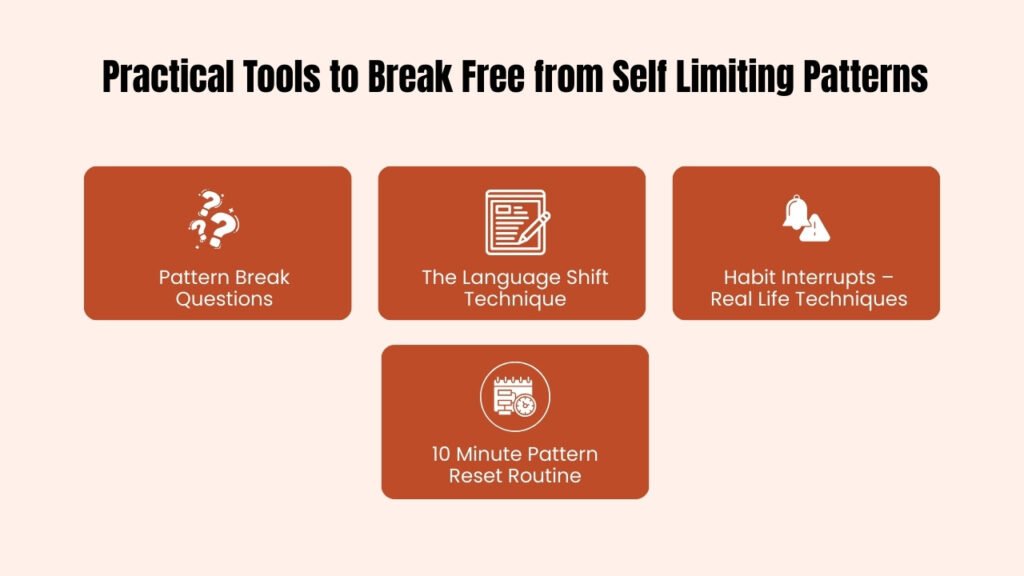
Pattern Break Questions
These questions help you step outside the pattern and see it clearly. Try answering them honestly, even if the answers feel uncomfortable.
What am I repeating again and again
What do I usually say to myself before I give up
What am I afraid might happen if I try something new
Is this coming from fear or from habit
What small step can I take instead of doing nothing
Answering even one of these can open your eyes to what is really going on inside your mind.
The Language Shift Technique
The words you use shape your thoughts, and your thoughts shape your actions. Changing your language can slowly change how your brain responds. Here are simple shifts you can try.
I can’t becomes I am learning
This always happens becomes What can I control today
I am not good at this becomes I am getting better every time
I failed becomes I learned something new
Others are better than me becomes I am on my own path
These shifts look small, but they send a completely different message to your brain.
Habit Interrupts – Real Life Techniques
When a pattern starts, you can interrupt it by changing your environment or your response. These simple tools can help.
Move to a different place when you feel stuck
Stand up, breathe and count slowly to five before reacting
Use friction, for example, hide distractions or remove easy access to them
Use support systems like reminders, checklists or accountability partners
Make the right choice easier than the wrong one
A small change outside often creates a big change inside.
10 Minute Pattern Reset Routine
You can use this quick routine in the morning or evening to reset your mind and stop autopilot mode.
Two minutes of slow breathing
Two minutes to write how you feel
Two minutes to notice any repeating thoughts
Two minutes to choose one small action for the day
Two minutes to say something kind to yourself
That is just 10 minutes, but it can help you start or end your day with clarity instead of stress.
Change is not about being perfect, it is about choosing differently, even once. These tools are simple, but when used with awareness, they can open the door to new patterns and new possibilities.
Conclusion – Your Brain Can Change
If there is one message to take from this blog, it is this, patterns are learned, which means they can be unlearned. You are not stuck because something is wrong with you, you are stuck because your brain is doing what it was trained to do. The good news is that the brain can also be trained to think and act in new ways.
Change does not start with big steps. It begins with awareness and one small decision at a time. You do not need to fix everything today. You only need to notice the pattern, understand where it comes from and make one different choice. That is how new paths are created in the mind.
Maybe your first step is answering one reflection question or trying a kinder sentence when you talk to yourself or taking one minute to pause before reacting. These small actions may not look powerful, but your brain learns from every choice you make.
The moment you become aware of your pattern, you are no longer fully controlled by it. That is a sign of growth. Your mind is not a fixed wall, it is more like soft clay. It can be shaped, it can be guided and it can change with practice.
So do not wait for the perfect time to begin. Take one micro action today that your future self will thank you for. Change is possible, and it starts with the next choice you make.
Frequently Asked Questions
1. What are self limiting patterns
Self limiting patterns are repeated thoughts or actions that hold you back, even when you want to move forward. They often come from past experiences and become automatic over time.
2. Why do I repeat the same habits even when I want to change
Your brain follows familiar routines because they feel safe. Most thoughts and reactions happen on autopilot, which makes it easy to repeat old habits without noticing them.
3. Can I really break self limiting patterns
Yes. Patterns are learned which means they can be unlearned. With awareness, understanding and small choices, you can slowly rewire how your brain responds.
4. What is the first step to change a pattern
The first step is awareness. You need to notice when and how the pattern shows up. Once you see it clearly, you can make new choices instead of reacting automatically.
5. How long does it take to change a pattern
Everyone is different, but small consistent steps work faster than waiting for motivation. Even one new response can start building a healthier pattern in the mind.