
Let’s be honest, most of us want to improve our life. We want to get fitter, save more money, feel more confident, wake up earlier, study better or grow in our career. But there’s one big problem. We know we want change, but we don’t know how to set a clear goal. So, we write a big to-do list, get motivated for a day or two, then slowly lose energy and go back to the same routine.
Many people start with excitement, write down a few goals, feel motivated for a week, then slowly run out of energy. It’s not because they don’t care. It’s because the goal has no structure. A line like I want to get fit, or I want to make more money sounds good, but it doesn’t show you what to do next. When the mind has no roadmap, it quickly loses interest.
The real problem is not lack of motivation. The real problem is the lack of a clear and practical plan. Most people never learned how to set goals properly. School teaches us formulas, but not how to create goals for real life. So, we try to figure it out ourselves and end up feeling stuck or disappointed.
This blog is not here to give general advice that you already know. It will not just explain what SMART goals mean. It will show you how to use them today in your real life. Step by step, in a simple way that anyone can understand and apply right away.
Imagine someone who says I want to get fit this year. They buy a gym membership, feel excited for the first week, then slowly stop going. Why does this happen? Because the goal is too general. There is no clear plan and no timeline. Now imagine if the goal was I will walk for 30 minutes every morning for the next 10 days. Suddenly it feels possible, clear and achievable. That is the power of setting SMART goals.
In the next section, we will break it down in the most practical way. By the end of this blog, you will know exactly how to create a goal that actually works. And you can start today, not someday.
Table of Contents
What Are SMART Goals
A SMART goal is not just a dream written on paper. It is a clear and practical plan that tells your mind exactly what to do. It gives direction, steps and a timeline so you don’t feel lost after setting the goal. When your mind has clarity, it becomes easier to start and easier to stay consistent.
SMART stands for five key parts. Let’s understand each one in a simple way so you can actually use it in your life.
S – Specific
A goal should be clear and focused, not general. Instead of saying I want to study more, say I will study science for 45 minutes after dinner every day. When a goal is specific, your brain understands it quickly and knows where to start. Vague goals only create stress.
M – Measurable
If you can’t measure your progress, it is hard to stay motivated. Numbers act like small wins for the brain. For example, I will read 10 pages a day or I will save 50 Dollars every week. When you measure your progress, you can adjust and improve it over time.
A – Achievable
A good goal challenges you, but still feels possible. If it feels too big, your mind may quit before starting. Ask yourself, can I really do this with my current time and energy? If yes, you are on the right track. Small steady progress always beats big empty plans.
R – Relevant
A goal should match your life at the moment. If it does not connect with your real needs, you will lose interest. For example, learning guitar may be nice, but if your main struggle is time management, you should focus on a goal that solves your current problem. Relevance keeps motivation alive.
T – Time-bound
Without a timeline, a goal becomes a wish. When you add a time limit, you give your mind a reason to act now. For example, I will reduce my screen time to 1 hour at night within the next 14 days. Deadlines create urgency, and urgency encourages action.
Why SMART Goals Work
Our brain likes clarity. When something is simple and structured, it feels easier to start. Many times people are not lazy, they are just confused about what to do next. SMART goals remove this confusion and replace it with direction. That is why this method helps so many people stay consistent and feel more confident while working toward their goals.
Now that the foundation is clear, it is time to see how SMART goals look in daily life. In the next section, we will explore real-life examples that you can relate to and even try today.
SMART Goals vs Normal Goals
Many people set goals with good intentions, but they still struggle to follow through. The problem is not the effort, it is the type of goal they set. A normal goal usually sounds like a wish. A SMART goal feels more like a plan. One brings hope, the other brings action.
Normal Goals vs SMART Goals at a Glance
Here is a simple comparison
| Normal Goal | SMART Goal |
|---|---|
| I want to get fit | I will walk for 30 minutes every morning at 7 AM for the next 14 days |
| I want to save money | I will save 50 dollars every week for three months |
| I want to study more | I will study math for 45 minutes after dinner, Monday to Friday |
| I want to wake up early | I will set my alarm for 6 AM and avoid phone use after 10 PM |
Why Normal Goals Often Fail
Normal goals are usually emotional and unclear. They do not give the brain any direction. When a goal is too general, the mind does not know how to start or what step to take next. This leads to confusion, delay and loss of motivation. Even with strong intention, people often give up because the goal has no structure.
What SMART Goals Add
SMART goals make things clearer. When a goal is specific, measurable and time-based, it becomes easier to follow. Instead of feeling lost, you know exactly what to do and when to do it. This gives you accountability, motivation and a sense of progress.
SMART goals also make success feel possible. When you see small wins, your confidence grows and you keep going. That is the real strength behind this method.
Framework: How to Create a SMART Goal Step by Step
Creating a SMART goal is not hard. You do not need any special tool or complicated system. All you need is clarity and a few minutes of honest thinking. Here is a simple way to create a SMART goal that actually works in real life.
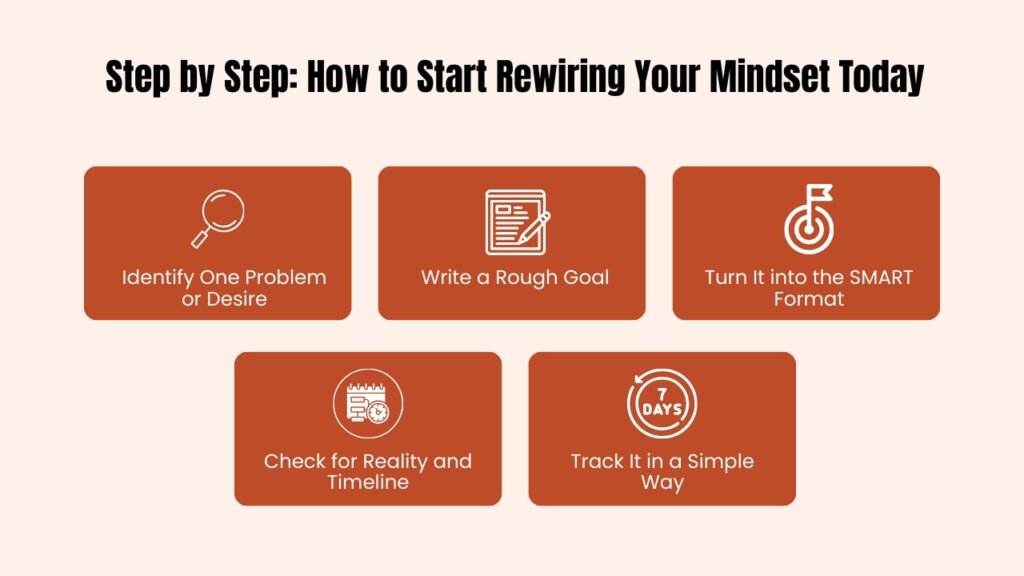
Step 1: Identify One Problem or Desire
Start with something real. What is one thing you want to improve or solve right now? It could be health, money, habits, studies, or confidence. Do not choose five goals at once. Pick one and focus your energy there. One clear goal is easier to follow than ten confusing goals.
Step 2: Write a Rough Goal
Write your goal in a simple sentence. For example, I want to save more money or I want to study better. This is not your final goal. This is just the starting point so your mind knows what direction you want to move toward.
Step 3: Turn It into the SMART Format
Now convert your rough goal using each letter of SMART
- Specific: What exactly will you do
- Measurable: How will you track it
- Achievable: Can you realistically do it
- Relevant: Does it matter to your life right now
- Time-bound: When will you complete it
When you answer these questions, your goal becomes clear and easier to follow.
Step 4: Check for Reality and Timeline
Ask yourself, can I really do this with my current time, energy and routine. If it feels too big, reduce it. A small goal that you finish is more powerful than a big goal that never starts. Make sure the timeline feels possible for you.
Step 5: Track It in a Simple Way
You do not need complex tools to track your goal. A notebook, calendar, journal app or even a note in your phone can work. Tracking keeps your mind aware and encourages consistency. Small wins keep motivation alive.
Sample SMART Goal Template
| Step | Example |
|---|---|
| Rough goal | I want to save more money |
| SMART goal | I will save 25 dollars every week for the next two months |
| Tracking method | Note it every Sunday in phone or journal |
This simple structure can be used for any area of life. Once your first SMART goal is set, the next ones become easier. In the next section, we will see real examples that anyone can relate to and even try today.
Real-Life Examples You Will Actually Relate To
Now that you understand the SMART goal system, let us see how it works in daily life. These are simple examples that anyone can try. Each one follows the SMART format and shows how a normal wish can turn into a real, doable plan.

Health Example: Build Stamina
Specific: I will walk every morning
Measurable: 25 minutes
Achievable: I already have that time free
Relevant: I want to improve my fitness
Time-bound: For the next 3 weeks
SMART Goal: I will walk for 25 minutes every morning at 7 AM for the next 3 weeks to improve my stamina.
Study or Skill Learning Example
Specific: I will learn basic video editing
Measurable: 30 minutes per day
Achievable: I can practice using free tutorials
Relevant: This skill will help my future projects
Time-bound: For the next 10 days
SMART Goal: I will learn video editing for 30 minutes every evening after dinner for the next 10 days using online tutorials.
Finance Example: Save Money
Specific: I will save money from my weekly income
Measurable: 30 dollars every week
Achievable: It fits my budget
Relevant: I want to create an emergency fund
Time-bound: For the next 3 months
SMART Goal: I will save 30 dollars every week for the next 3 months to start my emergency fund.
Confidence and Social Skills Example
Specific: I will talk to one new person
Measurable: At least once a day
Achievable: I meet people in college and at work
Relevant: I want to feel more confident socially
Time-bound: For the next 15 days
SMART Goal: I will start one short conversation each day with someone new for the next 15 days to improve my social confidence.
Career Example: Learn a New Skill
Specific: I will learn PowerPoint presentations
Measurable: One mini project per week
Achievable: I can learn using free tutorials
Relevant: It will help me at work
Time-bound: For the next 4 weeks
SMART Goal: I will create one PowerPoint mini project every week for the next 4 weeks to improve my presentation skills.
Personal Growth Example: Wake Up Early
Specific: I will set my alarm earlier
Measurable: At 6 AM
Achievable: I will avoid phone use after 10 PM
Relevant: I want more morning time
Time-bound: For the next 14 days
SMART Goal: I will wake up at 6 AM daily for the next 14 days and keep my phone away after 10 PM to help me sleep on time.
These examples show how a simple change in words can change the way your mind sees a goal. When your goal is clear and structured, your actions become easier to follow. You do not need to change your whole life at once. Just start with one SMART goal and take it one day at a time. That is how real progress starts.
Conclusion
Goals alone do not change life, clarity and action do. A goal becomes powerful only when it is clear enough to follow and simple enough to start. That is what SMART goals help us do. They turn ideas into direction and give the mind a path to walk on.
You do not need to redesign your whole life or wait for the perfect moment. Just begin with one small SMART goal. It could be walking daily, saving a little money, practicing a skill or waking up earlier. What matters is not the size of the goal but the act of starting. Action creates confidence and confidence builds habits.
If you found this helpful, you can share your own SMART goal in the comments or even write it down right after reading this. A simple start is sometimes all you need to change the way tomorrow looks. Your progress begins the moment you take the first step.
Frequently Asked Questions
1. What is the main purpose of a SMART goal
The main purpose is to give your mind clear direction. A SMART goal helps you know exactly what to do, how to do it and when to complete it. It turns a vague wish into a simple plan that is easier to follow.
2. Can I use SMART goals for any area of my life
Yes, you can use SMART goals for health, money, studies, personal habits, confidence, career growth and even daily routines. If something matters to you, you can turn it into a SMART goal.
3. What if my goal feels too big
If your goal feels too big, break it into smaller steps. A smaller goal that you complete is better than a large goal that never starts. You can always level up once the first step is done.
4. How do I stay consistent with my SMART goal
Keep it simple and track it daily. Use a notebook, calendar or a phone note. Check your progress at the end of the week and make small adjustments if needed. Consistency grows when things stay easy.
5. Do SMART goals really work
Yes, because they reduce confusion and give structure. Many people fail not because they are lazy but because they do not know where to start. SMART goals provide clarity and a path to follow, which increases the chances of staying active and reaching the goal.