
Ever had one of those days where you’re running around nonstop — answering calls, replying to messages, ticking off small tasks — yet when the day ends, you feel like you got nothing real done?
It’s frustrating, right? You’re working hard, putting in effort, but still feel stuck in the same place. You’re not alone — a lot of people feel like that. The truth is being busy doesn’t mean being productive.
We often fill our day with activities just to feel like we’re making progress. But busyness can is a trap — it keeps you moving without actually moving forward like running on a treadmill. You might be doing a hundred things but if none of them really matter you’re just spinning your wheels.
In this post, we’ll talk about what’s really going on when you’re always busy but not getting anywhere. You’ll see the difference between effort and impact — and learn how to improve productivity in a way that helps you make real progress, not just stay occupied.
Table of Contents
The Busy vs. Productive Paradox
You know that feeling when you’ve been on the go all day, but when you finally sit down at night, you can’t really explain what you actually did? You’ve answered messages, joined calls, replied to emails, helped a few people, and maybe even crossed off a few things from your list. But deep down, you know you didn’t move any closer to the life or goals you actually care about.
That’s the trap of being busy. It feels like progress because you’re always doing something. But it’s more like running on a treadmill — you’re moving fast, just not forward.
What Being Busy Really Means
Being busy looks productive from the outside, but it’s often just reacting to everything that comes your way. You wake up, grab your phone, check your notifications, and before you know it, you’ve spent 45 minutes doing nothing that really matters. Then the day begins, and it’s a blur of meetings, tasks, pings, and distractions.
You tell yourself you’ll get to the important stuff “after this one thing,” but that one thing keeps repeating. By the time the day ends, you’re drained, your brain feels fried, and there’s still a pile of unfinished work waiting for tomorrow.
That’s not productivity. That’s noise. It’s doing a hundred small, low-impact things that make you feel busy but never really satisfied.
What True Productivity Looks Like
True productivity doesn’t look like chaos. It’s not about squeezing more into your schedule or working longer hours. It’s about being clear on what actually matters and giving your energy to that.
Think about those rare days when everything just flows — you know what you need to do, you focus deeply, and by evening, you feel calm and accomplished. That’s what real productivity feels like. It’s not rushed or messy. It’s focused, intentional, and deeply satisfying.
A productive person might work less than a “busy” one, but their work hits harder. They choose quality over quantity. They protect their focus like it’s gold. And when they rest, they rest fully — no guilt, no pressure, just space to breathe.
Why This Difference Matters
Here’s the truth: chasing busyness leads to burnout. It drains your energy, kills creativity, and leaves you feeling stuck no matter how hard you try. Productivity, on the other hand, fuels you. It gives you clarity, peace, and progress — the kind that actually changes your life over time.
Once you start choosing progress over activity, you stop measuring success by how much you do and start measuring it by how much you move forward.
Because the goal isn’t to be busy all day. The goal is to live a day that actually matters.
The Mindset Shift: From Activity to Impact
You know that feeling when you’ve been “busy” all day but can’t really say what you actually got done? Yeah, that one. You’ve checked your emails, answered messages, maybe even crossed off a few small tasks but deep down, it doesn’t feel like progress.
That’s because busyness isn’t same as productivity. It just looks like it.
I used to think more I did, more successful I’d be. But honestly? It just left me exhausted. I was chasing every little task, saying yes to everything, and confusing activity with impact. Once I got clear on what really mattered, everything changed.
Clarity is powerful. When you know why you’re doing something, it’s easier to say no to things that don’t move you forward. You stop running in circles and start walking in a straight line.
Think about it. If you spend your whole day replying to messages, fixing small problems, and switching between five projects, it feels productive in moment — but at night, you still feel stuck. On other hand, when you focus on one or two things that actually create results, you end your day feeling lighter, calm, and proud of yourself.
That’s the beauty of working with clarity. It’s not about doing more it’s about doing what matters.
So, before you start your day, pause for a second. Ask yourself, “If I only got one thing done today, what would actually make a difference?” Do that first. The rest can wait.
When you work with intention, not pressure, you’ll notice something shift. You get more done, but you also feel more peaceful doing it. That’s what real productivity looks like.
How to Improve Productivity: Step-by-Step Framework
Let’s be honest, most of us don’t have a productivity problem — we have a clarity problem. We try to do everything, but not everything actually moves us forward. Once you know what’s important and what’s not, you stop wasting time and start seeing real progress.
Here’s a simple framework that helps you do just that.
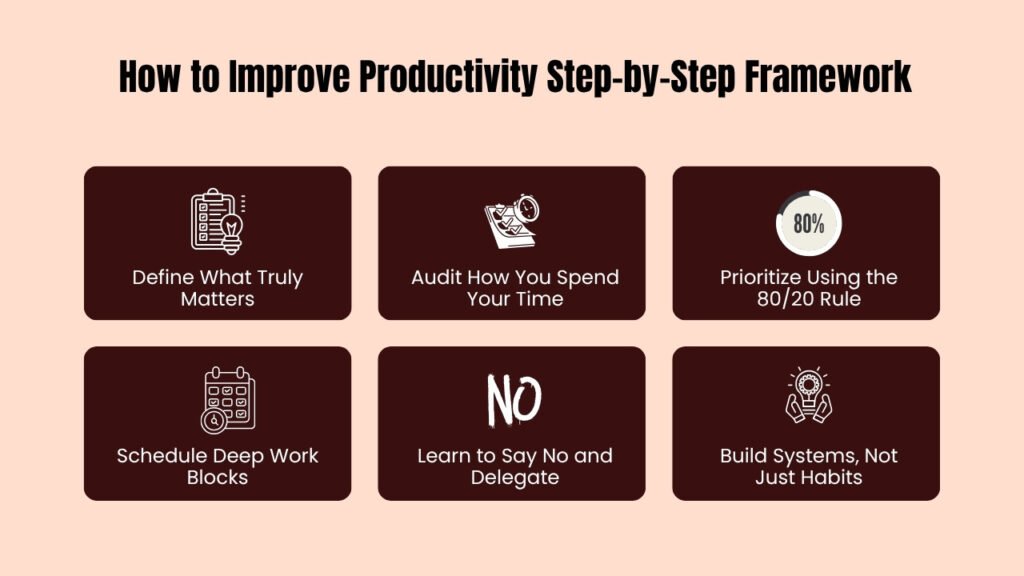
Step 1: Define What Truly Matters
Before you start filling your to-do list, take a moment to think about what really matters to you. What do you want your days to lead to? Maybe it’s growing your career, improving your health, or spending more time with your family. Once you’re clear on that bigger vision, you can turn it into smaller, weekly goals.
Think of it like this — if you don’t know where you’re going, even the fastest progress can take you in the wrong direction. So, write down three things that matter most this month and make them your north star.
Step 2: Audit How You Spend Your Time
You’d be surprised how much of your day goes into things that don’t actually need your attention. Try tracking how you spend your time for a week. Just got down what you’re doing every hour. At the end of the week, look back — where are you spending energy that isn’t bringing results?
You’ll quickly spot patterns. Maybe you spend too long answering emails, scrolling your phone, or fixing things that could be automated. Once you see it clearly, it’s easier to cut out what’s not serving you.
Step 3: Prioritize Using the 80/20 Rule
Not everything on your list matters equally. Usually, 20% of your tasks create 80% of your results. So instead of trying to do it all, figure out which few things actually make a real impact.
For example, if you’re a content creator, writing one great blog post that ranks on Google is worth more than posting five random updates that no one sees. Focus on what gives you the biggest return for your time.
Step 4: Schedule Deep Work Blocks
Multitasking feels productive, but it’s a trap. Real progress happens when you give your full focus to one thing at a time. Set aside 60 to 90 minutes for deep work — no notifications, no multitasking, just you and the task that matters most.
You’ll be surprised how much you can get done when you stop switching between tabs and focus on finishing one thing properly.
Step 5: Learn to Say No and Delegate
You can’t do everything. And you don’t have to. Saying no isn’t rude; it’s smart. Every time you say yes to something unimportant, you’re saying no to what really matters.
If someone asks for your time, try saying, “I’d love to help, but I don’t have the space for that right now.” Or “That’s not something I can take on at the moment.” It’s polite, clear, and protects your energy.
And if there’s something someone else can handle, let them. Delegating isn’t losing control — it’s making space for what truly needs your focus.
Step 6: Build Systems, Not Just Habits
Habits help you stay consistent, but systems make life easier. A system is just a way to make decisions automatic, so you save mental energy. For example, batching similar tasks, using templates, or planning your week every Sunday can save hours later.
The truth is that productivity isn’t about doing everything perfectly. It’s about creating routines that make progress feel natural, not forced.
When you start focusing on what really matters, you’ll notice something powerful you’re doing less but achieving more. And that’s the real secret to improving productivity.
Common Mistakes to Avoid
Let’s be real for a second. Most people aren’t lazy — they’re just busy in the wrong ways. You can fill every hour of your day with activity and still feel like you didn’t actually do anything meaningful.
There’s a big difference between spending an hour scrolling on Instagram and spending that same hour writing, learning, or working toward something that matters to you. Both take time, but only one moves you forward.

Here are a few mistakes that quietly steal your productivity:
1. Equating busyness with importance
Just because your calendar looks full doesn’t mean your day was productive. Sometimes we mistake motion for progress. You can be in constant motion and still stay stuck in the same place. Productivity isn’t about how much you do but about doing what actually matters.
2. Overloading your to-do list
A list with twenty tasks looks impressive but usually ends with you feeling drained and disappointed. Instead of trying to do it all, focus on three things that will make the biggest impact today. It’s not about how many boxes you tick; it’s about the quality of what you get done.
3. Neglecting rest and reflection
When you’re always on the go, it’s easy to forget that your brain needs breaks. Rest isn’t wasted time. It’s where ideas form and focus resets. Take a walk, sit quietly, or just breathe for a few minutes. You’ll come back sharper, calmer, and more creative.
4. Constantly switching systems or tools
New apps and planners feel exciting for a week, but constantly changing your systems can do more harm than good. Master one simple method that works for you and sticks with it. Productivity grows from consistency, not from chasing the next shiny thing.
Once you stop falling into these traps, you’ll start noticing something amazing — your time begins to stretch. You get more done without feeling rushed or overwhelmed. And that’s when productivity starts feeling natural, not forced.
Conclusion: Redefine Your Version of Productive Success
If you are chasing busyness thinking it will make you successful, you’re not alone. Most people do. We fill our day with tasks and check off lists and still go to bed wondering why it doesn’t feel like progress.
True productivity isn’t about doing more. It’s about doing what really matters. It’s about having clarity on where you’re going, focusing on what truly moves you forward, and having enough consistency to keep showing up. And yes, it means giving yourself rest when you need it.
You don’t need to fix everything now. Start small. Do one thing that really matters and give it your full attention. Let yourself feel what it’s like to make real progress instead of constant noise.
When you start choosing quality over quantity, your days begin to feel lighter, calmer, and more meaningful. That’s when you realize productivity isn’t about being busy at all. It’s about being intentional.
And maybe that’s the version of success you’ve been looking for all along.
Frequently Asked Questions
1. Why do I feel busy all the time but still unproductive?
You might be focusing on low-value tasks that keep you active but don’t create real progress. When you spend time reacting to everything instead of planning what truly matters, it feels like you’re working hard but getting nowhere.
2. How can I find what really matters in my day?
Start by asking yourself what outcomes make you feel proud or satisfied at the end of the day. Write down three things that actually move you closer to your goals and focus on those first.
3. Does multitasking help me get more done?
Not really. Multitasking often splits your attention, slows your progress, and increases mistakes. It’s better to give full focus to one task at a time. You’ll finish faster and do it better.
4. How much rest do I actually need to stay productive?
Short breaks every couple of hours can keep your mind fresh. And getting enough sleep at night is non-negotiable. Rest isn’t being lazy; it’s how your brain resets and stays sharp.
5. What’s one small change I can make today to improve my productivity?
Pick one important task and finish it before checking your phone, messages, or social media. Starting your day with a clear win sets the tone for everything else.