
Have you ever felt stuck no matter how hard you tried?
Maybe you’ve been putting in effort at work but can’t seem to move ahead. Or perhaps you’ve been chasing a personal goal—like getting fit or learning a new skill—only to feel like you’re running in circles. It’s frustrating, isn’t it? That invisible wall you keep hitting isn’t just about your circumstances—it’s often about your mindset.
This is where developing growth mindset can change everything.
In simple terms, a fixed mindset is the belief that your abilities, intelligence, and talents are static—you’re either good at something or you’re not. People with this mindset tend to avoid challenges, fear failure, and often give up when things get tough.
A growth mindset, on the other hand, is the understanding that skills and intelligence can be developed through effort, learning, and persistence. It’s the belief that every challenge is an opportunity to grow rather than proof of limitation.
The problem is, many of us unconsciously live in a fixed mindset.
We tell ourselves, “I’m not creative,” or “I’ll never be good with money,” or “That’s just not my thing.” These beliefs quietly build barriers that hold us back from reaching our full potential. Over time, we start accepting those barriers as truth—and that’s when growth stops.
But here’s the good news: mindset is not permanent. You can rewire how you think, learn, and respond to challenges. With the right awareness and tools, you can break free from self-limiting patterns and step into a mindset that fuels success, confidence, and resilience.
In this blog, you’ll discover seven proven steps to shift from a fixed to a fluid mindset—practical, science-backed strategies designed to help you embrace learning, handle setbacks better, and unlock the best version of yourself.
Whether your goal is career growth, personal transformation, or emotional resilience, mastering the art of developing a growth mindset is the foundation that makes lasting change possible.
This post contains affiliate links, which means I may earn a small commission if you purchase through them — at no extra cost to you. Thank you for supporting my work and helping this site grow. You can read my full disclosure here.
Table of Contents
Understanding the Difference Between Fixed and Growth Mindset
Before you can truly begin developing a growth mindset, it’s essential to understand the core difference between a fixed mindset and a growth mindset. This awareness forms the foundation for any mindset transformation and helps you recognize the subtle ways your thoughts shape your actions, results, and self-belief.
What Is a Fixed Mindset?
A fixed mindset is the belief that intelligence, talent, and abilities are static — that you’re either born with certain strengths or you’re not. People with this mindset tend to see their traits as unchangeable, which limits how they approach challenges and growth opportunities.
They often avoid situations where they might fail or look inexperienced, preferring comfort over challenge. Deep down, they equate struggle with weakness and failure with inadequacy. This belief keeps them stuck in their current level of performance, even if they’re capable of more.
Common signs of a fixed mindset include:
- Saying or thinking, “I’m just not good at this.”
- Avoiding challenges or giving up quickly when faced with difficulties.
- Seeking validation rather than improvement.
- Comparing themselves to others and feeling threatened by their success.
A fixed mindset often creates invisible barriers that stop progress before it even begins. It keeps people trapped in cycles of self-doubt, procrastination, and fear of failure.
What Is a Growth Mindset?
A growth mindset, a term popularized by psychologist Carol Dweck, is the belief that your abilities and intelligence can be developed through effort, learning, and persistence. People with a growth mindset see challenges as opportunities, mistakes as lessons, and effort as the pathway to mastery.
Rather than avoiding failure, they embrace it as feedback. They value the process of learning more than the outcome, and they understand that real growth comes from consistency and self-reflection—not perfection.
Key traits of a growth mindset include:
- Seeing effort as essential to success.
- Embracing challenges and stepping out of the comfort zone.
- Persisting through obstacles with patience and curiosity.
- Feeling inspired—not intimidated—by others’ success.
When you adopt a growth mindset, you begin to shift from asking, “Can I do this?” to “How can I learn to do this?” That simple change in language opens doors to creativity, confidence, and progress in every area of life.
Fixed vs. Growth Mindset: A Simple Comparison
| Fixed Mindset | Growth Mindset |
|---|---|
| Avoids challenges | Embraces challenges |
| Gives up easily | Persists despite obstacles |
| Sees effort as pointless | Sees effort as essential |
| Feels threatened by others’ success | Feels inspired by others’ success |
Developing a growth mindset isn’t about pretending failure doesn’t exist—it’s about redefining what failure means. When you start to see effort as progress and obstacles as opportunities, you open yourself to a life that’s not limited by fear, but fueled by curiosity and growth.
The Psychology Behind Developing Growth Mindset
Many people think that mindset is just a motivational buzzword — something that sounds inspiring but lacks real science. In reality, the concept of developing a growth mindset is deeply rooted in psychology and neuroscience. Understanding this science is powerful because it proves that mindset change isn’t just about “positive thinking” — it’s about literally reshaping how your brain works.
The Science Behind Mindset: Carol Dweck’s Research
The foundation of modern growth mindset psychology comes from the groundbreaking work of Dr. Carol Dweck, a Stanford University psychologist. Through decades of research, Dweck discovered that the way people think about their abilities profoundly influences how they perform, learn, and grow.
She identified two core beliefs that shape behavior: the fixed mindset (believing abilities are unchangeable) and the growth mindset (believing abilities can be developed).
Her studies revealed that individuals who adopt a growth mindset — those who believe they can improve through effort and learning — consistently achieve higher levels of success in academics, sports, careers, and personal goals.
This research completely reframed how psychologists, educators, and leaders view human potential. It showed that success isn’t determined by raw talent or IQ, but by one’s belief in the capacity to grow.
The Neuroscience: How Your Thoughts Shape Your Brain
Behind the psychology lies the fascinating science of neuroplasticity — the brain’s ability to reorganize and create new neural connections throughout life.
Every time you learn something new, challenge yourself, or practice a skill, your brain forms new pathways. Repeating those actions strengthens the connections, making new behaviors and thought patterns more automatic over time.
This means that when you actively work on developing a growth mindset, you’re not just changing your attitude — you’re physically rewiring your brain for growth, resilience, and adaptability.
For example:
- When you face a challenge and persist instead of giving up, you train your brain to associate effort with progress.
- When you reflect on failure as feedback, you strengthen your brain’s capacity for problem-solving and emotional regulation.
In short, your thoughts and reactions literally shape your brain’s structure and function.
Why This Matters for You
Understanding the science behind mindset helps eliminate doubt. It shifts the conversation from “Can I really change?” to “How can I start changing my brain through action?”
This perspective empowers you to take charge of your personal growth. It means that no matter your age, background, or past experiences, you have the ability to reshape your thinking patterns and build habits that lead to greater confidence, creativity, and achievement.
The key takeaway? Mindset change is scientifically possible. You have the power — backed by psychology and neuroscience — to reprogram how you think, learn, and respond to challenges.
When you understand how mindset affects success, you stop seeing growth as a personality trait and start treating it as a skill that can be trained, practiced, and mastered.
7 Proven Steps to Shift from Fixed to Fluid Thinking
Transforming your mindset doesn’t happen overnight — it’s a gradual process of awareness, reflection, and intentional action. These seven proven steps will guide you through the journey of shifting from a fixed mindset to a more fluid, growth-oriented way of thinking. Each step is practical, backed by psychology, and designed to help you build long-term resilience and adaptability.
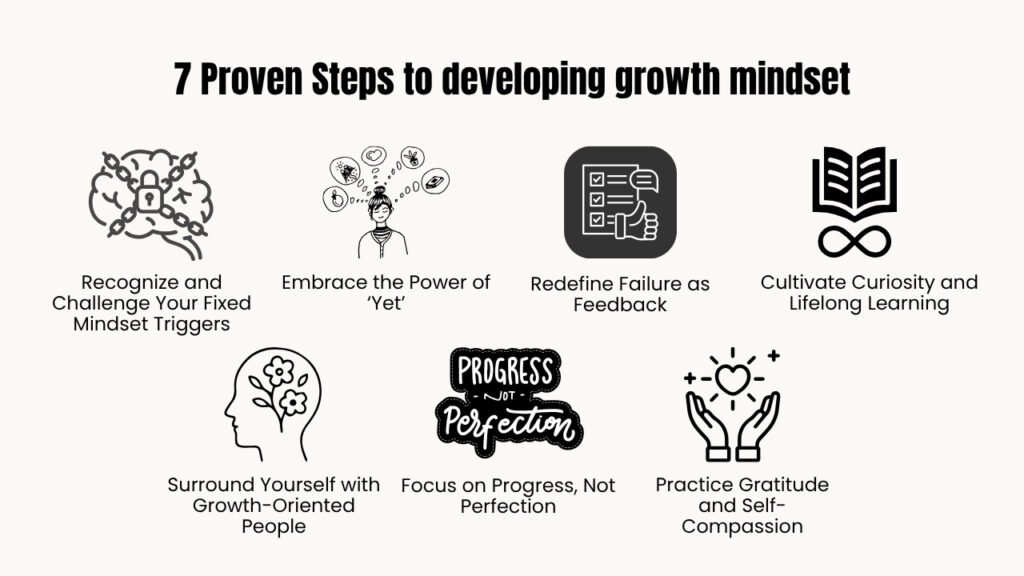
Step 1: Recognize and Challenge Your Fixed Mindset Triggers
The first step in developing a growth mindset is recognizing when your fixed mindset shows up. These triggers often appear as limiting thoughts like:
- “I’m just not good at tech.”
- “I’ll never be fit.”
- “I’m too old to learn this.”
These statements reflect a belief that your abilities are fixed. The key is to catch these thoughts in real time and replace them with learning-focused alternatives, such as:
- “I can learn this with time and practice.”
- “I’m improving every time I try.”
Action Tip: Start a Mindset Journal. Each time you catch a negative or limiting belief, write it down and reframe it into a growth-oriented statement. Over time, you’ll train your brain to default to possibility instead of limitation.
Step 2: Embrace the Power of ‘Yet’
One small word can create a massive shift in perspective — that word is “yet.”
When you find yourself saying, “I can’t do this,” add “yet.” The statement becomes, “I can’t do this yet,” which immediately opens the door to growth and potential.
This simple mental shift rewires your brain to see challenges as temporary and solvable, not permanent and impossible. It builds long-term resilience and a learning-oriented mindset that fuels progress even when results take time.
Key takeaway: The word “yet” transforms frustration into patience, and self-doubt into motivation.
Step 3: Redefine Failure as Feedback
Failure is one of the biggest barriers for people stuck in a fixed mindset. They see it as proof that they’re “not good enough.” But those with a growth mindset view failure differently — as feedback that guides them toward improvement.
Think of innovators like Thomas Edison, who famously said, “I have not failed. I’ve just found 10,000 ways that won’t work.” Or Michael Jordan, who missed over 9,000 shots in his career but credited those failures as the reason for his success.
Every setback contains data — insights about what didn’t work and what to adjust next time.
Action Tip: After each setback, write down three lessons learned and one change you’ll make moving forward. This turns every failure into a foundation for your next success.
Step 4: Cultivate Curiosity and Lifelong Learning
Curiosity is the heartbeat of growth. When you remain open to new ideas, perspectives, and experiences, you continually expand your potential.
A lifelong learning mindset keeps your brain adaptable and engaged. It prevents stagnation and encourages innovation — whether you’re exploring a new skill, reading a book, or having conversations outside your comfort zone.
Practical ways to cultivate curiosity:
- Read or listen to content on topics beyond your usual interests.
- Ask more questions — not to confirm what you know, but to explore what you don’t.
- Take online courses or join communities that challenge your perspective.
When you feed your curiosity daily, growth becomes a natural part of your lifestyle, not just a goal.
Step 5: Surround Yourself with Growth-Oriented People
Your environment plays a crucial role in shaping your mindset. The people you spend time with can either lift you higher or keep you stuck in the same patterns of thinking. If you’re serious about developing a growth mindset, start surrounding yourself with growth-oriented individuals — people who challenge you, inspire you, and encourage your progress.
These are the people who talk about ideas, not gossip. They believe in learning, not complaining. When you’re around such energy, growth becomes contagious.
Consider joining mastermind groups, online learning communities, or finding a mentor who embodies the mindset you want to develop. Interacting with others who embrace continuous learning and self-improvement keeps you motivated and accountable.
Action Tip: Be intentional about your circle. Limit your exposure to consistently negative or fixed thinkers — not out of judgment, but to protect your mental environment. Energy is transferable, and so is mindset.
Step 6: Focus on Progress, Not Perfection
Perfectionism is one of the biggest roadblocks to mindset transformation. People trapped in perfectionism often procrastinate, overthink, or quit altogether when things aren’t flawless. A progress mindset, however, values small, consistent steps over unattainable perfection.
The truth is that growth rarely happens in perfect conditions — it happens through practice, reflection, and persistence. When you focus on getting just 1% better each day, the results compound into extraordinary transformation.
How to build a progress mindset:
- Celebrate small wins. Every small improvement deserves recognition; it reinforces motivation and confidence.
- Avoid comparison traps. Comparing your chapter one to someone else’s chapter twenty only fuels self-doubt.
- Set process-based goals. Instead of “I need to lose 10 kg,” try “I’ll exercise for 20 minutes daily.”
This approach helps in overcoming perfectionism and builds long-term consistency — the real key to personal and professional success.
Step 7: Practice Gratitude and Self-Compassion
True growth doesn’t come from constant pressure — it comes from balance, patience, and kindness toward yourself. Practicing gratitude and self-compassion helps you stay grounded during the process of change.
When you acknowledge what’s going well instead of only focusing on what’s lacking, your brain rewires for optimism, resilience, and confidence. Studies show that gratitude boosts motivation and emotional health, which directly supports a stronger, more growth-oriented mindset.
Similarly, self-compassion allows you to treat mistakes as part of the learning curve instead of proof of failure. When you forgive yourself for setbacks, you maintain momentum and prevent burnout.
Action Tip: End each day with three positive reflections — something you learned, something you did well, and something you’re grateful for. This simple practice conditions your brain to focus on growth rather than shortcomings.
Remember, developing a growth mindset isn’t just about achieving goals — it’s about becoming the kind of person who grows, adapts, and thrives no matter the challenge.
Practical Tools and Resources for Mindset Growth
Developing a growth mindset is an ongoing journey, and having the right tools can make the process faster, more structured, and more effective. Whether you prefer reading, journaling, or guided practices, these resources provide practical support for developing a growth mindset and reinforcing positive thinking patterns.

Recommended Books
Books remain one of the most powerful ways to deepen your understanding of mindset and personal growth. Here are two highly effective titles:
- Mindset by Carol Dweck
This is the foundational book on growth mindset psychology. Dweck explains the difference between fixed and growth mindsets, provides real-life examples, and offers strategies for cultivating a mindset that embraces challenges, learning, and resilience. - Atomic Habits by James Clear
While focused on habit formation, this book complements growth mindset development perfectly. Clear shows how small, consistent changes compound into remarkable results, reinforcing the principle that effort and persistence drive progress.
Reading these books not only provides insight but also actionable strategies to implement immediately in your daily life.
Mindset Development Apps or Tools
In addition to books, digital tools can help you stay consistent, track your progress, and build self-awareness — key elements in mindset transformation.
- Journaling Apps:
Tools like Notion and Evernote allow you to track thoughts, document learning experiences, and monitor your mindset progress over time. A daily journaling practice helps you identify fixed mindset triggers and consciously reframe them. - Meditation and Mindfulness Apps:
Apps like Headspace and Calm guide you through mindfulness exercises that reduce stress, increase focus, and strengthen self-awareness. Mindfulness is closely linked to growth mindset development because it teaches patience, reflection, and emotional regulation.
By combining reading with practical, technology-supported exercises, you can accelerate your mindset growth and make positive thinking a consistent part of your daily routine.
Conclusion: Your Next Step Toward a Fluid Mindset
Developing a growth mindset isn’t about luck, innate talent, or being “naturally” smart. The key takeaway is that mindset is a skill, not a fixed trait. Just like learning to play an instrument or mastering a sport, it requires awareness, practice, and persistence. Every choice you make to embrace challenges, learn from failure, and focus on progress strengthens this skill — rewiring your brain to think in more fluid, adaptive ways.
Remember, meaningful change doesn’t happen overnight. Consistent practice is what transforms thinking patterns into habits. Each step you take — whether it’s challenging a limiting belief, celebrating a small win, or reflecting with gratitude — moves you closer to a mindset that fuels growth, resilience, and success.
Your journey toward a fluid, growth-oriented mindset begins with a single choice: to act, reflect, and keep learning. Over time, those small, intentional actions compound into lasting personal and professional transformation.
Frequently Asked Questions
1. What is a growth mindset, and why is it important?
A growth mindset is the belief that your abilities and intelligence can be developed through effort, learning, and persistence. It’s important because it helps you embrace challenges, learn from failures, and achieve long-term personal and professional growth.
2. How can I shift from a fixed mindset to a growth mindset?
You can shift by recognizing limiting beliefs, reframing negative self-talk, embracing challenges, learning from failure, and practicing daily reflection. Using tools like journaling, mindfulness, and supportive communities accelerates the process.
3. Can a growth mindset improve my career and relationships?
Yes. A growth mindset fosters adaptability, problem-solving, and resilience, which enhances career performance and professional relationships. It also improves empathy, communication, and collaboration in personal and professional life.
4. Are there scientific studies that support growth mindset development?
Absolutely. Research by psychologist Carol Dweck and studies on neuroplasticity show that mindset can be changed through consistent practice. Thoughts, effort, and learning reshape brain pathways to support growth-oriented thinking.
5. What tools or resources can help me develop a growth mindset?
Books like Mindset by Carol Dweck and Atomic Habits by James Clear are highly recommended. Digital tools like journaling apps (Notion, Evernote) and meditation apps (Headspace, Calm) can help reinforce learning, track progress, and build resilience.