
The way we work has changed dramatically. Hybrid work—a blend of remote and in-office responsibilities—has become the new norm. While this model offers flexibility, it also introduces a unique set of challenges: constant digital distractions, blurred lines between work and personal life, and an ever-present risk of burnout. For many professionals, staying productive in this environment feels harder than ever.
Traditional productivity hacks—like simple to-do lists, rigid time blocks, or generic “wake up earlier” advice—no longer cut it. They weren’t designed for the complexity of hybrid workflows, where meetings collide with deep work, home life overlaps with office hours, and technology both enables and interrupts our progress. As a result, professionals often find themselves working more hours but achieving less meaningful output.
This blog takes a different approach. Instead of short-term fixes, we’ll explore personal productivity systems—practical, repeatable frameworks built to survive distraction and prevent burnout in today’s hybrid world. These systems are not about doing more for the sake of it, but about working smarter, protecting your energy, and creating sustainable focus. By the end, you’ll walk away with actionable strategies you can implement immediately to regain clarity, balance, and control over your workday.
Table of Contents
The Hybrid Work Reality: Why Productivity Feels Harder
2.1 Remote + Office = More Complexity
Hybrid work was meant to give professionals the “best of both worlds”—flexibility at home and collaboration in the office. In reality, it often creates more complexity, not less. Employees must juggle an ever-growing stack of digital tools, back-to-back virtual meetings, and in-person responsibilities that rarely align.
What once felt like a clear separation of work and life has blurred into a single, always-connected workflow. Slack pings, email notifications, and video calls can extend late into the evening, fueling an “always-on” culture that makes it difficult to unplug. Instead of boosting efficiency, hybrid schedules often leave professionals feeling stretched in multiple directions, struggling to prioritize deep, meaningful work.
2.2 The Science of Distraction and Burnout
The biggest challenge isn’t just workload—it’s context switching. Each time you shift from writing a report to answering a message, or from a meeting to a quick Slack reply, your brain pays a cognitive price. Studies show it can take up to 20 minutes to fully refocus after a single interruption, meaning constant switching dramatically reduces productivity.
Left unchecked, this mental strain leads to burnout—a state of emotional, mental, and physical exhaustion. Early signs include:
- Struggling to concentrate or finish tasks.
- Feeling detached or unmotivated about work.
- Increased irritability, stress, or fatigue.
- Trouble sleeping or recovering after long workdays.
Recognizing these signs early is essential. By understanding how hybrid work environments create unique stressors, professionals can begin to adopt systems that protect focus, conserve energy, and prevent long-term burnout.
Principles of a Productivity System That Lasts
3.1 Beyond Hacks: Why Systems Outperform Shortcuts
When it comes to productivity, quick fixes are tempting. A new app, a color-coded to-do list, or the latest “morning routine hack” can feel exciting at first. But the truth is, hacks are short-term solutions. They may boost motivation temporarily, yet they rarely address the deeper challenges of distraction, overload, and burnout—especially in the complexity of hybrid work.
A system, on the other hand, is a repeatable process designed to adapt and scale over time. Instead of relying on willpower or novelty, systems create structure. They help you consistently focus on what matters most, regardless of shifting schedules, unexpected meetings, or fluctuating energy levels. Simply put: while hacks provide bursts of productivity, systems sustain it for the long term.

3.2 Core Pillars of a Sustainable System
A productivity system that truly works isn’t about cramming more into your day—it’s about aligning your efforts with your priorities and energy. Four key pillars make this possible:
Clarity: Knowing What Matters
Without clarity, even the most efficient workday can feel empty. Clarity means identifying your high-value tasks, long-term goals, and non-negotiables. By distinguishing between what is important and what is merely urgent, you ensure your time is spent moving the needle, not just reacting to noise.
Boundaries: Limiting Interruptions
Productivity collapses when boundaries are missing. Boundaries can be external—like blocking time on your calendar or setting “Do Not Disturb” modes—or internal, such as training yourself to resist constant email checks. Establishing clear rules around availability and focus protects your attention and energy.
Energy Alignment: Working With Your Natural Rhythms
Not all hours are created equal. Some people do their best thinking early in the morning, while others peak later in the day. Sustainable systems lean into these biological prime times, aligning deep work with peak energy and lighter tasks with natural dips. This prevents wasted effort and maximizes output.
Recovery: Rest as Part of Productivity
High performance is impossible without recovery. Breaks, sleep, exercise, and downtime are not luxuries—they’re core components of productivity. Research consistently shows that well-rested professionals make better decisions, solve problems faster, and resist burnout. By treating rest as part of the system, you create space for long-term growth.
System 1: The Priority Compass Framework
One of the biggest productivity killers in hybrid work is scattered focus. With endless tasks competing for your attention, it’s easy to feel busy but make little meaningful progress. That’s where the Priority Compass Framework comes in—a simple yet powerful system for separating what truly matters from what merely clutters your to-do list.
Must-Do, Nice-to-Do, Eliminate
At the heart of this framework is categorization. Instead of treating every task as equal, you divide them into three buckets:
- Must-Do: High-impact tasks directly tied to your goals, key results, or responsibilities. These are non-negotiables.
- Nice-to-Do: Useful but non-essential tasks that add value only when time and energy allow.
- Eliminate: Low-value or distracting activities that drain time without contributing to results. These are best automated, delegated, or deleted.
This simple shift helps professionals stop wasting hours on “busywork” and redirect energy toward what drives meaningful outcomes.
Weekly and Quarterly Audits
Even with categories, priorities shift over time. That’s why a regular review cycle is critical.
- Weekly audits: Review your task list and reassign items into must-do, nice-to-do, or eliminate categories. This prevents creeping overwhelm.
- Quarterly audits: Step back and evaluate whether your current tasks still align with larger career goals and organizational priorities. Adjusting every 90 days keeps your focus aligned with the bigger picture.
Tools to Support the Framework
You don’t need complex systems to apply the Priority Compass—it works with whatever tool you prefer:
- Digital planners like Notion, Todoist, or ClickUp for structured categorization.
- Project management apps such as Trello, Asana, or Monday.com for team collaboration.
- Analog methods like a notebook or whiteboard for professionals who prefer low-tech, distraction-free organization.
The Solution: Focus Without Overwhelm
By consistently applying the Priority Compass, you create a clear decision-making filter that eliminates guesswork. Instead of reacting to every email, ping, or meeting request, you can confidently say “yes” to what matters and “no” to what doesn’t. The result: less overwhelm, more focus, and steady progress toward your long-term goals.
System 2: The Deep Work & Flow Scheduling Method
In today’s hybrid work environment, constant interruptions make it nearly impossible to focus on meaningful tasks. Messages, meetings, and notifications fragment attention, leaving professionals drained but with little to show for their effort. To combat this, you need more than just discipline—you need a system. That’s where the Deep Work & Flow Scheduling Method comes in.
Blocking Distraction-Free Focus Hours
The first step is to carve out protected focus time in your calendar. These are uninterrupted blocks—usually 60–120 minutes—reserved exclusively for deep work such as strategic planning, writing, or problem-solving.
- Use time-blocking templates (daily or weekly) to structure these sessions.
- Protect these hours as if they were meetings with your most important client.
- Treat them as non-negotiable commitments, not “optional if free.”
By batching similar tasks and dedicating set windows, you minimize the energy wasted on constant task-switching.
Aligning Flow Blocks With Biological Prime Times
Not all hours are equally productive. Each person has biological prime times—the periods when energy, focus, and creativity peak.
- Morning people may reserve early hours for high-focus work.
- Night owls may find evenings ideal for creative or analytical tasks.
- Midday lulls can be used for lighter, routine activities.
By aligning deep work sessions with your natural energy rhythms, you maximize flow—working with your body rather than against it.
Using Tech Boundaries to Protect Focus
Technology is both a productivity tool and a major distraction. To stay in flow, establish firm digital boundaries:
- Do-Not-Disturb mode: Silence calls, texts, and notifications during focus hours.
- App blockers: Tools like Freedom, Cold Turkey, or RescueTime help prevent mindless scrolling.
- Calendar signals: Mark focus blocks clearly so teammates know you’re unavailable during those times.
These boundaries create an environment that supports, rather than sabotages, concentration.
The Solution: Space for Meaningful Work
The Deep Work & Flow Scheduling Method isn’t about squeezing more into your day—it’s about making room for what matters most. By blocking distraction-free time, aligning it with your natural energy, and enforcing tech boundaries, you create the conditions for meaningful, high-quality work. Instead of reacting to constant interruptions, you’ll experience more flow, deeper focus, and the satisfaction of making real progress.
System 3: The 3D Rule – Automate, Delegate, Eliminate
One of the biggest reasons professionals experience burnouts is that their workload keeps expanding, but their energy and time do not. Many end up drowning in repetitive tasks, low-value busywork, and responsibilities that could be handled by others or technology. The 3D Rule—Automate, Delegate, eliminate—offers a simple but powerful way to lighten your load and focus only on what truly requires your attention.
Running a Weekly Task Triage
The 3D Rule works best when applied consistently. At the start or end of each week, run a task triage:
- List every task on your plate.
- Categorize it into one of three buckets: Automate, Delegate, or Eliminate.
- Rebuild your weekly plan around what remains—your high-value “must-do” tasks.
This process not only creates clarity but also ensures you’re not unconsciously carrying tasks that drain your energy without delivering results.
Practical Examples
- Automate: Use scheduling tools to handle recurring meetings, email filters to sort messages, or AI assistants to draft responses. For example, automating invoice reminders saves hours every month.
- Delegate: Pass on routine reports, administrative updates, or repeatable processes to colleagues, freelancers, or virtual assistants. Delegation isn’t about dumping work—it’s about empowering others while freeing your own bandwidth.
- Eliminate: Cut out activities that add little value, like unnecessary meetings, redundant check-ins, or tasks that exist “because we’ve always done it this way.”
Each choice lightens the load, reduces cognitive clutter, and creates more space for meaningful work.
Recommended Tools to Support the 3D Rule
- AI Assistants: ChatGPT, Jasper, or Claude for drafting content, emails, or research.
- Workflow Automation Platforms: Zapier, Make (formerly Integromat), or IFTTT to connect apps and reduce manual work.
- Project & Task Management Tools: Asana, Trello, or ClickUp for delegating and tracking assignments.
The Solution: Lighten the Load, Prevent Burnout
The 3D Rule works because it creates intentional boundaries around your workload. Instead of reacting to everything that comes your way, you filter tasks through a productivity lens that prioritizes impact. By automating routine work, delegating responsibilities, and eliminating time-wasters, you not only reduce stress but also prevent burnout—leaving you with the mental space and energy to focus on what matters most.
System 4: The Rest–Reset Cycle
Most professionals think of productivity as doing more. But in reality, the key to sustained high performance lies in doing less at the right times. Rest is not wasted time—it’s a secret weapon for focus, creativity, and long-term productivity. Without it, even the most effective systems eventually break down, leading to exhaustion and burnout relapse. That’s where the Rest–Reset Cycle comes in.
Why Downtime Fuels Productivity
Research consistently shows that rest improves decision-making, problem-solving, and emotional resilience. When you step away from work, your brain continues to process information in the background, often leading to breakthroughs you’d never reach in front of a screen. Rest is what turns effort into progress.
Micro-Rest: The Power of Short Breaks
Taking regular short breaks during the day prevents mental fatigue and restores concentration. Examples include:
- 5–10 minute pauses every hour to stretch or walk.
- The Pomodoro Technique, which alternates 25 minutes of focus with 5-minute rests.
- “Active breaks” such as deep breathing, meditation, or quick workouts to reset both body and mind.
Macro-Rest: Weekends and Vacations
Just as short breaks recharge you daily, macro-rest restores you on a larger scale. Protecting weekends and taking vacations are essential for preventing long-term burnout. Time away from work not only boosts energy but also provides fresh perspective, helping you return with renewed motivation and clarity.
Rituals to Signal Work Completion in Hybrid Setups
Hybrid work often blurs the line between office and home, making it harder to truly switch off. That’s why shutdown rituals are vital:
- Closing all work tabs and apps at a set time.
- Writing a quick summary of what you accomplished and what’s next.
- Physically separating your workspace (e.g., shutting a laptop, leaving the room).
These signals tell your brain the workday is over, allowing you to transition into rest without lingering stress.
The Solution: Sustainable Energy, Not Just Short Bursts
The Rest–Reset Cycle ensures that productivity doesn’t come at the cost of health or well-being. By balancing micro-rest throughout the day, macro-rest on a weekly or quarterly basis, and intentional shutdown rituals, you create a rhythm that protects your energy, fuels focus, and prevents burnout from creeping back in.
Practical Action Plan: Building Your Anti-Burnout Productivity System
Having the right productivity systems is one thing—making them work for you is another. To ensure these strategies stick, you need a clear implementation roadmap. This action plan breaks the process into three simple steps, helping you build a sustainable, anti-burnout productivity system that actually fits your hybrid lifestyle.
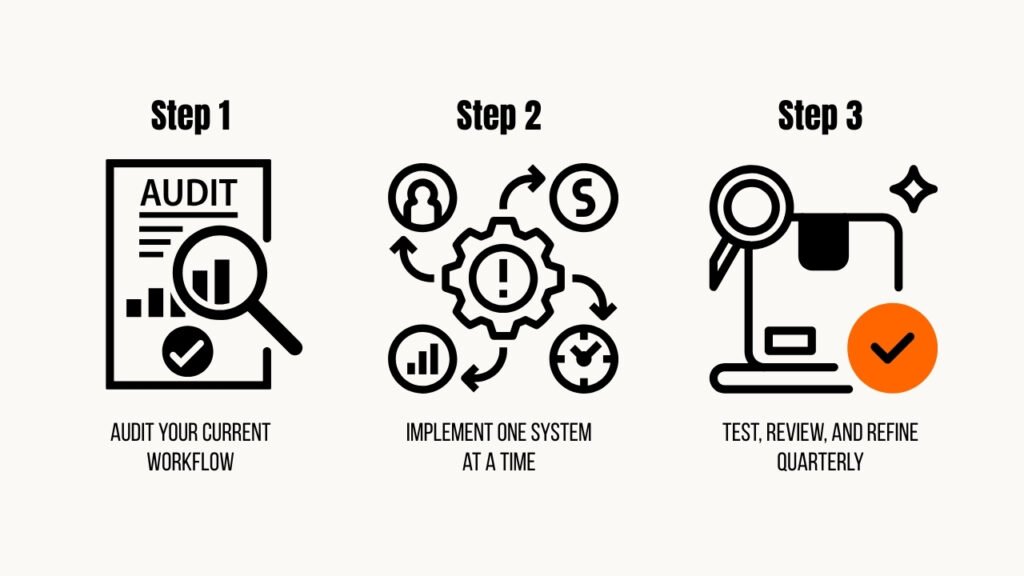
Step 1: Audit Your Current Workflow
Before adding new tools or frameworks, take a step back and analyze how you currently work. Ask yourself:
- Which tasks consume the most time?
- Where do distractions creep in?
- What patterns lead to stress or exhaustion?
Document your daily routines, meeting schedules, and task lists. A thorough audit helps you spot inefficiencies, eliminate low-value work, and identify where a new system could make the biggest impact.
Step 2: Implement One System at a Time
Trying to overhaul everything at once is a recipe for overwhelm. Instead, choose one system—such as the Priority Compass or Deep Work & Flow Scheduling—and integrate it gradually into your routine.
- Start small: experiment with one focus block, one weekly task triage, or one shutdown ritual.
- Allow time for adjustment before layering on additional systems.
- Track how the change affects your focus, stress levels, and output.
This phased approach ensures consistency and increases the likelihood that the system becomes a long-term habit.
Step 3: Test, Review, and Refine Quarterly
Productivity is not static—it evolves with your role, projects, and personal circumstances. That’s why quarterly reviews are essential. Every 90 days:
- Reassess whether your current systems are still aligned with your goals.
- Refine or replace processes that no longer serve you.
- Celebrate wins and identify where small tweaks could lead to bigger gains.
By testing and adjusting regularly, you ensure your productivity framework grows with you, rather than holding you back.
Conclusion
In today’s hybrid work environment, quick fixes and one-size-fits-all hacks aren’t enough. They may deliver a temporary boost, but they rarely solve the deeper challenges of distraction, overload, and burnout. The real key lies in building systems—structured, repeatable frameworks that adapt to your needs and keep you focused on what truly matters.
By shifting from hacks to systems, you move away from chasing short bursts of efficiency and toward sustainable productivity that supports both your performance and well-being. Whether it’s the Priority Compass, the Deep Work & Flow Scheduling Method, the 3D Rule, or the Rest–Reset Cycle, each framework offers tools to protect your focus, manage your energy, and create lasting balance.
Now it’s your turn. Don’t feel pressured to implement everything at once. Start small, experiment, and refine until you’ve built a custom hybrid productivity system that works for your unique goals, rhythms, and lifestyle. The ultimate measure of productivity isn’t how much you do—it’s how effectively you align your time and energy with what matters most.
Frequently Asked Questions
1. Why do traditional productivity hacks fail in hybrid work?
Productivity hacks often provide short-term fixes but don’t address deeper issues like constant distractions, blurred boundaries, and digital overload. Hybrid work requires systems that are sustainable and adaptable.
2. What is the difference between a productivity hack and a productivity system?
A hack is a quick tip or trick that may boost efficiency temporarily. A system is a repeatable framework—like the Priority Compass or 3D Rule—that ensures consistent focus, energy management, and long-term results.
3. How can I stay productive without burning out in hybrid work?
Focus on building systems that balance work and rest: block distraction-free hours, set boundaries with tech, automate low-value tasks, and prioritize recovery. This prevents overwork and keeps energy sustainable.
4. Which tools are best for building personal productivity systems?
Popular tools include Notion, Todoist, Trello, and Asana for task management, Zapier and Make for automation, and AI assistants like ChatGPT for drafting and delegation. Choose tools that fit your workflow, not the other way around.
5. How do I create my own custom hybrid productivity system?
Start by auditing your workflow, then implement one system at a time (e.g., Deep Work scheduling). Review and refine quarterly to ensure your system adapts to your evolving goals and hybrid setup.
Read our Other Blogs!