
Some days, you get through the day, but something still feels off. You show up, do your work, talk to people, and try to stay positive. Nothing dramatic happens. Yet inside, you feel tense, tired, or mentally worn out, and you’re not sure why.
This experience is more common than most people realize. Many of us live with quiet stress, constant worry, or a sense that our mind never truly rests. We keep moving forward, but inside, we feel drained. It doesn’t always look serious from the outside, but it slowly affects our mood, energy, and confidence.
In today’s fast-paced world, our minds rarely get a break. Notifications, deadlines, family needs, and daily responsibilities compete for attention. We push through because life demands it, but our mental health pays the price. Over time, it becomes harder to focus, stay calm, or feel like ourselves.
Most of the time, this isn’t about being “weak” or “not trying hard enough.” It’s about carrying more than our brain is designed to handle. Just like our body needs rest and care, our mind needs support too. When we ignore it, stress builds up and begins to shape how we think and feel.
The good news is that mental health isn’t something fixed or out of our control. It can be strengthened. With simple daily habits, we can calm the mind, reduce stress, and feel steadier from the inside out. Small, consistent steps can create real change.
If you’ve been feeling overwhelmed, scattered, or mentally tired, you’re not alone. This guide will walk you through practical habits that help you build a calmer, stronger mind — one day at a time.
Key Insight
- Mental health improves through small, repeatable actions, not sudden life overhauls. Simple routines like sleep, movement, breathing, and sunlight slowly train the brain to handle stress better. Consistency matters more than intensity.
- How you feel isn’t only about “mindset.” Sleep, lifestyle, environment, emotions, and relationships all play a role. When one area improves, others often follow, which means even one small change can start a positive ripple effect.
- Mental health can grow and strengthen over time. With support, healthy habits, and self-awareness, the mind becomes calmer, clearer, and more resilient. You are not “broken” — you’re building skills that support your well-being.
Table of Contents
What Is Mental Health
Mental health isn’t just about whether you feel happy or sad on a given day. It runs deeper than that. It shapes how you think, how you handle pressure, and how you respond when life doesn’t go as planned. It’s the quiet system working in the background of your life.
Here is a simple way to define it:
Mental health is your overall emotional and mental strength. It’s how you think, how you feel, how you handle stress, and how you deal with everyday challenges and relationships.
Most people don’t notice their mental health until something feels off. Maybe stress hits faster. Maybe small problems feel bigger than usual. Maybe motivation drops, or sleep becomes harder. Nothing dramatic may be happening, but daily life starts to feel heavier.
Mental health touches everything. It influences your choices, your relationships, your focus, and even your physical energy. When your mental health is supported, you think clearer, react calmer, and bounce back more easily from tough moments.
This is also where many people get confused. Mental health and mental illness aren’t the same thing. Mental health is something every person has, just like physical health. It changes based on sleep, stress, habits, and life events. Mental illness refers to specific medical conditions that may need treatment and professional care.
You can have challenges and still build strong mental health skills. You can also improve your mental health with small, steady habits, even during difficult seasons. It isn’t about being perfect — it’s about learning to cope, recover, and keep moving forward.
When we understand mental health this way, it stops feeling like an extra topic only for “serious situations.” It becomes part of everyday life — something worth caring for, just like our body.

What Affects Our Mental Health
Mental health doesn’t change for just one reason. It is shaped by what happens inside our body, how we live, where we spend time, and the people around us. Sometimes, these factors work together, and we may not notice the impact until stress builds up.
Understanding these influences helps us take smart, simple steps to support our mind instead of blaming ourselves for how we feel.
Biological factors
Our brain is part of our body, so physical health always affects mental health. Lack of sleep, hormone changes, illness, and even genetics can make stress feel heavier and emotions harder to manage. This doesn’t mean something is “wrong” with you. It simply means the brain may need more support.
Small steps can help regular sleep, balanced routines, and medical advice when needed. Caring for the body is one of the easiest ways to care for the mind.
Lifestyle choices
What we do every day shapes our mental state more than we realize. Fast food, no movement, endless scrolling, and working without breaks slowly drain energy and motivation. Over time, the brain becomes tired, unfocused, and more reactive to stress.
Helpful lifestyle habits include:
- simple daily movement
- regular meals instead of skipping
- reducing late-night screen time
- allowing real rest, not just distraction
Tiny changes here can improve mood and clarity surprisingly fast.
Environment around us
Where we live, study, or work can lift us up or wear us down. Busy workplaces, financial pressure, loud neighborhoods, or unstable homes create constant tension. Even when we try to stay calm, the environment keeps pushing stress back in.
We can’t always change everything, but we can adjust small parts. Creating quiet spaces, organizing clutter, and setting boundaries at work can give the mind room to breathe.
Emotional load
Life brings emotional weight. Loss, burnout, ongoing worry, or unspoken pain can stay inside for months or years. When emotions pile up without being processed, the mind works overtime just to hold everything together.
Finding safe ways to release emotions matters. Talking to someone, journaling, reflection, or counseling can lighten the load instead of carrying it alone.
Social connections
Humans need connection to feel safe and grounded. Supportive relationships help us cope better and recover faster from stress. But loneliness, toxic relationships, or constant comparison on social media can deeply hurt self-esteem and mental peace.
Healthy connection doesn’t require many people. Often it looks like:
- one honest friend
- someone who listens without judgment
- time spent with people who respect your boundaries
The right relationships strengthen mental resilience.
The key takeaway
Mental health isn’t shaped by one single cause. It is influenced by body, lifestyle, environment, emotions, and relationships. We can’t control everything — but small actions in even one area can start a positive ripple effect.
When we improve little things consistently, the mind becomes calmer, clearer, and more capable of handling life.
Six Simple Habits That Help Build Good Mental Health
You don’t need a perfect routine to take care of your mind. Real change starts with simple actions you can repeat. Try what fits your life, grow slowly, and give yourself time.
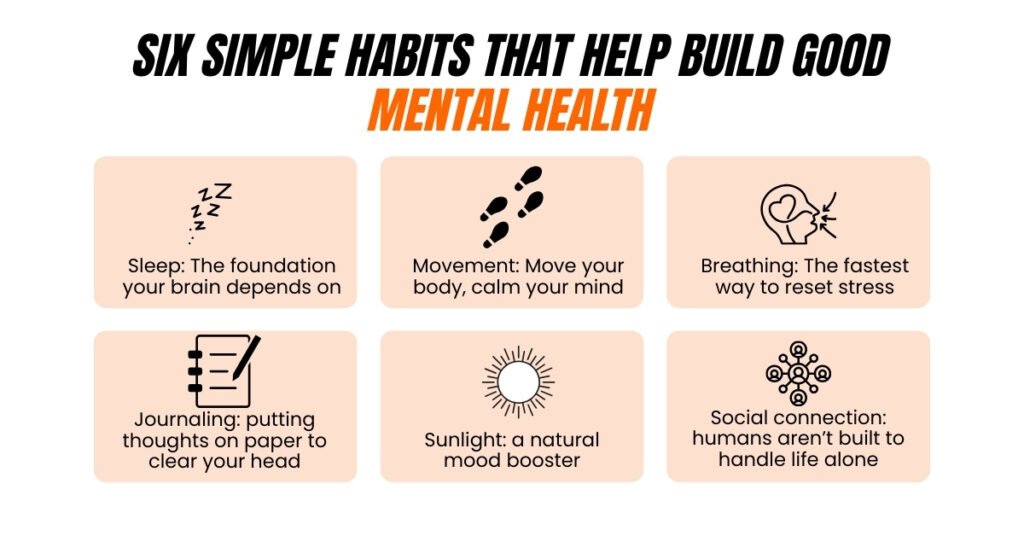
Sleep: The foundation your brain depends on
Sleep is one of the most powerful tools for mental health. When you sleep well, your brain processes emotions, repairs stress damage, and resets focus. When sleep is poor, reactions are stronger, patience is shorter, and problems feel heavier.
Most people underestimate how much sleep shapes mood and thinking. Improving sleep can often improve mental health before anything else.
Helpful ways to support sleep:
- Regular bedtime: going to bed at the same time helps your brain know when to relax.
- Screen limits: phones and TVs keep your brain active, making it harder to fall asleep.
- Calm routine: reading, gentle breathing, or quiet music tells your body it’s time to rest.
- Sleep-friendly space: dark, cool, and quiet rooms make deeper sleep easier.
Small improvements in sleep can create big improvements in mood and clarity during the day.
Movement: Move your body, calm your mind
Movement doesn’t just build muscles. It releases natural chemicals in the brain that reduce stress, lift mood, and boost focus. Even light activity can make your thoughts feel clearer and your emotions easier to manage.
You don’t need workouts that feel extreme. The goal is consistency, not intensity.
Ways to move with purpose:
- Walking: improves blood flow, clears the mind, and gently lowers stress levels.
- Stretching: relaxes tight muscles and helps release built-up tension.
- Dancing: mixes movement with fun, which boosts motivation and energy.
- Short exercise breaks: even 5–10 minutes can reset mood when the day feels heavy.
Studies show that even 10 minutes of walking can improve mood and focus. Those small moments add up, especially when done daily.
If movement feels tough, start slow. A short walk around the block counts. Over time, your body and mind begin to crave the healthy routine.
Breathing: The fastest way to reset stress
Breathing is one of the quickest ways to calm the mind because it speaks directly to the nervous system. When stress rises, the body goes into “fight or flight,” and breathing becomes fast and shallow. Slow, deep breathing sends a signal that you are safe, and the body starts to relax.
This is why a few calm breaths can reduce tension, slow the heart rate, and help you think more clearly.
Simple breathing techniques to try:
- Slow deep breathing: inhale slowly through your nose, exhale gently through your mouth.
- 4–7–8 breathing: breathe in for 4 seconds, hold for 7, breathe out for 8.
- Box breathing: inhale for 4, hold for 4, exhale for 4, hold for 4, then repeat.
Just 2–3 minutes of calm breathing can reset stress levels and bring the mind back to the present moment.
Journaling: putting thoughts on paper to clear your head
Journaling helps because thoughts feel heavier when they stay inside your head. Writing them down gives them structure, makes them easier to understand, and reduces the need to overthink everything at once. It’s like emptying a crowded room so you can finally see clearly.
You don’t need to be a “writer” to benefit. Journaling is simply being honest on paper.
Helpful prompts you can use:
- What is worrying me right now?
- What can I control today, and what can I let go of?
- What is one small thing that went right today?
- What do I need more of in my life right now?
A few minutes of journaling can turn confusion into clarity and stress into something more manageable.
Sunlight: a natural mood booster
Sunlight plays a bigger role in mental health than most people realize. It helps the brain release chemicals that support mood, and it also helps regulate our sleep cycle. When we don’t get enough natural light, energy drops, sleep gets worse, and motivation can fade.
Even a few minutes outside can make a difference, especially earlier in the day.
Simple ways to get healthy sunlight:
- spend a few minutes outside in the morning
- sit near a window while working or reading
- take short walks during daylight hours
Morning sunlight is especially helpful because it signals the brain to wake up gently and sleep better at night.
Social connection: humans aren’t built to handle life alone
Strong mental health is closely tied to healthy relationships. Talking, sharing, and feeling understood help the brain feel safe. When we stay isolated, stress grows, and problems feel heavier than they really are.
Connection doesn’t have to be dramatic or emotional. Simple, honest interactions can create powerful support.
Easy ways to build connection:
- send a quick check-in text to someone you trust
- make a short phone call instead of scrolling endlessly
- have one real conversation where you share how you feel
Having at least one supportive person — even just one — can make challenges easier to face and recovery faster.
How to Start with Just 5 Minutes a Day
Many people try to change everything at once and then feel discouraged when it doesn’t last. Real progress usually starts small. Five minutes may not sound like much, but it builds consistency, confidence, and momentum. Over time, those five minutes quietly reshape your mind and routine.
The goal isn’t perfection. The goal is showing up.
Pick one habit only
Choose just one mental health habit to start with. Focusing on too many at once makes it easy to quit. When you work on one small habit, your brain learns, “I can do this,” and it becomes easier to add more later.
Ask yourself: Which habit feels easiest right now? Sleep, movement, breathing, journaling, sunlight, or connection?
Attach it to something you already do
One of the best tricks is to connect your new habit to an old one. This is called habit stacking. When a habit is linked to something already in your routine, you’re more likely to remember and repeat it.
For example:
- take a 5-minute walk right after lunch
- write in your journal after brushing your teeth at night
- practice calm breathing before checking your messages in the morning
The old habit becomes your reminder.
Keep it so easy you can’t skip it
If your habit feels too hard, you won’t stick with it. Make your starting version simple. Five minutes is enough. Some days you may want to do more — but extra time is a bonus, not a rule.
A small win every day is better than a big effort once in a while.
A simple mini-routine to try
Here’s an easy five-minute routine many people find helpful:
- 1 minute of slow breathing
- 2 minutes of journaling about how you feel
- 2 minutes of stretching or walking
That’s it. Five minutes. Simple, realistic, and repeatable.
With time, these tiny steps start to feel natural. And when they feel natural, they turn into habits that quietly support your mental health every single day.
Final Thought: Your Mental Health Is a Daily Investment
Your mental health is something you live with every day, not just when life feels hard. The choices you make now help shape how calm, clear, and resilient you feel in the future. Small actions may not look impressive on the outside, but inside, your brain is learning new, healthier patterns.
Every habit you practice sends a message to yourself: “My mind matters.” That message builds confidence. It builds stability. And over time, it builds strength you can rely on when life gets challenging.
There will be days when motivation fades. That’s normal. What matters is that you keep coming back to the basics — sleep, movement, breathing, journaling, sunlight, and connection. These simple habits quietly protect your mental health in ways you may not see right away, but you will feel later.
You don’t need to rush. You don’t need to be perfect. Growth happens one small decision at a time. Trust the process and give yourself permission to take care of your mind, just as you care for your body.
The best time to begin is today — even if it’s only a few minutes. Consistency, not intensity, is what creates lasting change.
Take a moment and reflect:
Which habit are you starting with — and when will you practice it today?
Frequently Asked Questions
Can small habits really improve mental health?
Yes. Small habits slowly retrain the brain to handle stress in healthier ways. Over time, they help you feel calmer, think clearer, and bounce back faster from tough moments. Big changes can fade quickly, but small daily habits create results that actually last.
How long does it take to feel a difference?
Many people begin noticing small changes within a few weeks, especially with better sleep, movement, and breathing exercises. Progress doesn’t look the same for everyone, and that’s completely normal. What matters most is staying consistent, not trying to rush results.
Is it normal to still have bad days?
Absolutely. Even people with strong mental health still have difficult days. Good mental health doesn’t remove stress or problems — it helps you cope better and recover sooner. A rough day doesn’t erase your progress or mean you’re failing.
Do I need professional help if I’m working on my habits?
Healthy habits support mental health, but sometimes extra help is important. If stress, sadness, anxiety, or overwhelm feel constant or start affecting work, sleep, school, or relationships, speaking to a trained professional can make a big difference. Reaching out is a sign of strength, not weakness.
What is the easiest habit to start with?
Start with the habit that feels simple and realistic, not the one that looks impressive. Many people find success starting with better sleep routines, short walks, or a few minutes of calm breathing. When a habit feels easy, you’re more likely to stick with it — and that’s where real change happens.