
Have you ever felt ready to get things done, but your mind kept jumping around? You sit down to work or study, then someone calls you, your phone lights up, a notification pops, or you remember something random. Before you know it, one hour is gone and your task is still untouched.
This is happening to almost everyone today and it is not because we are lazy. It is because the world around us is full of distractions. Focus is becoming rare because our homes and minds are always busy. There is noise from people, television, traffic, and sometimes even our own thoughts. Our rooms are filled with clutter. Our phones are packed with apps that want our attention every minute. We keep getting messages, emails, and alerts that make it hard to think clearly.
These distractions are not just annoying, they are costly. Every time we get distracted, we lose time, then we feel stressed because we did not complete what we planned. After that comes self-doubt, the feeling that maybe we are not capable enough. And once this cycle starts, it becomes very hard to break.
Think about it for a moment.
How many times did you start something today, but did not finish it?
If this happens to you often, you are not alone. Many people are struggling with the same thing, especially at home. But here is the good news. You do not need a perfect quiet room to focus. You can create a distraction free environment with small practical steps, even if your home is noisy or crowded.
That is what this blog will help you do. Together we will learn how to take control of your surroundings, reduce noise, clear your space, manage your phone, and protect your focus like it is your superpower. Let us build an environment that helps you grow, not hold you back.
Table of Contents
Why Your Environment Controls Your Focus More Than Willpower
Many people think that focus is all about willpower, but that is not completely true. Your surroundings play a bigger role than you might expect. Even a strong mind will struggle in a messy, noisy, or distracting place. The environment around you quietly guides your actions every day, even when you do not notice it. If your space supports focus, your mind follows. If it invites distraction, your mind will wander.
2.1 The Brain Is Not Built for Constant Distractions
Our brain works best when it has one clear task to do. Imagine trying to solve a puzzle while someone keeps tapping your shoulder. That is what constant distractions do to your mind.
Attention span is the amount of time your brain can stay on one task. When your phone lights up or someone talks loudly in the room, your attention breaks. Every time this happens, your brain needs extra energy to refocus. This is called cognitive load. The more your brain has to switch between tasks, the more tired it becomes.
Multitasking sounds impressive but it actually lowers performance. The brain does not do two things at once, it jumps from one to another. Each jump costs time and energy, which slows you down and makes mistakes more likely.
Your surroundings also shape your behavior. If your desk is clean, your mind feels ready to work. If your phone is near you, your brain stays alert waiting for a notification. These are called cues. They silently guide your actions. A cue-based environment means your space is sending signals that either support focus or invite distraction.
2.2 The Distraction Cycle and How It Silently Destroys Growth
When distractions take over, a cycle begins. It usually follows this pattern:
Distraction → Lost time → Stress → Guilt → Procrastination → Repeat
Once this cycle starts, it becomes hard to break. The biggest problem is that most people blame themselves instead of the environment around them. They think they are lazy or unmotivated, when the real issue is that they are surrounded by cues that invite distraction.
The goal is not to force yourself to focus harder. The goal is to design better surroundings that make focus easy and natural. When the environment supports growth, your mind follows with much less effort. Create the right space and you will not have to fight for focus every day. Instead, it will come to you more naturally and peacefully.
Step by Step: How to Create a Distraction Free Environment at Home
Creating a distraction free space does not mean having a perfect home or a silent room. It means making small changes that support your focus instead of fighting against it. Even if your house is noisy or crowded, you can still build a space that helps you think clearly and work with ease. Let us go step by step.
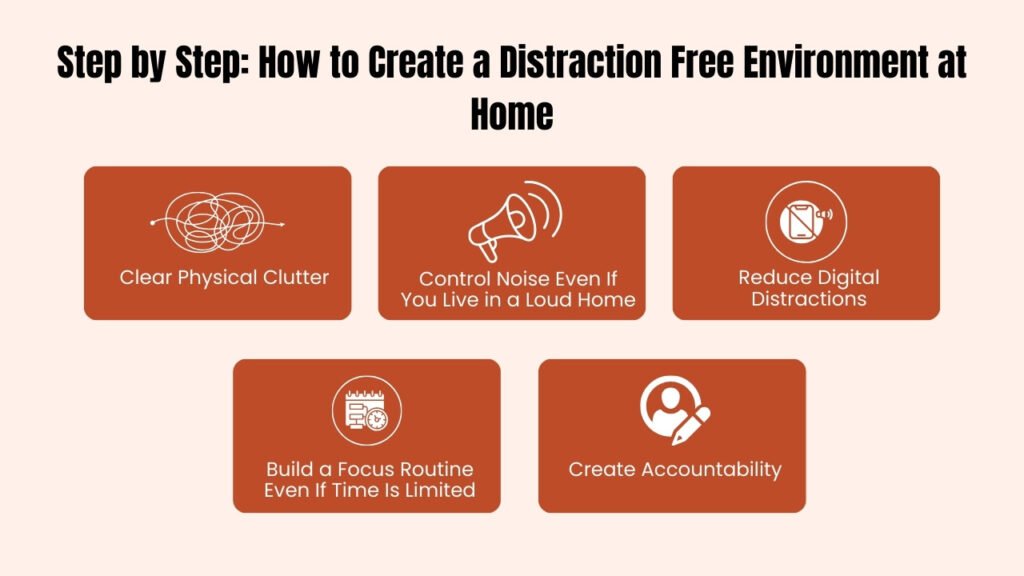
3.1 Step 1: Clear Physical Clutter
Your Brain Sees It as a To Do List
Clutter is not just mess; it sends signals to your brain that something needs attention. That is why a messy desk feels heavy. Your brain treats every object like a reminder. A clean space gives space for clear thinking.
Before-after mindset
Before you start working, take a moment to look around and ask one simple question, is this space helping me focus or making me think about other things
Quick 10 minute declutter method
Do not try to clean everything. Set a 10 minute timer and remove only what you do not need for your current task. You will feel lighter instantly.
Separate work zone and relax zone
If you work and relax in the same place, your brain gets confused. Try to use different corners or even separate chairs for work and rest. When your environment changes, your mind knows how to behave.
3.2 Step 2: Control Noise Even If You Live in a Loud Home
Noise can shake your focus quickly, but you can reduce its effect even without silence. The goal is not zero noise, it is controlled noise.
Noise blocking strategies
Earphones, white noise apps, soft background music, or even turning your chair away from the noise source can help. Try different options and see what calms your mind.
How to use noise layering to your advantage
Sometimes total silence feels strange. A simple repeating sound like rain noise, fan sound, or calm instrumental music can block sudden noises around you. This is called noise layering. I once lived in a very loud home where people talked all day. Instead of fighting the noise, I played soft rain sounds on loop. Over time, my brain connected that sound with focus. It became a consistency cue and helped me concentrate even in the middle of chaos.
3.3 Step 3: Reduce Digital Distractions
Phone, Laptop, Notifications
Digital distractions are often stronger than physical ones because they give instant rewards. We cannot remove screens from life, but we can design them for focus.
Home screen setup for focus
Keep only essential apps on the home screen. Move social apps to the last page or hide them inside folders. A calm home screen means a calm mind.
App blockers and focus modes that work
Use app blockers, focus mode, do not disturb settings, or schedule phone free hours. Most phones have these tools built in, but we rarely use them. Try them for one week and see the difference.
The One Swipe Rule
If an app is one swipe away, it is dangerous. If it takes 5 steps to reach, your brain will think twice. Make distractions harder to reach and focus easier to access.
3.4 Step 4: Build a Focus Routine Even If Time Is Limited
You do not need long hours to focus; you need structured time. Routine tells your brain when to switch into work mode.
Energy based time blocks
Your energy is not the same all day. Some people think clearer in the morning, some in the evening. Track your energy for a few days and work during your strongest hours.
Three task rules
Instead of long to do lists, choose only three important tasks for the day. Finish them first. These stops overwhelm and give clear direction.
Micro routine framework
If your home is busy, build a tiny routine. For example, sit at your desk, drink water, play focus music, and start a timer. Repeat this daily. This small pattern signals the brain that it is time to concentrate.
3.5 Step 5: Create Accountability
The Most Ignored Strategy
Accountability means your actions are tracked, reviewed, or shared. This pushes you to stay disciplined.
Environment and identity shape behavior
When you see yourself as someone who protects focus, you automatically make better choices. Identity grows when habits repeat.
How tracking focus improves results
If you track how long you focused today, you will naturally try to improve it tomorrow. Progress becomes a game. Small wins create motivation.
Tools you can use
A notebook, timer app, habit tracker, or even a simple sheet of paper is enough. Write down the time you worked and the distractions you faced. When you measure it, you manage it.
Even in a noisy home, a distraction free environment is possible. It is not about control, it is about design. One small change at a time is all you need to start. Your environment is your silent partner. When it supports your goals, your mind rises to meet them.
Your Distraction Free Environment Framework
We covered many steps, but sometimes too much information can feel heavy. To make things easy, here is a simple system you can remember and use every day. This framework keeps things clear and helps you build a distraction free environment one step at a time.
Think of it like a short formula:
SPACE + DIGITAL + NOISE + ROUTINE + ACCOUNTABILITY
Each part plays a role in protecting your focus. Let us break it down in a simple and practical way.
SPACE
Your surroundings guide your mind. A clean and separate space tells your brain it is time to work. Even one small corner at home can become your focus zone if you use it every day.
Key actions to try:
• 10 minute declutter before work
• separate work and relax zones
• clear your desk after finishing a task
DIGITAL
Your phone and laptop can be your biggest helpers or your biggest distractions. Designing them for focus is more powerful than trying to fight urges all day.
Key actions to try:
• hide distracting apps from your home screen
• use focus mode or app blockers during work
• remember the one swipe rule, make distractions hard to reach
NOISE
You may not control all sounds around you, but you can decide how your mind reacts to them. The goal is not silence, it is consistency.
Key actions to try:
• use earphones, white noise, or soft background sounds
• sit away from noisy areas
• let one familiar sound repeat daily so your brain links it with focus
ROUTINE
Routine trains your brain to enter focus mode naturally. Even a short pattern repeated daily can create a strong mental habit.
Key actions to try:
• work in your strongest energy hours
• use the three-task rule
• build a small pre work routine like water, music, and timer
ACCOUNTABILITY
When actions are tracked, improvement becomes natural. This step is often ignored but it can change how seriously you take your goals.
Key actions to try:
• track your focus time every day
• write down distractions you faced
• share progress with someone or keep a simple habit tracker
This framework works best when used daily, not perfectly. You do not need a silent home or a fancy desk. You just need a setup that supports your goals and a mindset that protects your focus. When you repeat this system, even small changes can make a big difference. Your environment can be your biggest challenge today or your biggest advantage tomorrow. The decision starts with how you choose to shape it.
3 Day Challenge for you
If you want to feel a real change, here is a simple challenge you can try. It only takes three days, and you do not need a perfect home or a lot of time. You just need a little commitment and a desire to focus better. Try it once and see how different your mind feels.

Day 1: Clean Your Workspace
Spend just 10 to 15 minutes and clear the area where you study or work. Remove things you do not need for the task. A clean space does not just look good, it makes your mind lighter and more ready to focus. Even a small corner of your room can become your focus zone if you use it every day.
Day 2: Set Up Phone Focus Mode
Today, make your phone a tool for work, not a source of distraction. Turn on focus mode or do not disturb. Move distracting apps to another screen or hide them inside folders. When your phone becomes quiet, your mind becomes calm too.
Day 3: Track Your Distractions
Take a paper or a simple note on your phone and write down every time you get distracted. You do not need to judge yourself, just observe. After a few hours, you will start to see patterns, and when you see the pattern, you can fix it. Awareness is the first step toward change.
If you do this for three days, you will feel the difference. Your mind will start to settle, your focus will improve, and your day will feel more controlled. You do not need years to build better habits. Sometimes, you just need three days to start the journey.
Conclusion – Your Environment Is Your Hidden Superpower
The truth is, most people do not struggle because they are weak or lazy. They struggle because their surroundings are working against them. When your environment improves, your mind feels safer, your energy feels stronger, and motivation rises on its own. You do not need to push yourself every day when your space is already supporting you.
Focus is not a personality trait, it is a setup. No one is born with perfect concentration. It is something you build by shaping the place around you and protecting your attention like it matters, because it does. A small change in your room, your phone, or your routine can create a big change in your life.
You do not need to wait for the perfect time. You do not need the perfect home. You do not need the perfect mood. You only need to start small.
Clean one spot, silence one distraction, track one pattern. That is enough to begin. The moment your environment starts supporting your growth, your mind will follow. The first step may seem small, but it is the step that changes everything. Start today, and let your surroundings become your silent partner in success.
Frequently Asked Questions
1. Can I create a distraction free environment even if my home is noisy?
Yes, you can. You may not control all sounds, but you can control how your mind responds. Use earphones, white noise, or a repeating background sound to block sudden noises. Even choosing a specific spot to work every day can train your brain to focus, even in a noisy home.
2. I do not have a separate room for work. What should I do?
You do not need a full room, even a small corner can work. Use the same spot every time you study or work. When your brain sees that space regularly, it starts connecting it with focus. Clear the area for a few minutes before starting, and that becomes your focus zone.
3. How do I stop checking my phone again and again?
Make distractions difficult to reach. Hide apps from your home screen, turn on focus mode, or schedule no phone hours. If an app is one swipe away, it is more tempting. If it takes effort to reach, your mind will think twice. Design your phone for focus instead of fighting your urges all day.
4. How long does it take to feel a difference?
For many people, changes start showing within three days when they declutter, manage phone settings, and track distractions. Focus is not built overnight, but small daily changes lead to steady improvement. Consistency matters more than perfection.
5. What if I keep getting distracted even after trying everything?
Do not blame yourself. Instead, observe what distracts you and write it down. When you see patterns, you can fix them. Sometimes a small change like moving your desk, blocking one app, or using a timer can make a big difference. Progress happens step by step, not all at once.