
Most of us feel mentally overwhelmed today because life is louder than ever. There is constant information coming at us, our phones never stop buzzing, and our minds rarely get a quiet moment to breathe. Even simple things feel heavier when our thoughts keep running in every direction. It’s not that we are weak, it’s that our minds are carrying too much at once.
In this guide, I want to keep things simple, practical and human. No complicated theories or fancy techniques. Just real solutions that actually help in daily life. I’ve been through phases where my mind felt full, even when nothing big was happening. I would lie down at night and suddenly every thought showed up at once. That experience is what pushed me to learn how to calm my mind in small, steady ways.
You can expect clear steps, easy habits and gentle ideas you can try right after reading. Nothing that demands a huge lifestyle change. Nothing that feels too heavy. Just things that make your day feel lighter and your mind feel clearer.
A calm mind is not about being perfect or peaceful all the time. It is about giving yourself space to think clearly, manage stress with confidence and stay focused on what truly matters. When your mind slows down, your decisions get better, your relationships improve and your productivity naturally rises. Most importantly, you start feeling like yourself again.
Let’s make this guide worth your time, and let’s help you find a calmer, clearer version of your mind, one practical step at a time.
Table of Contents
Why Your Mind Feels Overwhelmed
Information overload and constant noise
We live in a time where our minds take in more information in one day than people used to handle in a week. Messages, notifications, social media, news and endless opinions keep coming at us. The brain tries to process all of it, but it gets tired. This constant noise makes it harder to stay calm, think clearly and stay focused on what truly matters.
Overthinking and mental clutter
When your mind is full, even simple thoughts start looping again and again. You might replay old conversations, worry about the future or imagine problems that don’t exist yet. This is what creates mental clutter. The more clutter you carry, the heavier your mind feels. Overthinking does not make life easier; it just drains your mental energy.
Emotional stress building up silently
Stress does not always show up loudly. Sometimes it sits quietly in the background. A small argument, a long to-do list, a tough day at school or work or even not feeling understood can add emotional weight. When this keeps building up, your mind starts reacting faster and gets overwhelmed much more easily.
Lack of rest or recovery time
The mind needs breaks just like the body. When you keep moving from one task to another without pausing, your brain never gets a chance to reset. Lack of sleep, skipping slow moments, or being busy all the time makes your mind feel constantly alert. Over time, this leads to restlessness, irritability and a tired mind that struggles to stay calm.
A simple note to help you move forward
Understanding the real reason behind your overwhelm makes it easier to choose the right method to calm your mind. When you know the root, the solution becomes clearer, and the steps feel more natural.
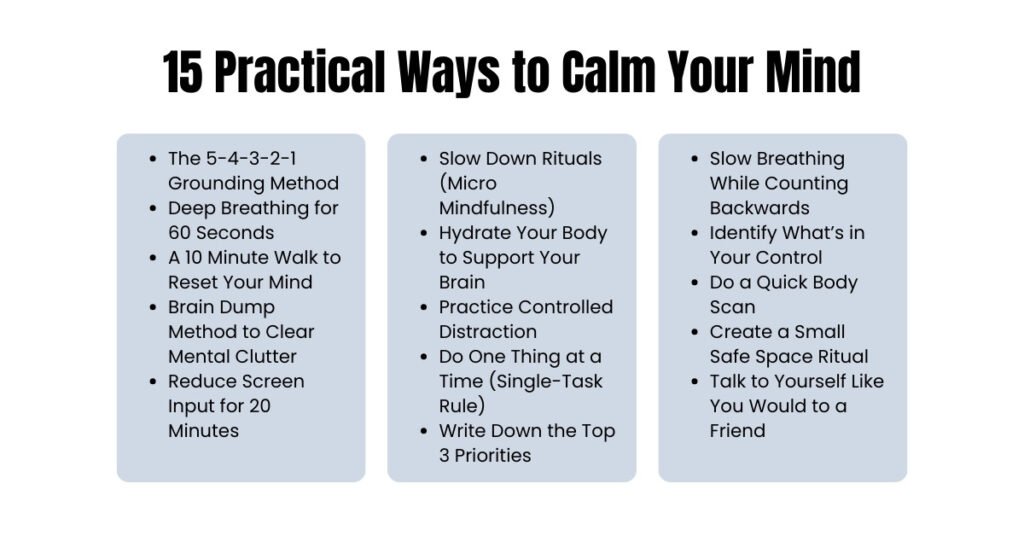
15 Practical Ways to Calm Your Mind
1. The 5-4-3-2-1 Grounding Method
The 5-4-3-2-1 grounding method is a simple way to bring your mind back to the present when it feels overloaded. It works by helping your brain focus on what is real and right in front of you instead of the thoughts that are stressing you out.
You gently shift your attention by noticing five things you can see, four things you can touch, three things you can hear, two things you can smell and one thing you can taste. You do not need to get all five perfect, the idea is to slow down your mind, not perform a task.
This method helps because your senses pull you out of fear mode and give your mind something steady to hold. When your brain feels grounded, your thoughts naturally slow down and become easier to manage.
In short, grounding calms your mind by pulling you into the present, reducing noise and helping you feel more stable in stressful moments.
2. Deep Breathing for 60 Seconds
Deep breathing is one of the quickest ways to relax your mind because your breath directly affects your nervous system. When stress rises, your breathing becomes fast without you noticing, and this makes your mind feel even more tense.
By slowing down your breath on purpose, you send a signal to your brain that you are safe. This reduces the pressure on your thoughts and helps your body relax. A simple pattern like inhaling slowly through your nose, pausing for a second, and exhaling through your mouth can change how you feel within a minute.
You do not need a quiet place or a long routine. You can do it while sitting, standing or even before an important moment. What matters is the slow, steady rhythm.
In short, deep breathing calms the mind by slowing the stress response and creating instant mental clarity.
3. A 10 Minute Walk to Reset Your Mind
Walking helps your mind reset because movement changes how your brain processes stress. When your body moves, your mind follows, and this naturally reduces the weight of racing thoughts.
A short 10-minute walk increases oxygen flow, relaxes tight muscles and shifts your attention away from the environment that may be stressing you. Even stepping outside for a simple loop around your house or workplace can create a surprising sense of relief.
You do not have to think about anything while walking. Let your steps, your breathing and the sounds around you guide your attention away from overthinking. This small break gives your mind space to breathe again.
In short, walking calms your mind by breaking overthinking patterns, refreshing your energy and giving your brain a natural reset.
4. Brain Dump Method to Clear Mental Clutter
The brain dump method is a simple way to clear out the thoughts that keep circling in your mind. When your head feels full, your brain tries to hold too many ideas, tasks and worries at once. Writing everything down gives your mind a break because it no longer needs to remember or organize everything by itself.
To do a quick brain dump, grab a paper or open a blank note and write down everything that is on your mind. Do not judge it, sort it or try to make it look neat. Just let the thoughts flow out. It can be to-dos, worries, reminders, ideas or anything that is taking space in your head. Once it is written, your mind immediately feels lighter.
A brain dump works best when you feel stuck, overwhelmed or unable to focus. It also helps when you have too many things happening at once and you don’t know where to start. By putting everything in front of you, your mind gets clarity, and you gain control again.
In short, a brain dump calms your mind by releasing mental clutter, creating space and helping you think more clearly.
5. Reduce Screen Input for 20 Minutes
Screens add a huge amount of noise to your mind. Social media, notifications and constant updates keep your brain active even when you are tired. This overstimulation makes it harder to relax, think straight or stay calm. The mind needs quiet time, but screens push it into alert mode all day long.
Reducing screen input for just 20 minutes can create an instant shift. When you step away, your brain gets a chance to slow down and settle. A small digital break stops the endless flow of information and gives your attention room to breathe. You can sit quietly, stretch, drink water, take a walk or just look around your environment.
You do not need a long digital detox to feel a difference. Even a short break helps your mind cool down, reduces stress and brings clarity back.
In short, reducing screen time calms your mind by lowering mental noise and giving your brain a chance to reset.
6. Slow Down Rituals (Micro Mindfulness)
Slow down rituals are tiny moments in your day where you pause and give your mind a chance to settle. These small habits help you shift out of rush mode and into a calmer, more balanced state. They take only a few seconds, but they can change how your whole day feels.
Simple examples include drinking water slowly, taking three deep breaths before starting a task, enjoying a quiet moment after waking up or pausing before responding during a conversation. These small actions create stillness in your mind, even when life is busy.
Slowing down works because your mind follows your body’s pace. When you move with more intention and patience, your brain stops rushing and starts relaxing. This helps reduce stress, improve focus and bring a gentle sense of calm to your day.
In short, slow down rituals calm your mind by creating small pockets of stillness, helping your thoughts settle and making your day feel more manageable.
7. Hydrate Your Body to Support Your Brain
Your brain needs water to work properly, and even mild dehydration can make you feel stressed, tired or mentally foggy. When your body lacks enough water, your brain has to work harder to do simple tasks, which makes your mind feel tense and overwhelmed. You might notice headaches, low energy or trouble focusing, and many times the cause is just dehydration.
A simple hydration check is drinking a glass of water whenever your mind feels heavy or your thoughts feel stuck. You can also notice the color of your urine. If it is darker than usual, your body is asking for more water. You do not need fancy drinks. Regular water is enough to reset your energy.
Staying hydrated gives your brain the fuel it needs to think clearly, stay calm and handle daily stress better.
In short, good hydration calms your mind by restoring energy, reducing tiredness and helping your brain work smoothly.
8. Practice Controlled Distraction
Controlled distraction means choosing a small, healthy activity that helps you shift your focus when your thoughts become too loud. It is not about running away from problems. It is about giving your mind a short break so you can return with a clearer head.
Healthy distractions include listening to calming music, cleaning a small part of your room, doing a hobby you enjoy, stretching, or stepping outside for fresh air. Unhealthy distractions, like endless scrolling or emotional eating, often make stress worse and leave your mind even more drained.
Distraction becomes the best option when your thoughts feel stuck or your emotions are too strong to manage in the moment. A short, intentional break gives your brain the reset it needs to think calmly again.
In short, controlled distraction calms your mind by giving it a safe pause, reducing pressure and helping you think more clearly afterward.
9. Do One Thing at a Time (Single-Task Rule)
Multitasking sounds productive, but it actually increases stress. When your mind jumps between tasks, it loses focus and takes longer to finish anything. This creates mental clutter and makes you feel like you are constantly behind. The brain is built to focus on one task at a time, not multiple things at once.
Single-tasking is the opposite. By choosing one task, finishing it and then moving to the next, your mind stays clear and steady. You feel more in control, your work becomes smoother and your stress drops. Even simple tasks feel easier when your attention is not split.
You can start by picking your next task, turning off distractions and giving yourself a few minutes to finish it fully. Even small victories help your mind calm down.
In short, single-tasking calms your mind by reducing mental noise, improving focus and helping you feel more organized.
10. Write Down the Top 3 Priorities
Writing down your top three priorities is a simple way to bring order back into your mind. When you keep everything inside your head, it creates uncertainty because the brain keeps trying to remember and arrange things all at once. This constant mental juggling makes you feel scattered and unsure where to begin.
Choosing just three priorities removes that uncertainty. It gives your mind a clear direction and stops the feeling of being pulled in ten different directions. You know exactly what matters right now, and everything else can wait.
This small action reduces overwhelm because the mind relaxes when it has structure. Instead of trying to manage your entire day at once, you focus on what needs attention in the present moment. Your thoughts become more organized, and your stress naturally decreases.
In short, writing the top three priorities calms your mind by creating clarity, direction and a sense of control.
11. Slow Breathing While Counting Backwards
Slow breathing while counting backwards is a simple pattern that helps your mind settle when your thoughts start racing. By focusing on your breath and numbers at the same time, you give your mind something steady to follow, which reduces the pressure on your thoughts.
The practice is easy. Take a slow breath in, breathe out gently and count backwards from ten to one. You can go slower if you want. This creates a calming rhythm that your mind naturally adjusts to. The counting pulls your attention away from anxious thoughts and guides you back into a calmer state.
Counting works because the brain can only focus on one main thing at a time. When you give it a small, simple task like counting backwards, it interrupts anxiety loops and breaks the cycle of overthinking.
In short, slow breathing with backward counting calms your mind by giving it a steady rhythm and blocking anxious thought patterns.

12. Identify What’s in Your Control
Understanding what you can control and what you cannot is one of the most freeing mental habits. Many times the mind gets overwhelmed because it tries to fix things that are outside your control. This creates unnecessary stress, emotional weight and constant mental tension.
A quick way to filter this is to ask yourself two simple questions:
Is this something I can take action on right now?
Or is this something I have no control over?
If it is in your control, take a small step. If it is not, remind yourself that worrying about it will not change the outcome. This mental filter helps you focus your energy where it actually matters.
Letting go of things outside your control reduces a huge amount of stress. Your mind becomes lighter because it is no longer carrying problems it cannot solve.
In short, identifying what is in your control calms your mind by removing unnecessary mental burden and helping you focus on what you can influence.
13. Do a Quick Body Scan
A body scan is a simple practice where you gently check in with different parts of your body, starting from your head and moving down to your feet. You are not looking for anything specific. You are just paying attention to how each part feels, whether it is tight, relaxed, warm or tired. This awareness helps you reconnect with your body when your mind feels distant or overwhelmed.
A body scan calms your mind because tension in the body often feeds stress without you noticing. When you pause and notice the tightness in your shoulders, your jaw or your back, your body naturally begins to relax. As your muscles loosen, your mind follows and the internal pressure starts to fade.
In short, a body scan calms both your mind and body by releasing hidden tension and helping you feel more grounded.
14. Create a Small Safe Space Ritual
A safe space ritual is a personal routine that signals your mind to relax. It can be as simple as lighting a soft lamp, using a calming scent, sitting in a quiet corner, playing gentle music or doing a small routine that makes you feel safe. The goal is to create a moment where your mind knows it can breathe.
These small rituals work because the brain responds strongly to familiar cues. When you repeat the same calming habit, your mind starts linking it to relaxation. Over time, just starting your ritual sends a message to your brain that it is time to slow down and unwind.
This habit makes it easier to calm down quickly, especially during stressful days.
In short, a safe space ritual calms your mind by giving it a familiar, comforting cue that it is safe to relax.
15. Talk to Yourself Like You Would to a Friend
How you speak to yourself has a huge impact on your stress levels. When your mind is overwhelmed, it is easy to be hard on yourself, but harsh self-talk only adds more pressure. Talking to yourself the way you would talk to a friend creates a kinder, more supportive inner voice.
You can use a simple pattern:
Acknowledge how you feel, remind yourself that it is okay to struggle and tell yourself what you would say to someone you care about. Something like, “I am doing my best, it is okay to slow down, and I can handle this step by step.”
This shifts your mindset from pressure to patience. Your mind relaxes because it feels understood instead of judged.
In short, speaking kindly to yourself calms your mind by reducing self-pressure and giving you the emotional support you often forget to offer yourself.
Final Thoughts
A calm mind grows from small steps, not big changes. You do not need to try all the methods at once. Just choose one or two that feel right for you and start there. Even tiny shifts can create a big difference in how your day feels.
Calming your mind is something you learn with practice. It gets easier the more you do it. Think of it like building a muscle. Every slow breath, every walk and every moment of awareness trains your mind to relax a little faster.
There have been times when my own mind felt crowded and loud, and what really helped me was slowing down and giving myself space. Simple habits, done consistently, made everything feel more manageable.
Take a few small steps each day. Let your mind breathe, give yourself patience and allow calm to grow at its own pace. With time, you will notice your thoughts feeling lighter and your days feeling clearer.
Frequently Asked Questions
What is the fastest way to calm the mind?
The fastest way to calm the mind is slow, deep breathing. It quickly signals your brain that you are safe, which helps your thoughts slow down. Grounding exercises like the 5-4-3-2-1 method also work fast because they pull your focus back to the present moment.
How do I stop overthinking at night?
Overthinking at night often happens because your mind finally gets quiet, and all the thoughts you ignored during the day show up. A brain dump helps a lot. Write down everything on your mind so your brain does not have to hold it. Slow breathing, dim lights and staying off screens before bed also make a big difference.
How long does it take to train my mind to stay calm?
It depends on how often you practice. Many people start noticing small improvements in a few days, and bigger changes in a few weeks. Calming the mind is like building a new habit. The more consistent you are with small steps, the easier it becomes.
Why does my mind feel so loud and restless?
Your mind feels loud when it is carrying too much information, stress or emotional weight. Constant screen time, lack of rest, multitasking and unresolved thoughts all add noise. When the mind does not get enough quiet moments, it becomes restless and overloaded.
Which habits help keep the mind calm long-term?
Simple habits like daily walks, slow breathing, drinking enough water, writing your priorities, reducing screen input and creating small calming rituals help your mind stay steady. These habits keep mental clutter low and give your brain space to relax throughout the day.